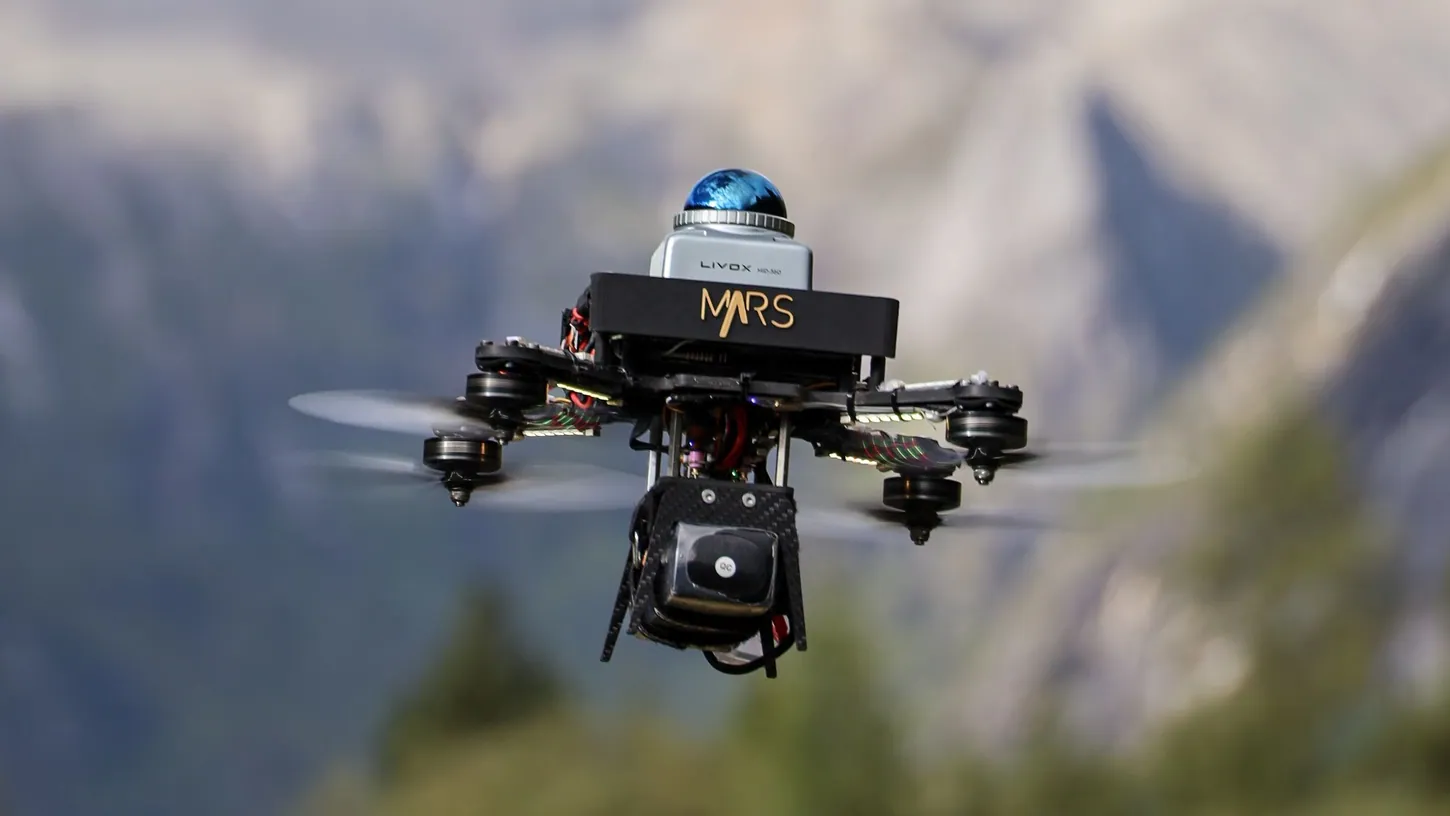
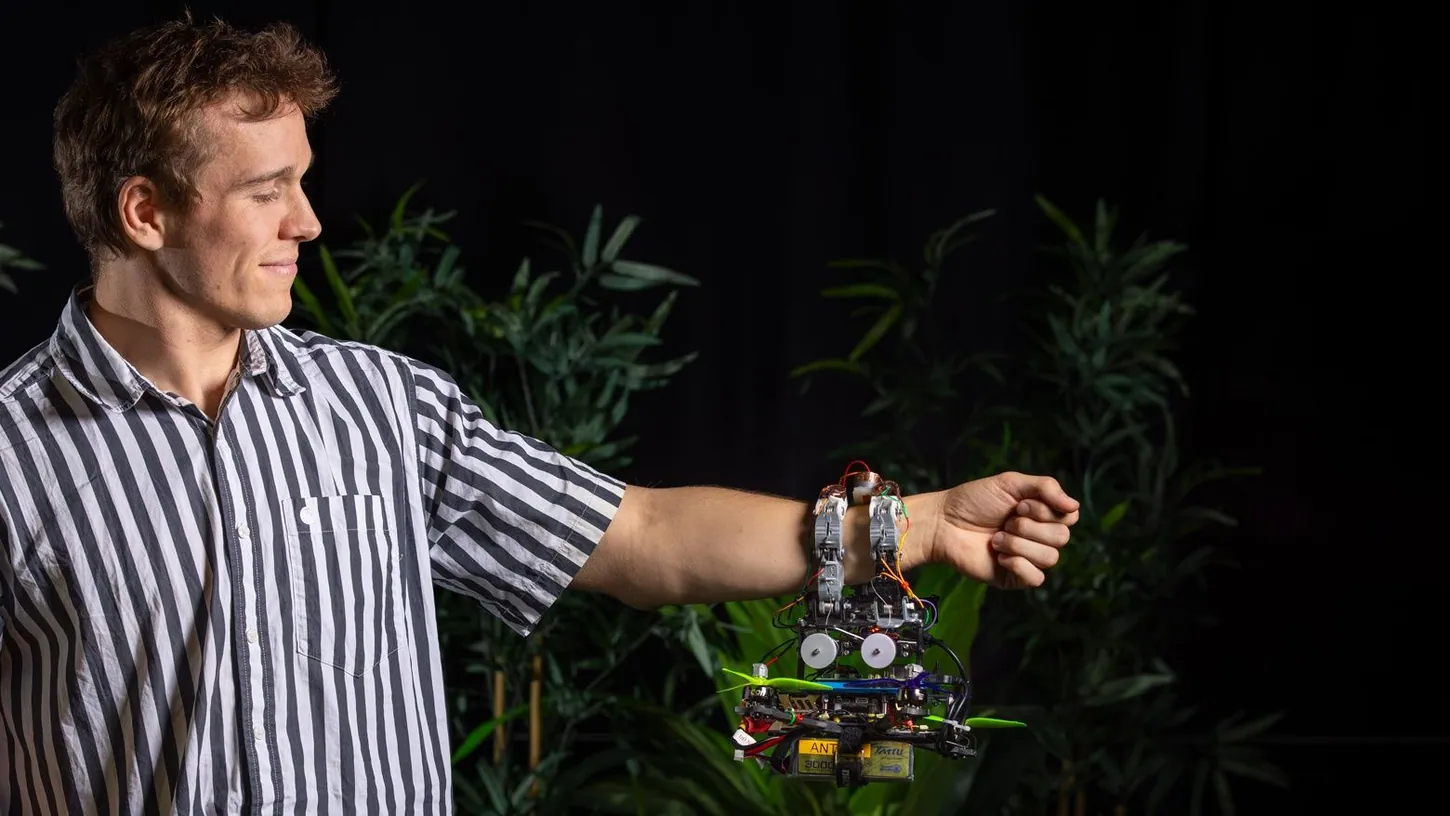
A quadcopter built at Delft University of Technology in the Netherlands finds its perch by touch instead of sight. It sweeps a three-fingered, human-style hand through the air until a finger bumps its target, works out where that branch or bar is from the contact, grabs it, and switches its motors off. Spring-loaded fingers then hold the drone up without drawing any power.
The work comes from the same TU Delft BioMorphic Intelligence Lab that built the SquirrelDrone we covered in June, and the team published it in August. In 26 flight trials the drone perched every time, including runs where its starting estimate of the target was off by about 2 feet (0.6 meters). In every one of those runs, a motion-capture system in the lab was telling the drone where it was.
Springs Keep the Hand Shut While Nine Copper Pads Do the Feeling
The drone’s hand has three fingers with three segments each, proportioned like a human finger. Springs in every joint hold the fingers shut, and one servo-wound tendon per finger pulls it open, so the drone spends energy opening its hand and none keeping it closed.
Each of the nine segments carries a square of copper foil under a soft EcoFlex silicone pad, wired to a capacitive sensor board. The signal is a plain yes or no. Because the flight computer knows where each pad sits on its own fingers, one yes becomes a point in space.
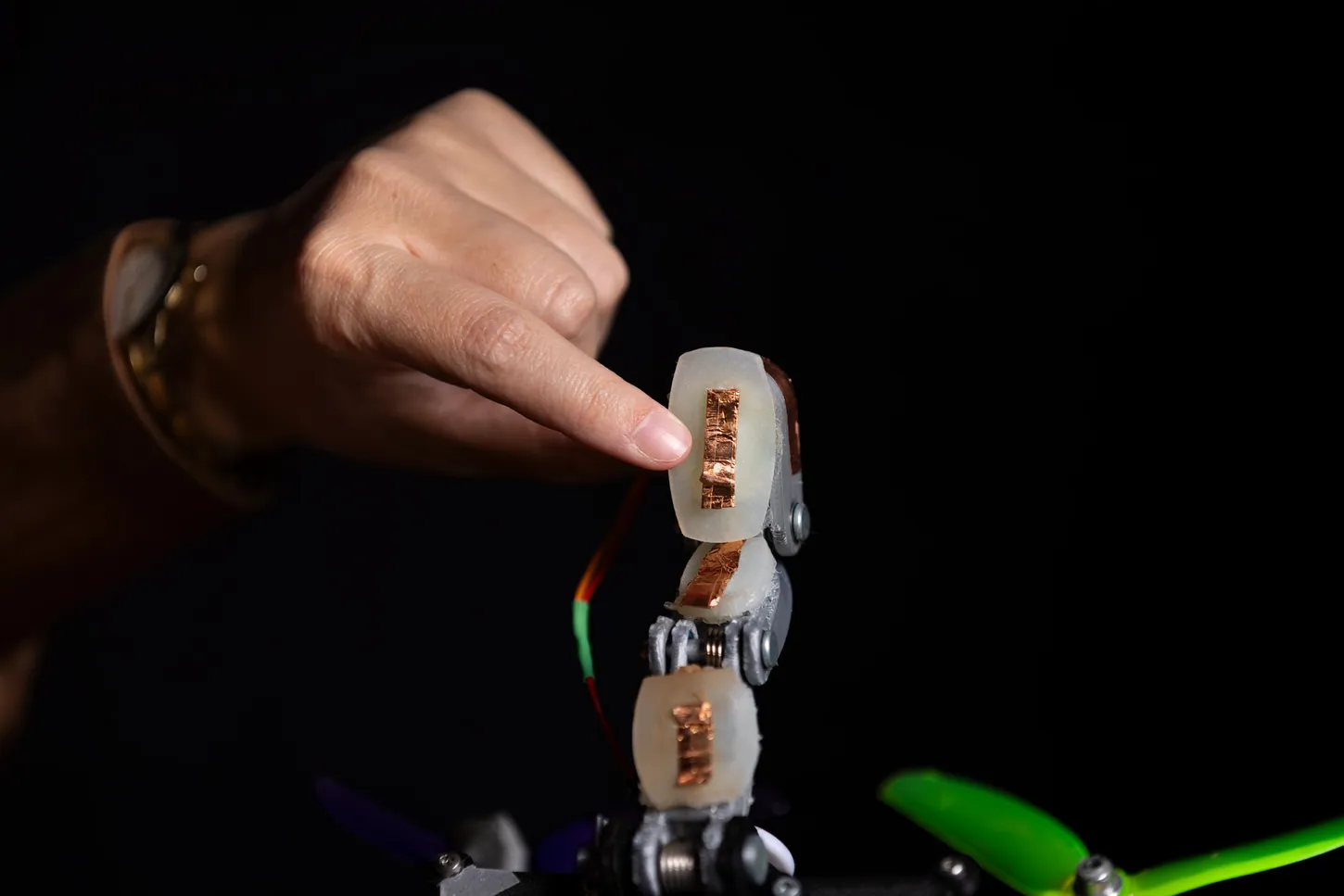
“Each sensor only tells us ‘something is here,’” PhD candidate Anton Bredenbeck said in TU Delft’s announcement. Knowing the shape of the hand, he said, is enough to rebuild where the branch is and how it is turned.
The flight routine is a figure-eight search pattern that climbs a little after each loop while the hand opens and closes. On first contact the drone backs off, slides underneath the touch point, and closes its fingers a little at a time. Any finger that touches stops closing, and the drone yaws away from it until all three fingers are in contact. It only cuts the motors once the bottom pads all report contact and the three tendons carry equal tension. If tracking goes wrong at any stage, it returns to a safe hover and starts the search over.
The hardware is hobby-grade: a SpeedyBee FS225 V2 5-inch frame, a Pixracer R15 flight controller running PX4, a Raspberry Pi 5 companion computer and a single 4S battery.
Touch Let the Drone Start 2 Feet Off Target and Still Perch
Simulation put a number on what touch buys. In 100-run sweeps, the touch method perched more than 99% of the time with its target estimate off by up to 2 feet. A blind approach that flies to the estimated spot and closes the hand tolerated about 4 inches (0.1 meters).
Those results are in the team’s paper in npj Robotics, published August 22 by Bredenbeck, Anish Jadoenathmisier and Associate Professor Salua Hamaza.
Touch also widened the yaw tolerance from about 45 degrees to about 60, and the largest perch the drone could reliably grab from roughly a 4-inch radius to 6 inches (0.15 meters). Below a radius of about 0.8 inches (0.02 meters) both methods failed, because too few pads touch a thin twig to confirm the grip.
The 26 real flights used a cylinder and a T-shaped bar as targets, with yaw offsets up to 20 degrees. Science News Explores reports each grasp took less than 70 seconds. Separately, the spring-closed hand held the drone’s full weight hanging from tree branches, wooden beams, a traffic cone and Bredenbeck’s own arm.
Every Flight So Far Leaned on Motion Capture
The 2-foot tolerance covers only the target’s position, because the drone never worked out its own. The lab’s motion-capture system supplied it, which the paper calls a proof of concept, citing earlier work where one camera and an IMU did that job on board.
The method also assumes the target sits near the first estimate, fits inside the hand, and has nothing else around it to touch.
The team has posted the hand’s design files and all the trial data in a public GitHub repository. David Lentink, who worked on Stanford’s bird-like SNAG perching gripper and is now at the University of Groningen, told Science News Explores that engineered machines still fall short of a bird’s versatility.
DroneXL’s Take
I like this one because it attacks drone endurance from the right end. Battery chemistry moves slowly, and a monitoring drone that hangs from a branch with its motors off stops burning energy altogether. The touch trick also removes the part where perching usually falls apart: the gripper blocking the camera just before contact. Most earlier perching grippers, as the paper’s own survey of them notes, needed the target’s exact position before the approach. This hand forgives a miss of 2 feet. The real test is a tree in wind, with no motion-capture cameras on the walls.
Sources: npj Robotics, TU Delft, Science News Explores.
DroneXL uses automated tools to support research and source retrieval. All reporting and editorial perspectives are by Haye Kesteloo. Read our editorial standards.