
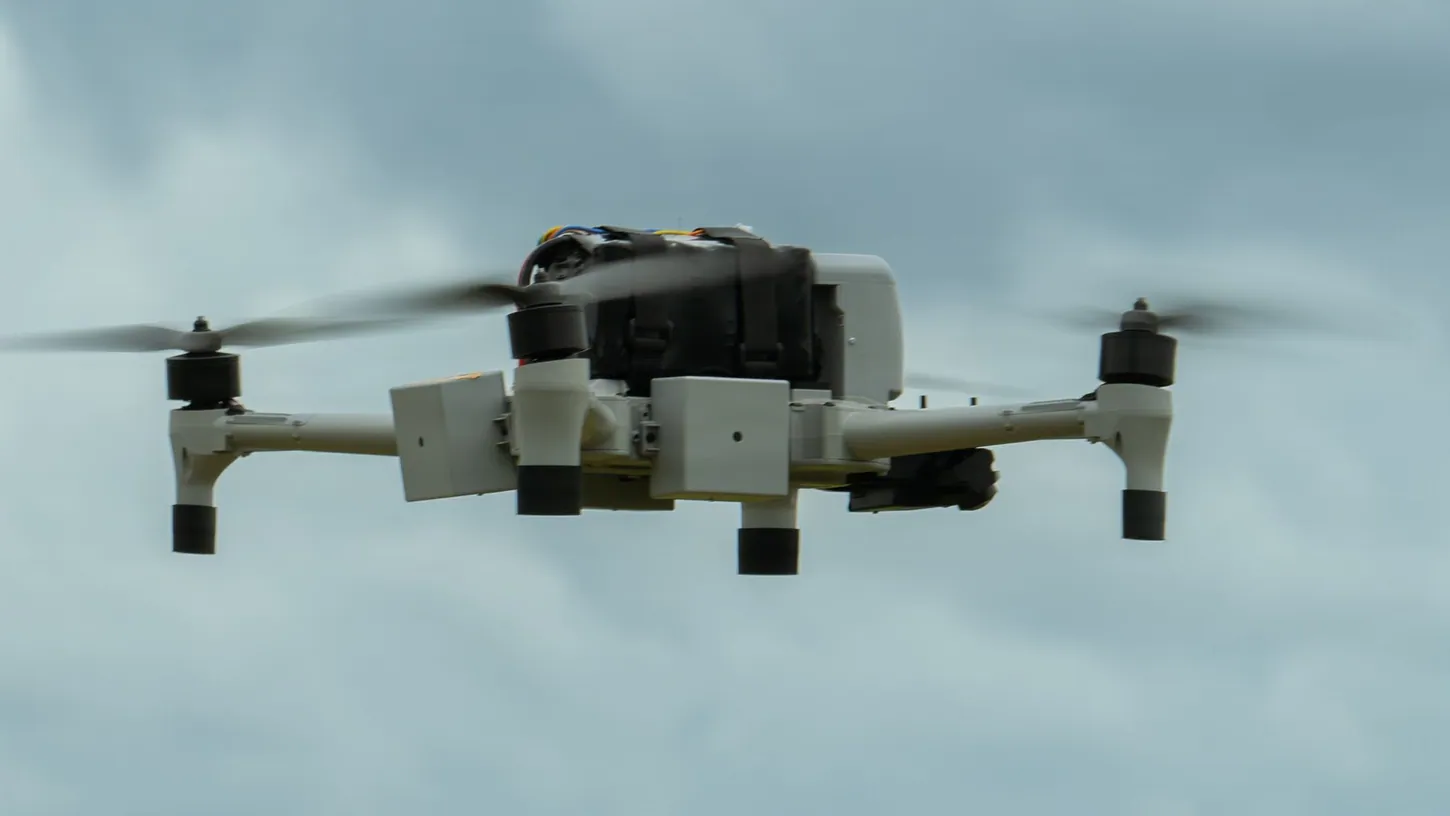
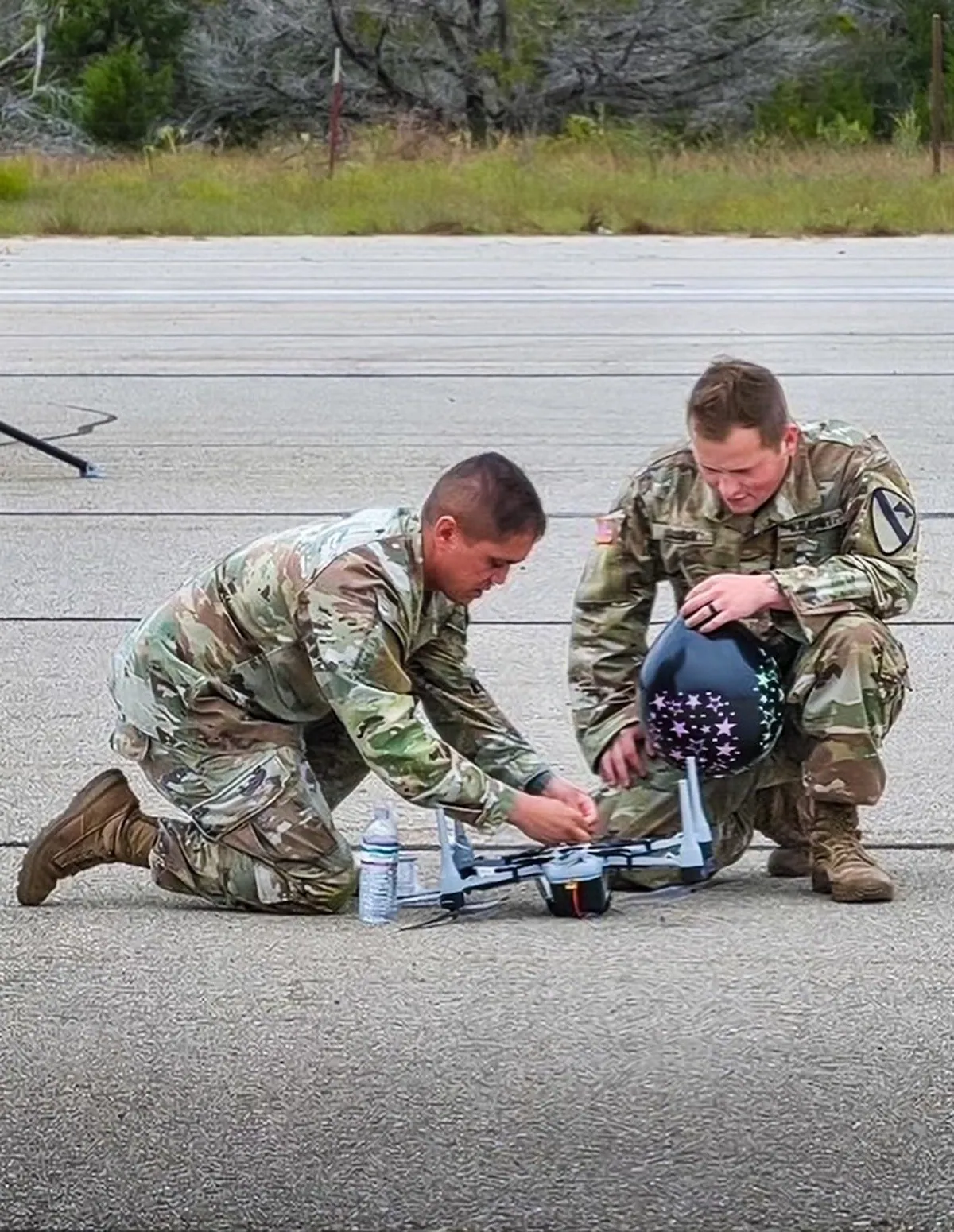
Soldiers from the U.S. Army’s 1st Cavalry Division Artillery spent November 2 to 13 at Fort Hood, Texas, learning to fly the Bumblebee V2, a quadcopter that brings down hostile drones by flying into them. Joint Interagency Task Force 401 (JIATF-401), the Pentagon’s counter-drone task force, ran the training and announced it on November 18.
The trainees were not infantry. They came from the sensor platoon of the division artillery’s Target Acquisition Battery, and the Army says they are fitting the drone into the defense of artillery positions and brigade support areas.
DroneXL covered the V2 in February, when the Army’s Global Response Force was about to assess it at Fort Bragg, and again in May, when 10th Mountain Division soldiers trained on the earlier V1 at Fort Drum. Fort Hood puts it with an armored division’s guns. The task force calls what happened there testing, and its release reports no result.
1st Cavalry’s Sensor Platoon Gets An Interceptor That Also Spots
The sensor platoon trained to use the Bumblebee V2 two ways. JIATF-401 describes it as a dual-use aircraft: an intelligence, surveillance and reconnaissance drone and a kinetic interceptor that defeats other drones by direct collision. The task force bought the systems and led the two weeks of instruction.
The Army’s release says the training was meant to build operator proficiency and assess how the drone is used tactically. Chief Warrant Officer 2 Andrew Westerberg of 1st Cavalry Division Artillery called it “a practical, dual-purpose capability they can integrate immediately into the fight.”
Brig. Gen. Matthew Ross, the director of JIATF-401, said working with the division lets the task force “refine emerging technology in operationally relevant conditions.”
In April, 1st Cavalry ran a live-fire test of Golden Shield, a network that links sensors and weapons across an armored formation’s vehicles.
Bumblebee V2 Has Now Reached An Air Force Base And Army Artillery
JIATF-401 awarded Perennial Autonomy a $5.2 million contract for the Bumblebee V2 on January 30, with the Global Response Force at Fort Bragg due to assess it first, in March. The V2 went to Air Force base defenders at MacDill in October, and now to Army artillery at Fort Hood.
In May the task force folded the Bumblebee into a three-year contract with Perennial worth up to $500 million, alongside the company’s Merops interceptor and Hornet strike drone.
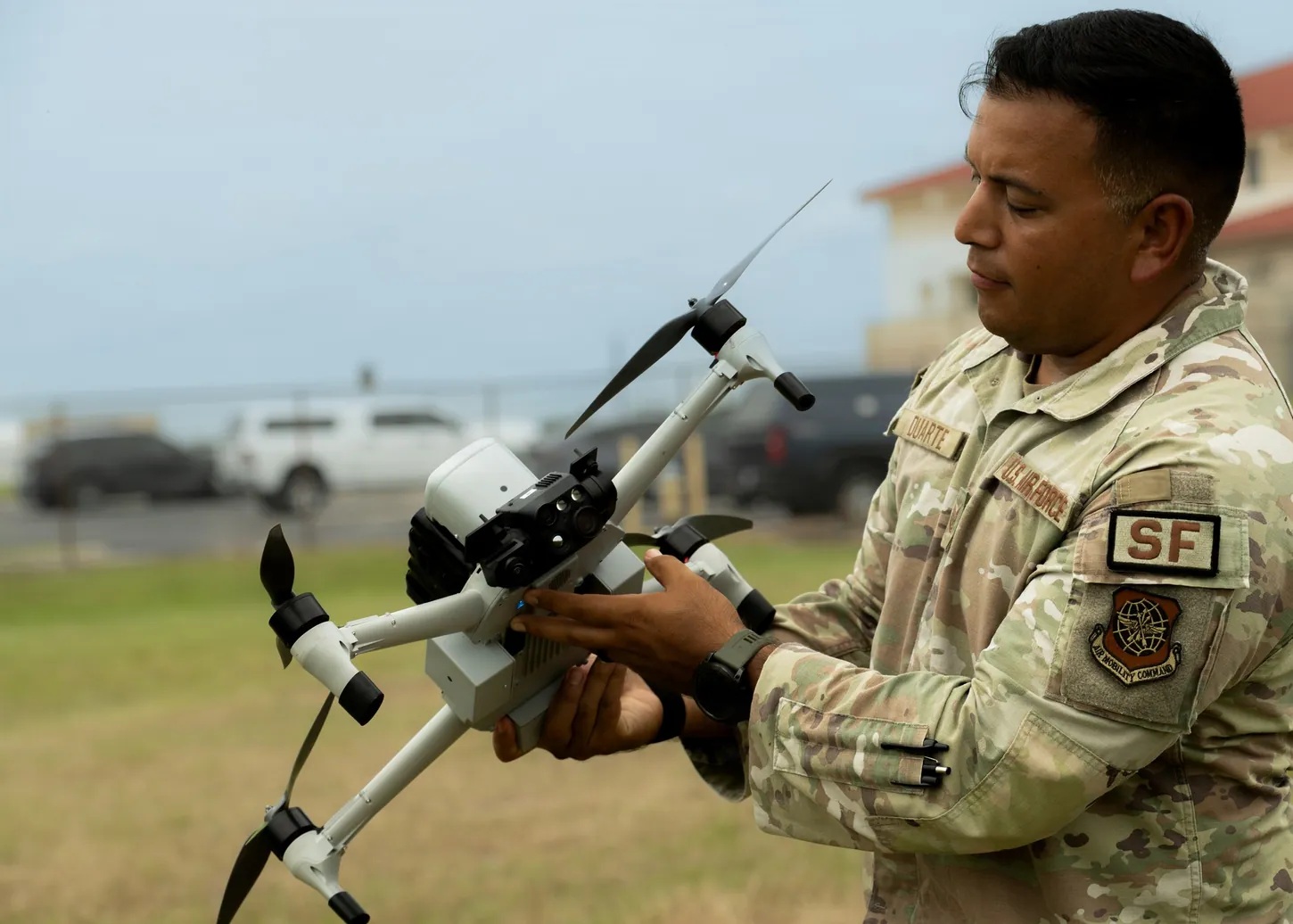
At MacDill Air Force Base in Florida, airmen of the 6th Security Forces Squadron tested the V2 on October 8 and 9 alongside U.S. Secret Service personnel. The base’s photo report calls MacDill the first Air Force installation to test it, and shows a Paladin net-launching counter-drone system at the same event.
JIATF-401 Ties The Training To Project Agincourt And Gives No Numbers
The release closes by placing the Fort Hood event under Project Agincourt, the effort Defense Secretary Pete Hegseth ordered on September 30. It does not say how many Bumblebees the division received, whether soldiers flew live intercepts or how many hit, and it never names the manufacturer.
Agincourt is the interim program meant to build the path to a four-star Autonomous Warfare Command by October 1, 2027. Its memo puts the office that owns JIATF-401 in charge and calls for systems to be tested with operators in exercises. The Fort Hood release echoes that, saying the task force brings together operators, industry experts and emerging technologies.
DroneXL’s Take
Giving the interceptor to the artillery’s own sensor platoon makes sense to me. Guns and supply areas sit still long enough to be found, and a platoon that already hunts targets with sensors is a natural crew for a drone that hunts drones. But I’ve now read three official accounts of Bumblebee training, from Fort Drum, MacDill and Fort Hood, and none of them says how often the drone hits what it chases. In May, Perennial would not tell reporters how many aircraft the $500 million ceiling buys. A cheap interceptor is only cheap if it connects, and JIATF-401 should publish that number before the next order goes in.
Sources: U.S. Army, MacDill Air Force Base, U.S. Department of War
DroneXL uses automated tools to support research and source retrieval. All reporting and editorial perspectives are by Haye Kesteloo. Read our editorial standards.
Advertise with DroneXLYour company hereReach 200,000+ drone readers a month with a sponsored article, a banner on your beat, or a partnership.See the options →


