
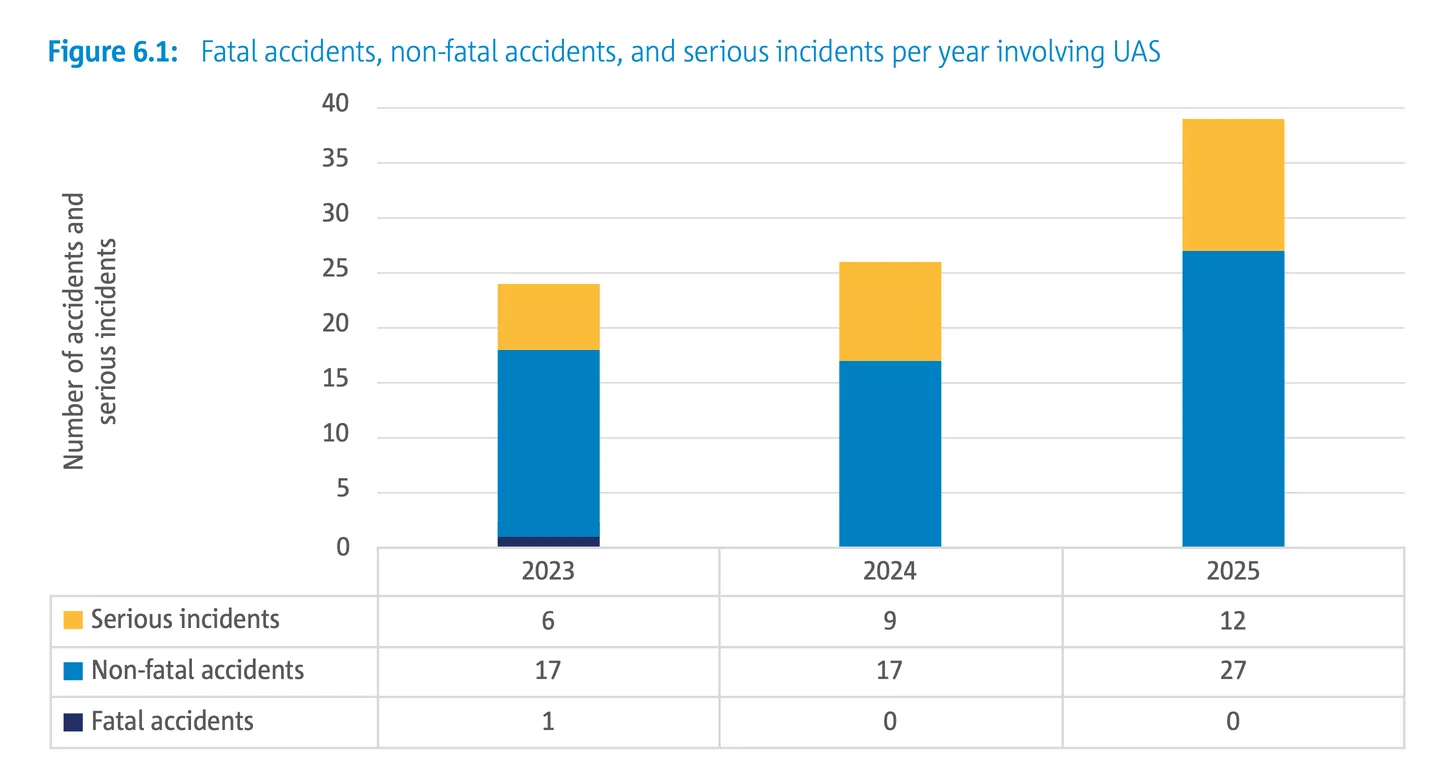
Europe’s aviation safety regulator recorded no deaths from civil drones in 2025. The European Union Aviation Safety Agency (EASA) counted 27 accidents and 12 serious incidents involving unmanned aircraft in its member states last year, 39 in all, in the Annual Safety Review 2026 it published in late October. Two people were seriously hurt.
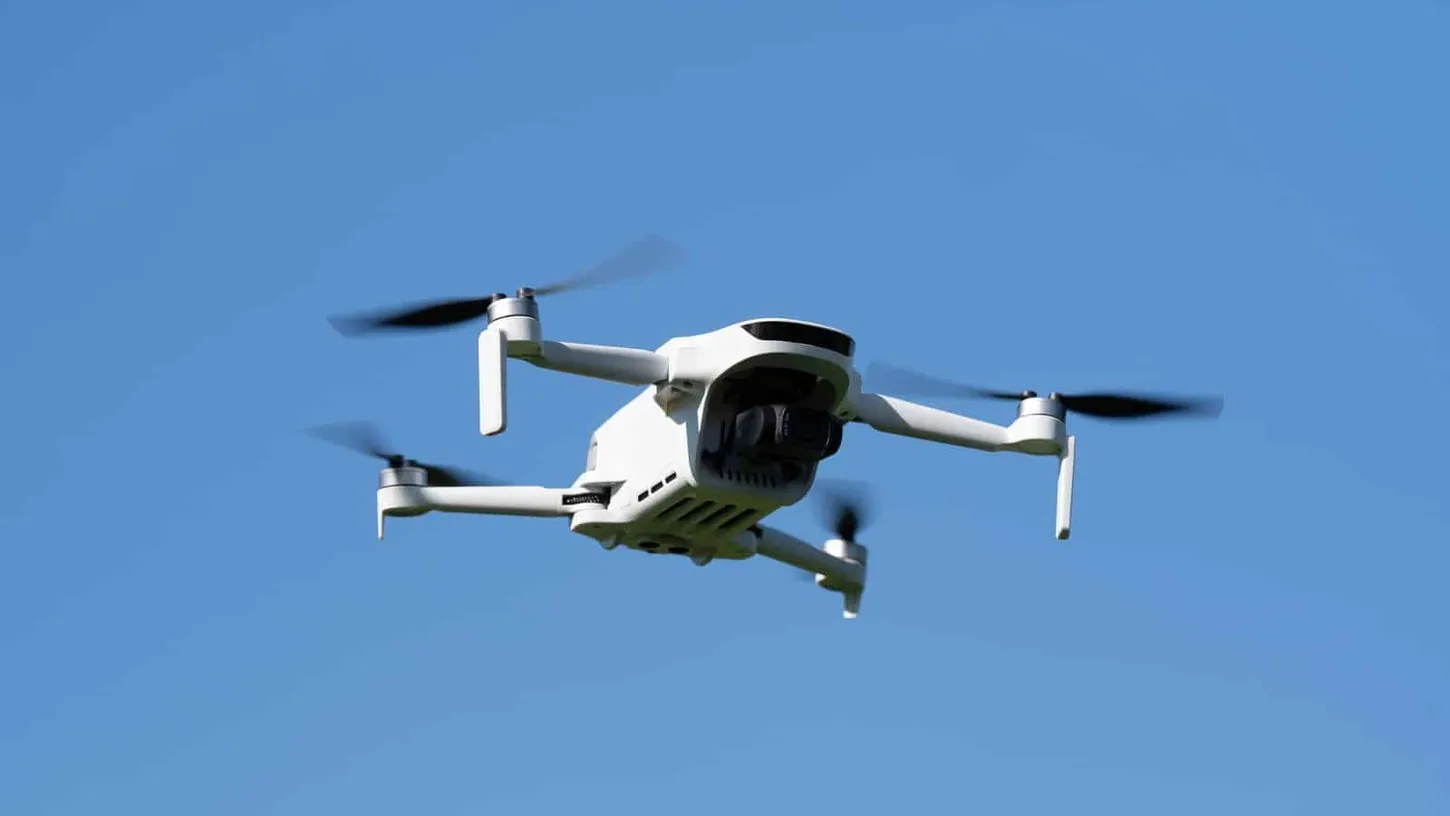
Six of the 39 events involved a crewed aircraft, and one of those was a collision. A 249-gram drone hit a hot-air balloon and dropped into a basket carrying eight people.
The same chapter ranks airborne collision as the top safety risk from drones in Europe. EASA built that ranking on three years of occurrence reports, and it says a large share of them are drone sightings.
Six Of 39 Drone Events Involved A Crewed Aircraft
EASA logged one accident and five serious incidents in 2025 in which a drone and a crewed aircraft were both involved, 15% of the year’s 39 events. In 2024 the share was 10 of 26, or 38%, and the yearly total averaged 25 across 2023 and 2024.
The full 132-page review gives the balloon collision four sentences in its drone chapter. The pilot had a minor injury, the balloon’s scoop was torn, and the flight continued. EASA does not name the country, the drone model or the operator. At 249 grams the drone sat one gram under the ceiling of C0, the lightest class in the EU rulebook and the one at issue in EASA’s confirmation of the DJI Mini 5 Pro’s C0 status last year.
The five serious incidents happened in Germany (two) and Switzerland (three). Four were near misses with helicopters and fixed-wing aircraft. EASA notes that a remote pilot who causes one is required to report it, and that “such self-reporting by UAS remote pilots is rare.”
One of the two serious injuries came during a drone operation supporting agriculture. The other was sustained by a person flying a model aircraft, which EASA counts as a drone. The only death in the three years the chapter covers was in 2023, at a model aircraft field. Loss of control in flight was the most common occurrence category in 2025.
For scale, the same review counts 16 deaths in sailplanes and 40 in small non-commercial aeroplanes in 2025. EASA warns against comparing totals between domains with different activity levels, and its drone chapter gives no rate per flight or per flight hour.
One Munich Shutdown Scored 156 Times The Average Drone Report
Airborne collision ranks first because EASA scores what a report could have become, and the collision category holds the most drone reports, many of them sightings. The average drone report in that category scores 639. EASA gave the October 2025 shutdown of Munich Airport a score of 100,000.
The risk ranking uses a wider pool than the 39 accidents and serious incidents. Europe’s central occurrence database holds 5,047 drone reports for 2023 through 2025, and 3,667 of them carry a risk score. EASA writes that the sightings in that pool only very rarely led to near collisions with crewed aircraft.
Munich is the fifth of those five serious incidents. DroneXL covered the sightings that closed the airport that week. EASA says many similar interferences happened at European airports during the year, and Munich was the only one classed as a serious incident. It received a risk grade of X1, in the red band.
The cost of those interferences is better documented than the collision risk. EASA cites a June 2026 study by the German Aerospace Center (DLR), which took 226 drone events reported to Germany’s Federal Aviation Office in 2025 and found 116 disruptions at 25 commercial airports. DLR put the minimum damage to German aviation at about €60 million, and at up to €160 million once knock-on delays and cancellations it judged likely to be drone-related are included. When Munich closed its runways again on May 30 this year, police searched and found nothing.
The review feeds the European Plan for Aviation Safety, the yearly document in which EASA and its member states set rulemaking and safety actions. “Conflict with unauthorised UAS” is on EASA’s list of Top Safety Topics, and the helicopter chapter reports that near-miss reports involving drones rose between 2023 and 2025.
EASA’s Drone Count Leaves Out Crashes Nobody Has To Report
A crash of an uncertified drone reaches EASA’s data by obligation only when someone is killed or seriously injured, or when a crewed aircraft is involved, and everything else is voluntary. Military, police and other state drones are excluded unless a civil aircraft was part of the event.
One footnote shows what falls through. In April 2025 a 570-gram drone flown in the open category collided with a French police AS350 helicopter. EASA calls it a borderline case, and it is not in the 2025 figures because nobody reported it to the central database.
The older numbers moved too. Last year’s review listed 30 non-fatal accidents and 10 serious incidents for 2023 and 2024 combined. This year’s lists 34 and 15 for the same two years, after late information came in. The jump to 39 in 2025 is measured against a baseline that is still filling up.
The reporting system has another strain on it. In its chapter on inspections of national authorities, EASA says authorities and industry complained of overload in 2025, and that it shows in the growth of drone operations and in the volume of occurrence reports that need risk coding. More than a quarter of the drone reports from 2023 to 2025 still have no score.
DroneXL’s Take
I think this chapter shows that Europe has a drone sighting problem and a drone reporting problem. I don’t see a drone casualty problem in it. Three years of civil drone flying across 31 countries produced one death, at a model aircraft field, and three serious injuries. The one event that drives the risk score is an airport closure where the cost was in cancelled flights.
The balloon collision cuts the other way, and it involved the weight class EASA wants to pull into training and Remote ID with the 100-gram proposal we reported in June. A 249-gram drone that lands in a basket with eight people in it is a real hazard. But it is one event in a dataset EASA itself describes as limited, with rare self-reporting and a helicopter collision missing from it. I’d want the agency to fix what it counts before it lowers that threshold, because right now it cannot say how often small drones crash or cause minor injuries.
Sources: EASA Annual Safety Review 2026, European Plan for Aviation Safety, German Aerospace Center (DLR)
DroneXL uses automated tools to support research and source retrieval. All reporting and editorial perspectives are by Haye Kesteloo. Read our editorial standards.
Advertise with DroneXLYour company hereReach 200,000+ drone readers a month with a sponsored article, a banner on your beat, or a partnership.See the options →


