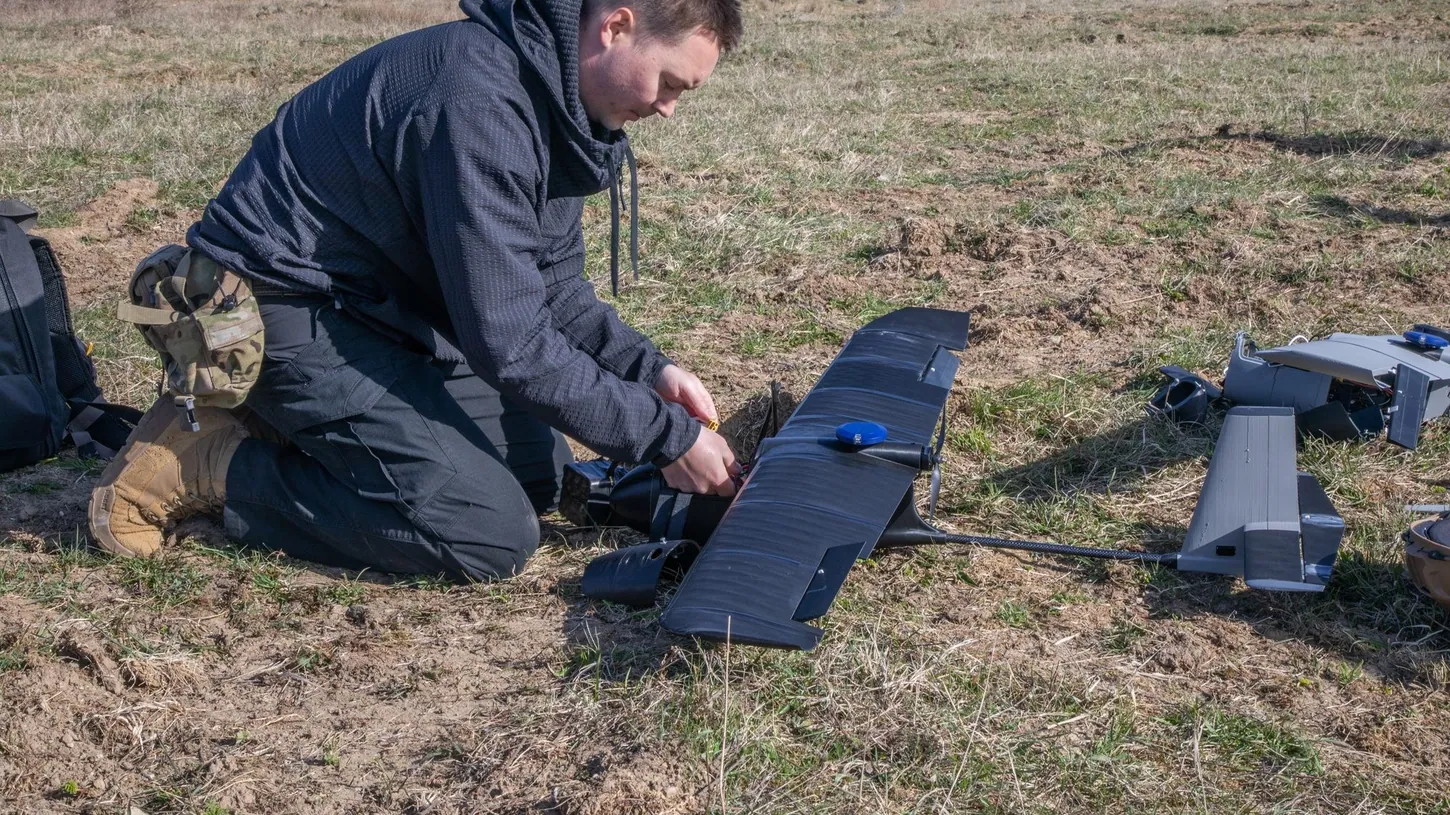
The US Army Combat Capabilities Development Command Army Research Laboratory says it has patented a two-polymer 3D printing filament and signed a research agreement with Texas manufacturer ZYLtech Engineering to mass-produce it. The lab says parts printed with it carry twice the interlayer strength of standard filament.
The release, as issued by US Army DEVCOM Army Research Laboratory
ADELPHI, Md. – A new patent issued to the U.S. Army Combat Capabilities Development Command, known as DEVCOM, Army Research Laboratory will serve as the cornerstone of an Army-industry partnership that will unlock the Army’s ability to produce more resilient 3D-printed parts for drones, ground vehicles and other combat platforms.
DEVCOM ARL researchers are working with ZYLtech Engineering, a commercial 3D printer filament manufacturer based in Texas, to scale up the production of ARL’s patented thermoplastic filament, which will enable Soldiers in the field to create 3D-printed structures and components with double their normal strength and durability.
ARL’s collaborative initiative with ZYLtech Engineering seeks to answer the Army’s need for reliable, on-demand additive manufacturing capabilities for Soldiers in remote and hostile environments where supply chain disruptions can severely impact mission success.
The partnership introduces a new manufacturing framework for mass-producing ARL’s patented filament to help encourage the widespread adoption of this new technological innovation in the U.S. industrial base.
“Much of ARL’s scientific research is so unconventional and unprecedented that oftentimes the bedrock infrastructure needed to realize and scale up our discoveries doesn’t exist in industry yet,” Dr. Dimitra Stratis-Cullum, ARL’s chief scientist. “Our researchers resolve this dilemma by collaborating with external partners to find ways to help them build that infrastructure.”
Most 3D printers produce parts using a process called fused filament fabrication, which often result in structural weaknesses between layers that leave the finished 3D-printed product too brittle for extended use on the battlefield.
ARL researchers eliminated the structural weaknesses by inventing a thermoplastic filament comprised of two different polymers with different melting points, one that enables geometric stability and one that provides strong bonding.
“The vast majority of commercial filaments available right now contain only a single polymer,” said Dr. Eric Wetzel, ARL mechanical engineer and one of the inventors of the new filament technology. “Our invention puts two polymers together in a single filament, and our experiments proved that doing so results in much stronger 3D-printed parts.”
Initially, Wetzel and his team collaborated with DEVCOM Ground Vehicle Systems Center to evaluate the performance of the filament in a ground vehicle application. Joint experimentation demonstrated promising signs for the ARL team.
“In early application testing, the dual material filament was incredibly easy to run through the standard-issue printers used by Soldiers in the field,” said Matthew Ludkey, mechanical engineer and lab manager at DEVCOM GVSC. “Due to the improved structural performance of the dual material filament, we were able to test and approve 3D-printed replacement parts using expeditionary printing capabilities that were previously only printable using industrial-style 3D printers.”
To demonstrate the filament’s resilience, the ARL team sent several 3D-printed quadcopter drone bodies to the Army’s 25th Infantry Division in Hawaii, where Soldiers installed motors to the drone bodies and flew the drones in a series of trials that tested their durability.
The drone bodies produced by ARL outperformed those made using conventional filament, and even stomping on ARL’s 3D-printed drones did not break them.
“Simply replacing the filament in a regular 3D printer with our patented dual material filament produces a 3D-printed part with twice as much interlayer strength,” Wetzel said. “But we also discovered that if you heat that 3D-printed part in an oven within a specific temperature range, you get even higher strength without changing the dimensions and 3D geometry of the part.”
However, scaling up new scientific innovations requires a cost-effective manufacturing approach and access to specialized manufacturing technology that may not yet exist in the industrial base.
Recognizing the technical challenges that their transition partners faced, ARL researchers spent the next several years executing research to lower the manufacturing costs of mass-producing the dual material filament and create the conditions needed to sufficiently de-risk the adoption of this invention for commercial investors.
Once Wetzel and his team devised a manufacturing solution, they eventually discovered that ZYLTech Engineering possessed the necessary equipment for implementing their favored approach to mass-producing the dual material filament.
“Our solution requires a specialized filament extrusion line that feeds multiple extruders into a single filament extrusion die,” Wetzel said. “ZYLTech was one of the only domestic vendors available with this special setup.”
ARL first initiated a Cooperative Research and Development Agreement in 2025 with the company to execute several pilot productions of ARL’s dual material filament.
ARL provided expertise in material selection, the geometric arrangement of the materials within the filament cross-section and the design of the dual material extrusion die. ZYLTech provided the extrusion setup and the expertise to push the filament towards commercial production rates.
Over multiple pilot filament trials, the CRADA team was able to produce filaments that resulted in 3D-printed parts that ARL sent to different Army units for evaluation on the field.
According to Wetzel, the partnership demonstrates the power of Army-industry collaboration and highlights the value of ARL’s partnership agreements, the mechanisms which enable Army researchers to work with businesses to solve scientific problems.
“Our partnership with ZYLtech takes us one step closer to delivering superior 3D-printing technology to our Soldiers so that they can create stronger 3D-printed structures on-demand in the operational environment,” Wetzel said. “We are continuing our research to increase the quality of our filament at the highest production rates. Our work isn’t over yet, but we believe that our progress so far has built the foundation for a new technological capability that will help the Army win in the future.”
About DEVCOM ARL
DEVCOM ARL is the Army’s sole fundamental research laboratory serving as the nexus of science between the military, academia and industry. Operating under the U.S. Army Futures and Autonomous Systems Command, ARL executes globally recognized research to accelerate delivery of war-winning, disruptive technologies for tomorrow’s Army.
Advertise with DroneXLYour company hereReach 200,000+ drone readers a month with a sponsored article, a banner on your beat, or a partnership.See the options →