
History of Drones: From Kites and Balloon Bombs to FPV Warfare
The complete history of drones, from Chinese kites and 1849 balloon bombs through the Kettering Bug, Predator, and DJI's rise, to the FPV war over Ukraine. Told through more than 90 photos from the Intrepid Museum's drone exhibition.
Last updated August 29, 2026 · Kept current by the DroneXL newsroom
Every drone that flies today, from a $30 toy quadcopter to an armed MQ-9 Reaper, descends from one idea: put eyes, or a weapon, in the sky without risking the person holding the controls. That idea is far older than powered flight. It runs from Chinese signal kites through 1849 balloon bombs, two world wars’ worth of flying torpedoes, the Predator era, the DJI Phantom on your shelf, and the FPV drones now deciding battles in Ukraine.
In 2017, I spent a day aboard the Intrepid Sea, Air & Space Museum in New York photographing “Drones: Is the Sky the Limit?”, a DJI-sponsored exhibition that traced this whole arc with real hardware, from a Radioplane target drone to a Predator’s specification board. The photos in this guide are mine from that visit, and the original photo essay remains online. This page tells the fuller story the exhibit could not: what the placards got wrong (several mislabel World War II as World War I, and I correct those dates here), the DJI origin story a DJI-sponsored show never told, and everything that has happened since, because drone history has moved faster since 2022 than in the previous fifty years.


Where does the history of drones begin?
The lineage starts with Chinese kites around the 5th century BCE, roughly 2,400 years before the Wright brothers, and the military got there almost immediately: armies used kites for signaling, for reading wind, and, in the case of General Han Xin, reportedly for measuring the distance to a besieged city’s walls so his troops knew how far to tunnel. A kite over a fortress is a drone in every sense that matters. It is an expendable aerial platform doing reconnaissance while its operator stays out of arrow range.
Balloons added lift you could weaponize. After the Montgolfier brothers flew in 1783, it took decades for someone to send one up armed, and in July 1849 Austrian forces besieging Venice did exactly that, launching around 200 pilotless hot-air balloons carrying explosive charges on timed fuses. The wind shifted and blew several back over Austrian lines, which taught the first hard lesson of unmanned flight: without guidance, the sky does what it wants.
America ran the same experiment in the 1860s. During the Civil War, Thaddeus Lowe’s manned observation balloons watched Confederate forces for the Union, and in 1863 the inventor Charles Perley patented an unmanned balloon designed to drop bombs on enemy troops. The exhibit’s placard notes the idea was abandoned because the bomb-release timers proved unreliable and dangerous, a sentence that could describe half of drone history’s first century.


What was the first true drone?
The first true drones, powered aircraft flying without a pilot on board, arrived in 1917 and 1918, built from three technologies that matured almost simultaneously: radio control, which Nikola Tesla had demonstrated with his remote-controlled boat at Madison Square Garden in 1898, gyroscopic stabilization, and the airplane itself, barely a decade old.
Britain moved first. In 1917, Archibald Low’s “Aerial Target” program flew a radio-guided monoplane intended to intercept German Zeppelins. In the United States, Elmer Sperry, inventor of the gyrocompass, teamed with Peter Hewitt to fit a Curtiss N-9 with gyroscopic autopilots and a barometer for altitude, producing the Hewitt-Sperry Automatic Airplane, the Navy-funded “aerial torpedo” the Intrepid’s placard describes. It flew successfully but never reached combat.
The US Army’s answer was the Kettering Bug, designed by Charles Kettering with input from Orville Wright. The Bug was a cheap wood-and-papier-mâché biplane launched from a rail cart. A mechanical counter tracked engine revolutions to estimate distance flown; at the preset count the engine cut, the wings detached, and the fuselage fell on its target with 180 pounds of explosives. Thousands were ordered. The war ended before any flew in anger, but the concept, a disposable aircraft that navigates itself to a target and dives in, is the direct ancestor of both the cruise missile and the Shahed-136 loitering munitions Russia launches at Ukrainian cities a century later.


Why are drones called drones?
The name traces to a British biplane. In 1935 the Royal Navy demonstrated the de Havilland DH.82B Queen Bee, a radio-controlled Tiger Moth used as a live anti-aircraft gunnery target, and US Navy Admiral William Standley watched the demonstration. He assigned Commander Delmer Fahrney to build an American equivalent, and Fahrney named the aircraft “drones” in tribute to the Queen Bee: the drone is the male bee, and the name honored the British original. The exhibit’s own placard offers the simpler version, that the targets were named for the sound they made. Both are true enough, and the word outlived every aircraft it described.
The target-drone business became an industry in Southern California. British-born actor Reginald Denny turned his radio-control model hobby into the Radioplane Company, and when war came the military ordered its OQ-2 target drone by the thousands, making it the first mass-produced UAV, with roughly 15,000 built during World War II. Radioplane targets flew from ships too, including Intrepid herself: the exhibit opens with a 1945 photograph of a target drone launching from the carrier’s deck while the crew watches.


Radioplane’s factory in Van Nuys also produced drone history’s strangest footnote. In June 1944, an Army photographer documenting women in war work photographed an 18-year-old assembler named Norma Jeane Mortenson on the drone line. The pictures launched a modeling career, and the world came to know her as Marilyn Monroe.


The target mission never went away, it just scaled up. Since the war, the US Navy and Air Force have converted retired fighters into full-size unmanned targets, and today the QF-16, a drone conversion of the F-16 Falcon, absorbs missiles so that training stays honest.

How were drones used in World War II?
World War II turned the drone from a training target into a weapon on three fronts at once: intercontinental balloon bombs, jet-powered cruise missiles, and the first television-guided strike aircraft. A note on the photos in this section: several of the Intrepid’s placards, faithfully reproduced in my original photo essay, mislabel these programs as “World War I (1939-1945)”. The dates give the error away. Everything below is World War II, 1939 to 1945.
Imperial Japan built the war’s most audacious unmanned system with no electronics at all. The Fu-Go balloon bombs rode the Pacific jet stream from Japan to North America, more than 9,000 of them launched between late 1944 and early 1945, each carrying incendiary and high-explosive bombs meant to ignite forest fires and spread fear. Only 361 were ever found, scattered across 26 states, Canada, and Mexico. In May 1945 one killed a woman and five children at a church picnic in rural Oregon, the only fatalities from enemy action in the continental United States during the war. They are considered the first intercontinental weapons in history.

Germany’s V-1 “buzz bomb” was the Kettering Bug’s idea executed with a pulse jet and a functioning autopilot. Over 9,500 were launched against England and another 2,448 at Belgium. The US Navy captured V-1s and copied them as the Republic-Ford JB-2 Loon, test-fired from submarines like USS Cusk, and the line from that program to the modern cruise missile is unbroken.


The Allies also tried converting worn-out bombers into radio-guided missiles. Under Operation Aphrodite and its Navy counterpart Anvil, war-weary B-17s and PB4Y bombers were stripped, packed with explosives, and flown toward targets by pilots who armed the payload and bailed out once a chase plane took radio control. The system was unreliable, and on August 12, 1944, Lieutenant Joseph P. Kennedy Jr., older brother of the future president, was killed with his copilot Wilford Willy when their aircraft exploded prematurely over England.


The war’s most forward-looking drone barely gets remembered. The US Navy’s Interstate TDR-1 carried a torpedo or a 2,000-pound bomb and a nose-mounted television camera, with an operator watching the picture from a modified Avenger flying miles behind. TDR-1s flew 46 strike missions against Japanese positions in the Solomon Islands in 1944 and scored 18 hits before the program was canceled. A camera on the aircraft, a screen in front of the operator, a weapon released on what the screen shows: that is FPV combat, invented in 1944 and then shelved for 70 years.
What did the Cold War add to drone technology?
The Cold War gave drones jet engines, cameras worth the flight, and nuclear warheads, in roughly that order. When Francis Gary Powers’ U-2 was shot down over the Soviet Union in 1960, the case for unmanned reconnaissance stopped being theoretical, and the resulting aircraft bridged the gap between the V-1’s dumb autopilot and the modern surveillance drone.
The nuclear branch came first. The SSM-N-8 Regulus I, conceived during the war and fielded in the early 1950s, was a turbojet-powered cruise missile with a 500-mile range that could carry the two-megaton W27 warhead, more than 100 times the force of the bombs dropped on Japan. It deployed on carriers, cruisers, and five submarines, including Growler, which is preserved at the Intrepid museum today. Regulus boats ran roughly 40 deterrent patrols in the Pacific before Polaris ballistic missiles, launchable from underwater, made surface-launched cruise missiles obsolete in 1964.


The Navy’s other Cold War drone was stranger: the Gyrodyne QH-50 DASH, an unmanned coaxial helicopter small enough to fly from destroyers that could not carry piloted aircraft. Its job was to carry the Mark 57 nuclear depth bomb, or a pair of homing torpedoes, far enough from the ship that the ship would survive the attack. DASH flew anti-submarine missions from 1963 to 1971 and then towed targets for weapons testing until 2006, a 43-year career.


Reconnaissance drones did the most dangerous flying of the era. The Ryan Model 147 Lightning Bug, a modified Firebee target, was dropped from DC-130s and flew more than 3,400 sorties over North Vietnam and China between 1964 and 1975, photographing targets no crewed aircraft could survive, then parachuting into mid-air helicopter recoveries. Lockheed’s D-21 pushed further still, a Mach 3 ramjet drone launched from the back of a Blackbird to photograph Chinese nuclear facilities. Neither appears in the exhibit’s galleries, and both belong in any honest telling of this era.
When did drones become decisive weapons?
The modern military drone was proven over Lebanon’s Bekaa Valley in June 1982, when Israel used unmanned aircraft to win an air battle before its jets arrived. Israeli Scout and Mastiff drones flew into Syrian radar coverage first, provoking the SA-6 missile batteries into lighting up their radars, and relayed the frequencies and positions in real time. Israeli strike aircraft then destroyed the batteries, 19 sites in hours, without losing an aircraft. Every air force noticed. US Navy Secretary John Lehman bought into the Israeli approach directly, which produced the AAI RQ-2 Pioneer, and during the 1991 Gulf War a Pioneer spotting for battleship gunfire watched Iraqi soldiers on Faylaka Island wave white cloth at it: the first troops in history to surrender to a drone.
The next leap came out of a garage in Los Angeles. Abraham Karem, a former Israeli Air Force designer, built his Albatross endurance drone at home and developed it into Amber; his company was absorbed by General Atomics, Amber became the GNAT 750, and the GNAT became the RQ-1 Predator, which entered service in 1995 as a surveillance aircraft. The Predator’s real trick was not endurance but the Ku-band satellite link, which meant the crew no longer had to be anywhere near the war. In February 2001 the Air Force test-fired a Hellfire missile from a Predator, and after September 11 the armed MQ-1 went to work over Afghanistan. Its successor, the MQ-9 Reaper, carries 15 times the ordnance at more than twice the cruise speed.


The US military classifies its drones into five groups by weight, altitude, and speed, from the hand-launched RQ-11 Raven up through the RQ-7B Shadow and RQ-21 Blackjack to the Predator and the high-altitude RQ-4 Global Hawk, which flies autonomous surveillance missions measured in days. The exhibit’s placards walk through all five.


Two smaller aircraft in the galleries show how far the technology spread below the headline hunters. The Boeing Insitu ScanEagle launches from a catapult and lands by flying its wingtip hook into a hanging rope; it started life spotting fish for commercial fishermen, became the first drone the FAA approved for commercial flight beyond visual line of sight, and provided the live overhead picture during the 2009 rescue of Captain Richard Phillips from Somali pirates. The AeroVironment RQ-14 Dragon Eye, a six-pound flying wing launched by hand or bungee cord, fed live video to a Marine’s goggles, first-person view as standard military equipment two decades before FPV became a hobby term.


The galleries also gather the specialists: the Kaman K-MAX, an unmanned logging helicopter that hauled over 2,250 tons of cargo to Marines in Afghanistan; Israel’s Cormorant casualty-evacuation vehicle with its enclosed rotors; and the Northrop Grumman X-47B, which flew nearly flawless autonomous carrier landings before the Navy redirected the program into the MQ-25 Stingray aerial tanker, a mission change the exhibit dryly attributes to balancing drones against “the interests of pilots.”


The exhibit does not look away from the cost. Between 2009 and 2016, US counterterrorism strikes outside active war zones, mostly by drones, killed approximately 3,000 people across 526 strikes by the government’s own accounting, with independent estimates running higher. The debate the placard frames, precision and force protection against remote killing and civilian deaths, has only sharpened since.


How did DJI put a drone in everyone’s backpack?
The consumer drone was born from the smartphone, and the company that understood this first was DJI, founded by Frank Wang in 2006, seven years before most people had heard the word “quadcopter.” Mass smartphone production collapsed the price of everything a small drone needs: MEMS gyroscopes and accelerometers, lithium-polymer batteries, cheap ARM processors fast enough to run stabilization math, and powerful brushless motors. By 2007 Chris Anderson’s DIY Drones community was building the ArduPilot open-source autopilot around exactly these parts, and in 2010 Parrot’s AR.Drone became the first mass-market quadcopter, flown from an iPhone.
Wang grew up in Hangzhou obsessed with radio-controlled helicopters, the kind that punished imperfect thumbs with expensive crashes. As a student at the Hong Kong University of Science and Technology, mentored by professor Li Zexiang, he built helicopter flight controllers in his dorm room and founded Da-Jiang Innovations in 2006, setting up shop in Shenzhen with a goal he later described as feeding a team of ten or twenty people. The early years were lean and the turnover was high; Wang’s perfectionism is a recurring theme in every account of the company, including the documentary history of DJI’s rise we covered in 2025.

The Phantom, released in January 2013, changed everything: a ready-to-fly quadcopter with GPS position hold that an amateur could unbox and fly the same afternoon. The Phantom 3 integrated a stabilized 4K camera and a real digital video downlink in 2015, the Phantom 4 added computer-vision obstacle avoidance in 2016, and the folding Mavic Pro that same year shrank the whole category into something that fit a jacket pocket. DJI rode that cadence to roughly 70 percent of the global consumer and commercial drone market, and Wang became one of Asia’s youngest tech billionaires. When the last Phantom 4 shipped in 2025, it closed the product line that had created the consumer drone industry.
There is a quiet irony in the photos from the Intrepid. The exhibition was sponsored by DJI, and its consumer-drone display case held a Phantom 3 Pro, the drone that had explored Vietnam’s Son Doong cave. Yet the exhibit never told DJI’s own story. In 2017 the company was at the peak of its uncomplicated fame, a gadget maker celebrated in a New York museum. The geopolitics came later.


What did civilian drones change beyond photography?
By the mid-2010s the drone had become a general-purpose tool, and the exhibit’s civilian gallery, “Drones, Drones, Everywhere!”, caught the breadth of it: agriculture, public safety, science, humanitarian aid, sport, and art, each with hardware to show.


Agriculture was the sleeper. Multispectral cameras see crop stress days before the naked eye does, and the exhibit’s placard cites Japanese farmers already flying more than 10,000 agricultural drones, with US investors projecting agricultural drones would come to dominate the commercial market and generate $82 billion in economic growth within a decade. That projection aged well: spraying and crop-scouting drones are now a routine farm implement across Asia and the Americas, with DJI’s Agras line doing much of the flying.


Public safety agencies were early too. The Mesa County Sheriff’s Office in Colorado put a Draganflyer X6 to work in 2009, years before most departments had a policy, and the FDNY was already flying tethered camera drones at fires when the exhibit opened. That thread runs straight to today’s drone-as-first-responder programs, where a drone often reaches a 911 call before the patrol car does.


Science claimed its share. NOAA’s Coyote, a 14-pound drone dropped from a hurricane hunter aircraft, flies into the storm layers below 3,000 feet that are too dangerous for crewed flight and radios back pressure, temperature, and wind data that sharpen forecast models.


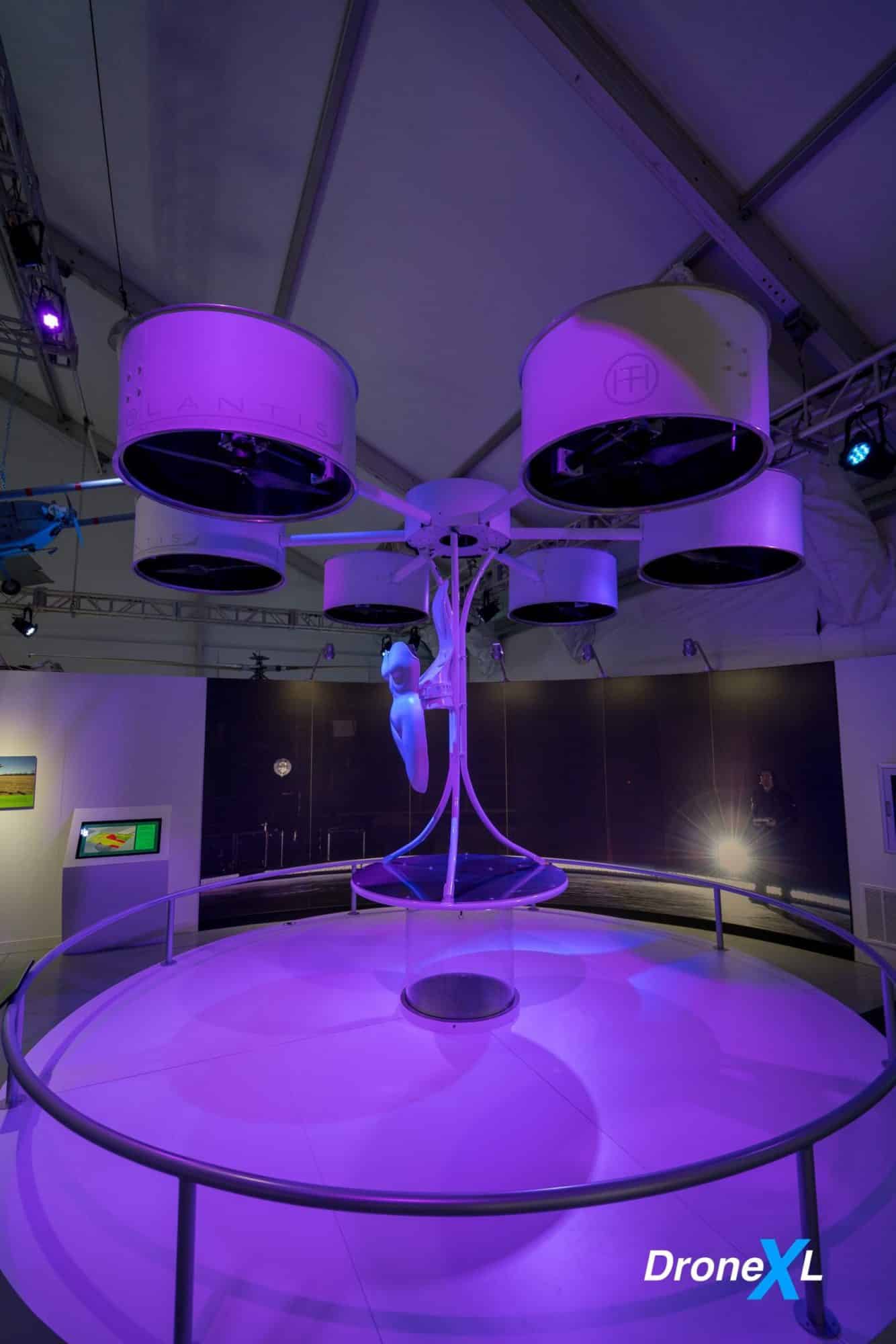
And the culture absorbed the technology in stranger ways. Racing pilots in FPV goggles turned drone flight into a sport. Cirque du Soleil flew a swarm of lampshade drones in autonomous formation for its film Sparked. Lady Gaga made her 2013 album-launch entrance in the Volantis “flying dress,” a hexacopter built to carry a passenger who has no control over where it goes, plausibly the first passenger aircraft flown entirely by a remote operator.


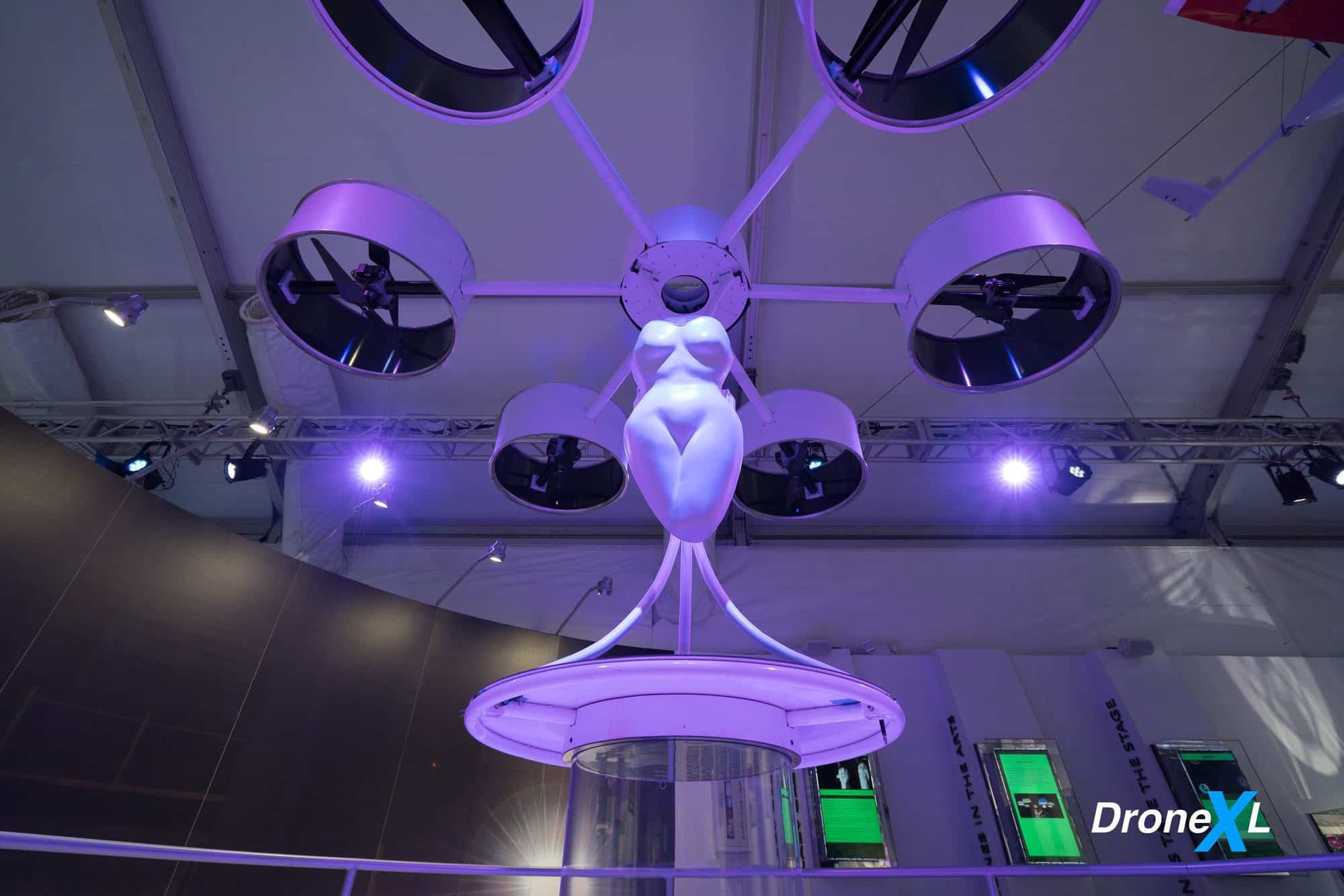
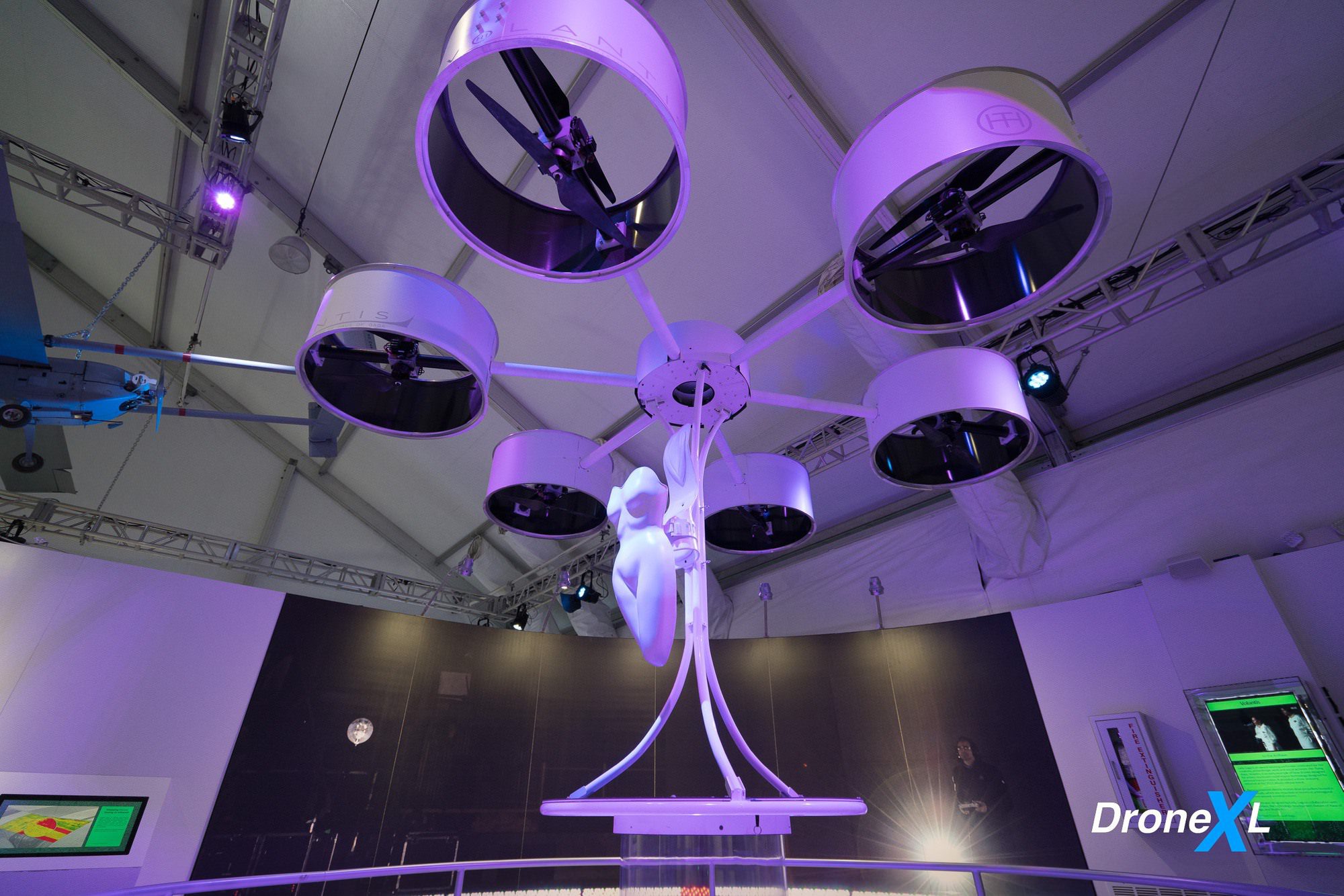
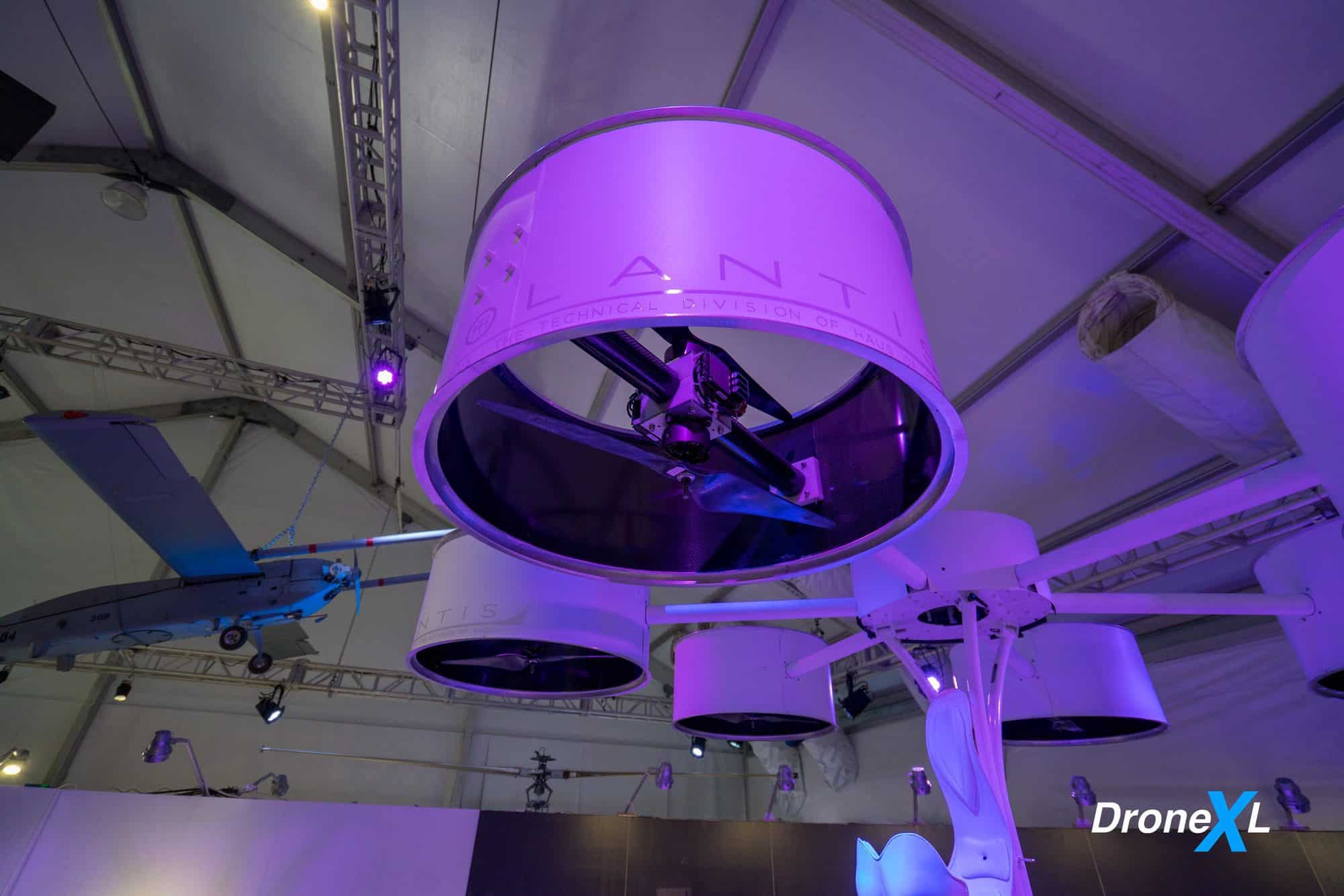
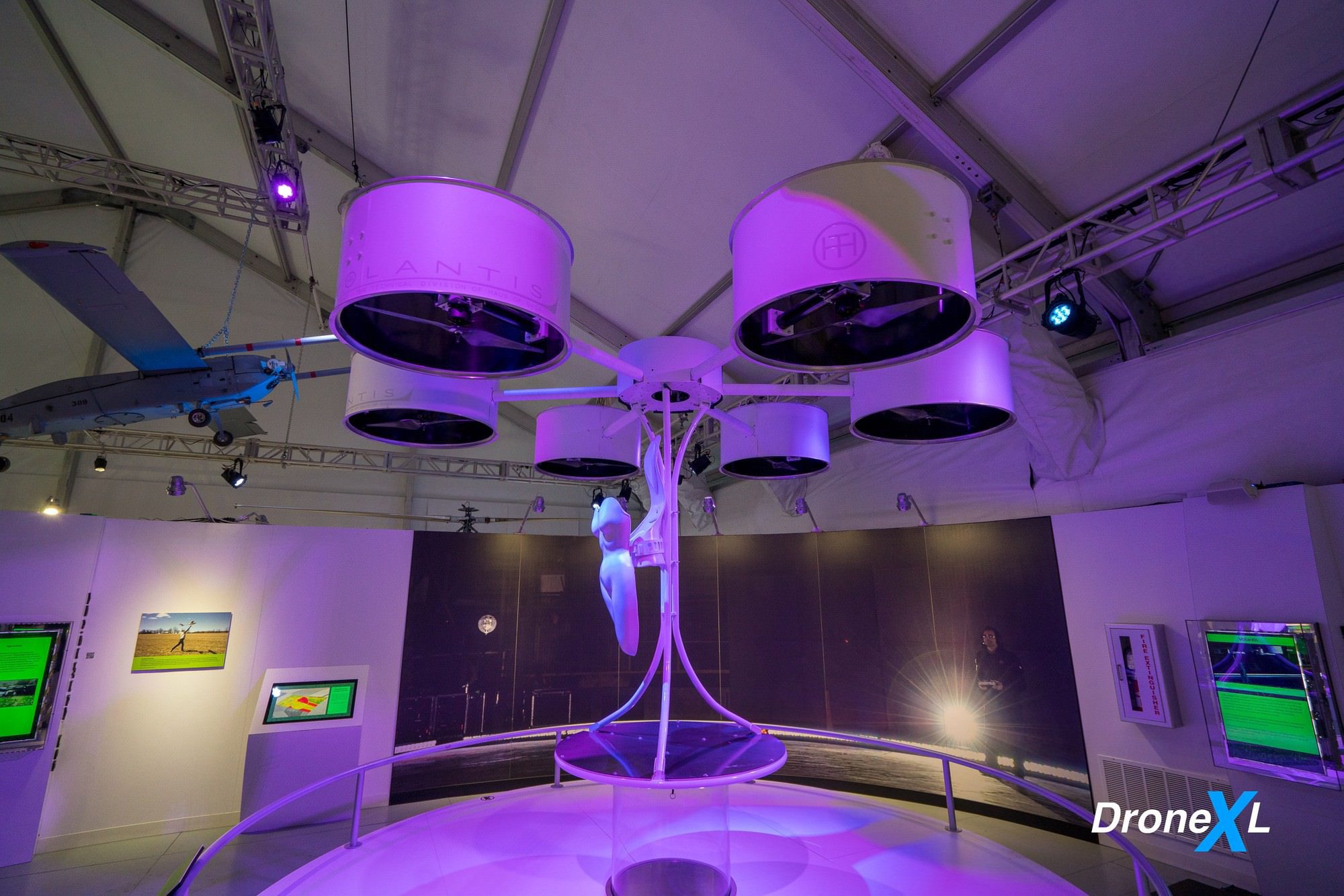
The humanitarian panels were the most prescient in the room. They described drones delivering medical supplies to the 800 million people without reliable access to basic health services, and communities in developing countries training to fly their own disaster-response missions. That vision became Zipline, which has now flown millions of commercial deliveries of blood, medicine, and groceries, including nationwide autonomous delivery in Rwanda.


What did the exhibit predict for the future, and what actually happened?
The 2017 exhibit made four checkable predictions, and from 2026 the scorecard reads: one direct hit, one on track, one slower than promised, and one wrong in an interesting way. Its closing panels imagined package delivery at scale, pilotless air taxis, apartment balconies doubling as landing pads, and, in the introductory text, drones exploring Mars.
Mars happened first and most completely. NASA’s Ingenuity helicopter flew at Jezero Crater in April 2021, the first powered flight on another planet, and logged 72 flights before a rotor strike ended the mission in 2024. Delivery is on track but a decade behind the render: Zipline and Walmart run real networks over Texas today, though the Amazon Prime Air system displayed at the Intrepid, with its 30-minute-delivery specification card, remains a modest operation. Air taxis are still in flight test and certification rather than commuting; nobody’s balcony is a vertiport yet. And the Terrafugia TF-X flying car on display, promised at 200 miles per hour with vertical takeoff, was quietly shelved, while the eVTOL companies that replaced that dream are still working through certification. The exhibit’s instinct was right and its timelines were optimistic, which is the usual verdict on aviation futurism.


When were consumer drones first weaponized?
The consumer drone became a weapon within three years of the Phantom’s launch, and it happened in two places at once. In Ukraine, after Russia annexed Crimea in 2014, volunteer groups like Aerorozvidka began modifying commercial multirotors for reconnaissance and, soon, for dropping munitions, building institutional knowledge that would matter enormously eight years later. In the Middle East, the Islamic State turned off-the-shelf quadcopters, many of them DJI Phantoms, into grenade-dropping bombers during the battles for Mosul and its Syrian territory in 2016 and 2017, forcing coalition forces to improvise the first counter-drone defenses of the small-UAS era.
Syria stayed a proving ground to the end. When rebel forces toppled the Assad government in December 2024, their offensive leaned on locally built Shaheen strike drones and, reportedly, Ukrainian-supplied aircraft and expertise; our analysis of how drone warfare transformed Syria’s civil war traces how a tactic that began with hobby-grade quadcopters ended up deciding a 13-year war.
How did the war in Ukraine rewrite drone warfare?
Russia’s full-scale invasion in February 2022 turned Ukraine into the laboratory where every assumption about air power is being retested, and the Ukraine drone war has been DroneXL’s most consequential beat since. Both sides arrived with drone experience from eight years of low-intensity war in the Donbas, and the escalation since has compressed decades of military evolution into four years.
The war’s first drone icon was Turkish. Bayraktar TB2s destroyed Russian convoys in the invasion’s opening weeks and got a folk song written about them, while the US rushed Switchblade loitering munitions into the country.

But the durable revolution was cheaper. Commercial DJI quadcopters became the standard reconnaissance and artillery-spotting tool of both armies, and modified Mavics dropping grenades showed what the ISIS-era improvisation looked like with trained armies behind it. Then came FPV racing drones with warheads attached: a few hundred dollars of hobby parts that can chase a moving vehicle into its open hatch. Consumption became industrial, with Ukraine at one point losing a reported 10,000 drones a month, a number that made production speed itself a weapon. Russian medical reporting has attributed the large majority of casualties in some sectors to FPV strikes, and drones now account for most armored-vehicle kills on both sides.

Each escalation bred a counter. Iran’s Shahed-136 gave Russia a mass-produced deep-strike weapon, the Kettering Bug’s concept at industrial scale, and defeating Shaheds has become its own discipline. Electronic warfare blanketed the front until jamming became the default environment, and the answer arrived by wire: fiber-optic FPV drones that spool out kilometers of hair-thin cable and cannot be jammed at all. Autonomy followed, with FPVs like the Kolibri that finish their attack runs alone after the operator designates a target.

The strategic ceiling rose too. In June 2025, Ukraine’s Operation Spiderweb smuggled FPV drones deep into Russia in trucks and destroyed strategic bombers on airbases thousands of miles from the front, an attack no missile arsenal could have delivered for the price. Naval drones pushed Russia’s Black Sea Fleet away from Crimea. Every Western military is now standing up FPV units, buying interceptors, and rewriting doctrine around what Ukraine demonstrated, and the counter-drone industry that barely existed in 2017 has become one of the fastest-growing sectors in defense.
Where do drones stand today? Regulation, bans, and what comes next
The consumer and commercial drone story of the 2020s is being written by regulators as much as engineers, and its two defining threads are the FAA’s slow move to routine beyond-visual-line-of-sight flight and Washington’s confrontation with DJI.
On the rules side, Part 107 made commercial drone flight routine in 2016, and our Part 107 guide covers what certification involves today. The next unlock is Part 108, the FAA’s beyond-visual-line-of-sight rule, proposed in August 2025 with a two-tier system of permits and certificates. It is the piece that scaled delivery, inspection, and public-safety flying have waited a decade for, though the FAA blew past the February 2026 deadline set by executive order, and as of this writing the final rule is still pending.
On the geopolitical side, the company that democratized the sky became a national-security flashpoint. Congress gave US agencies until December 23, 2025 to audit whether DJI and Autel posed a security risk; no agency completed one, and the deadline’s automatic trigger put DJI on the FCC’s Covered List, blocking new equipment authorizations, which means new DJI models cannot legally enter the US market. DJI called the action “not grounded in evidence”, and existing drones keep flying, with the FCC extending the firmware-update waiver to January 2029. The full picture, including which drones federal-facing pilots can still buy, lives in our NDAA-compliant drones guide.
The military future is already in flight test: collaborative combat aircraft like Australia’s MQ-28 Ghost Bat and the American XQ-58A Valkyrie, designed to fly as autonomous wingmen beside crewed fighters, plus swarms, interceptor drones, and AI targeting hardened by Ukrainian combat data. The civilian future looks like the exhibit’s last gallery finally arriving on schedule: delivery networks measured in millions of flights, drone-as-first-responder programs in hundreds of cities, and, eventually, the air taxis.


The through-line
Han Xin’s kite over a besieged city, Perley’s balloon, the Kettering Bug, the Lightning Bug, the Predator, the Phantom, and a fiber-optic FPV threading a Ukrainian treeline are all the same machine wearing different centuries’ technology: eyes or a weapon in the sky, with the human somewhere safer. Each era pushed the idea as far as its propulsion, guidance, and sensors allowed, and every era’s operators discovered the same truths about wind, interference, and the value of not being where the aircraft is.
If this history gave you the itch to put your own eyes in the sky, start with our guide on how to start flying drones. And if you want the museum experience these photos came from, the full photo essay from the Intrepid exhibition runs more than a hundred images at full size.


Frequently asked questions
What was the first drone?
It depends on how strict your definition is. Austria launched pilotless bomb-carrying balloons against Venice in 1849, and Charles Perley patented an unmanned bombing balloon during the American Civil War. The first powered, unpiloted airplanes were the Hewitt-Sperry Aerial Torpedo and the Kettering Bug, both built in 1917 and 1918 for World War I.
Why are drones called drones?
The name comes from the de Havilland Queen Bee, a radio-controlled target biplane the Royal Navy demonstrated in 1935. When the US Navy started its own program, Commander Delmer Fahrney called the aircraft drones, after the male bee, as a nod to the British Queen Bee. The buzzing engines made the name stick.
When were drones first used in combat?
Pilotless balloons carried bombs as early as 1849, but the first powered combat drone was the US Navy's TDR-1, which flew 46 television-guided strike missions against Japanese positions in the Solomon Islands in 1944. The first armed Predator strikes followed in Afghanistan in 2001.
Who founded DJI and when?
Frank Wang, also known as Wang Tao, founded DJI in 2006, building flight controllers out of his dorm room at the Hong Kong University of Science and Technology before moving the company to Shenzhen. The Phantom, released in January 2013, became the first ready-to-fly camera drone for the masses, and DJI grew to roughly 70 percent of the global consumer drone market.
When were consumer drones first used as weapons?
Around 2014 in Ukraine, where volunteer units like Aerorozvidka modified commercial quadcopters for reconnaissance and bombing after Russia annexed Crimea, and by 2016 in Iraq and Syria, where the Islamic State rigged off-the-shelf DJI Phantom quadcopters to drop grenades around Mosul. Both threads led directly to the FPV warfare that now defines the war in Ukraine.
How has the war in Ukraine changed drones?
It industrialized them. Attrition once ran at a reported 10,000 aircraft a month, which turned cheap FPV drones into precision munitions, made electronic warfare and fiber-optic control lines standard battlefield equipment, and pushed autonomy from demo to deployment. Every military doctrine written since 2022 responds to what Ukraine proved.
DroneXL uses automated tools to support research and source retrieval. All reporting and editorial perspectives are by Haye Kesteloo and the credited author.