Connecticut Drone Detection Sensors Coming to School Rooftops as Surveillance Network Expands

Check out the Best Deals on Amazon for DJI Drones today!
Public schools are about to become surveillance stations. Connecticut State Police are requesting permission to install Dedrone drone detection sensors on two New Haven high school rooftops, funded entirely by federal anti-terrorism grants. If approved, Sound School and New Haven Academy would become nodes in the state’s expanding aerial monitoring network, with Yale University potentially joining as a third site.
Connecticut State Police have formally requested that New Haven install Dedrone detection equipment on top of Sound School and New Haven Academy, with Yale University being considered as a third site, reports the New Haven Register. The expansion aims to improve drone monitoring around Union Station, Tweed Airport, and the Port of New Haven.
“The installation of Dedrone detection equipment at these sites is critical to helping support the city’s and state’s ongoing efforts to monitor and manage unauthorized drone activity and enhancing public safety for our region,” Mayor Justin Elicker told the New Haven Register.
| Detail | Information |
|---|---|
| Proposed Sites | Sound School, New Haven Academy, Yale University |
| Technology | Dedrone RF Detection Sensors |
| Funding Source | FEMA Port Security Grant |
| Cost to Schools | $0 (fully federally funded) |
| Approval Required | New Haven Board of Education |
| Target Areas | Union Station, Tweed Airport, Port of New Haven |
How the Dedrone System Works
The Dedrone sensors operate by listening to radio frequency signals that drones emit during flight. When a drone sends data, including video feeds, back to its remote controller, the RF sensors analyze these signals to classify the drone type and pinpoint its location. Officials say they can also likely determine where the operator is positioned.
Kayla Bland, New Haven’s emergency management director, wrote in a December 8 memo that the three proposed sites, “when linked together, will significantly enhance the reliability and accuracy of the citywide detection network.”
Connecticut State Police stated that if a drone is detected as unauthorized and the pilot’s location is identified, law enforcement will respond to “address the violation.” When pilot location cannot be determined, police coordinate with the FAA to locate the operator.
Federal Anti-Terrorism Money Funds School Installations
The city and Board of Education will not pay for the sensors, installation, or ongoing maintenance. A FEMA Port Security Grant covers all costs. These federal grants are designed to protect port infrastructure against terrorism and improve maritime security protocols.
The requirements for a suitable installation site are straightforward: a rooftop where the sensor can be secured with clear signal reception and access to a standard electrical outlet. Paul Whyte, assistant superintendent of instructional leadership for New Haven Public Schools, explained at a committee meeting Thursday that police prefer government buildings over private property for these installations.
The Board of Education must approve the use of school rooftops. The Citywide School Building and Stewardship Committee discussed the proposal Thursday, with the next step being a Finance and Operations Committee review before full Board approval.
Officials Address Student Privacy Concerns
Committee members raised questions about equipment size and safety for children. Whyte promised to bring photos of the equipment to future presentations. He assured members that the drone sensors do not use video capabilities and only monitor radio signals, meaning there should be no student privacy issues.
Yale’s head of public safety, Duane Lovello, said the university has not yet been formally asked to install the equipment, despite being named as a potential third site.
Dedrone’s Growing Footprint in Law Enforcement
Dedrone is no small player in the counter-drone market. The San Francisco-based company was acquired by Axon, the Taser and body camera giant, in a deal that closed in the second half of 2024. The acquisition integrated Dedrone’s airspace security technology into Axon’s broader law enforcement ecosystem.
The company’s advisory board includes former FBI Counter-Drone Unit Chief Rob D’Amico, and its technology is deployed across 37 countries, including by nine U.S. federal departments and agencies. Cincinnati Police Department currently pays $250,000 per year for Dedrone radar as part of their Skydio drone program, which enables beyond visual line of sight operations.
DroneXL’s Take
The timing of this request is impossible to ignore. It arrives almost exactly one year after the New Jersey mystery drone panic that gripped the East Coast, a story we consistently called out as mass hysteria fueled by misidentified aircraft. That panic, which we covered extensively, has now been largely explained away by authorities as FAA-authorized research flights and misidentified planes, yet the fear it generated is being institutionalized into permanent infrastructure.
Schools becoming surveillance nodes is a significant development. The justification is protecting ports and airports, but the sensors are going on school buildings because they have convenient rooftops and electrical outlets, not because students need protection from drones. The FEMA Port Security Grant angle is particularly telling: anti-terrorism funding originally meant for maritime infrastructure is now placing surveillance equipment where children attend class.
This fits a broader pattern we’ve been documenting. NYPD drone flights surged 3,200% in the first half of 2025, reaching over 6,500 flights with minimal oversight. The FBI is actively seeking AI-powered surveillance drones with facial recognition capabilities. New York’s Governor Hochul is pouring $127 million into police surveillance tech, including drones specifically designated for monitoring protests.
The “no student privacy concerns” assurance deserves scrutiny. Yes, RF sensors technically only detect radio signals, but Dedrone’s integration with Axon’s broader ecosystem raises questions about data sharing and mission creep. We’ve seen how Las Vegas police drone programs expanded from emergency response to rooftop surveillance networks, and how Flock Safety is pitching license plate readers integrated with drone systems.
Connecticut has already shown questionable judgment on drone policy, passing one of the most problematic state drone laws with restrictions that likely violate federal preemption. The state has also considered banning DJI drones from first responders, which would ground programs that have actually saved lives.
The fundamental question isn’t whether drone detection technology is useful. It can be. The question is whether turning public schools into surveillance infrastructure, funded by anti-terrorism grants, during a period of manufactured drone panic, represents sound policy or fear-driven overreach.
What do you think about placing drone detection sensors on school buildings? Is this reasonable security or surveillance creep? Share your thoughts in the comments below.
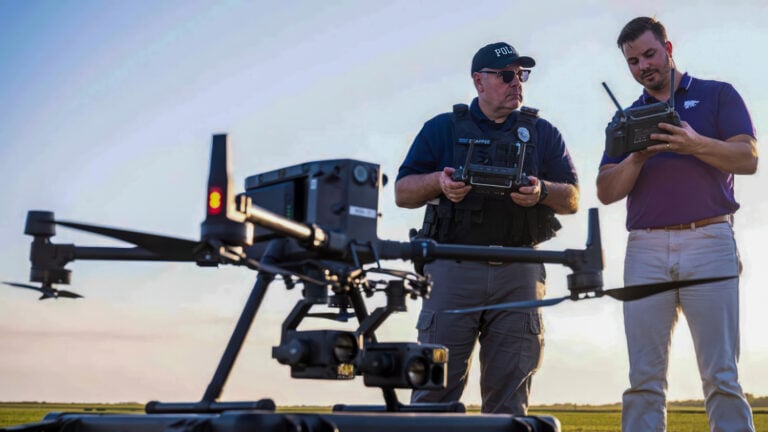
Photo courtesy of Dedrone
Discover more from DroneXL.co
Subscribe to get the latest posts sent to your email.
Check out our Classic Line of T-Shirts, Polos, Hoodies and more in our new store today!

MAKE YOUR VOICE HEARD
Proposed legislation threatens your ability to use drones for fun, work, and safety. The Drone Advocacy Alliance is fighting to ensure your voice is heard in these critical policy discussions.Join us and tell your elected officials to protect your right to fly.

Get your Part 107 Certificate
Pass the Part 107 test and take to the skies with the Pilot Institute. We have helped thousands of people become airplane and commercial drone pilots. Our courses are designed by industry experts to help you pass FAA tests and achieve your dreams.

Copyright © DroneXL.co 2026. All rights reserved. The content, images, and intellectual property on this website are protected by copyright law. Reproduction or distribution of any material without prior written permission from DroneXL.co is strictly prohibited. For permissions and inquiries, please contact us first. DroneXL.co is a proud partner of the Drone Advocacy Alliance. Be sure to check out DroneXL's sister site, EVXL.co, for all the latest news on electric vehicles.
FTC: DroneXL.co is an Amazon Associate and uses affiliate links that can generate income from qualifying purchases. We do not sell, share, rent out, or spam your email.