Skyrover Pledges to Stay in the US, But Its DJI Ties Raise Questions the Five-Year Plan Doesn’t Answer
Check out the Best Deals on Amazon for DJI Drones today!
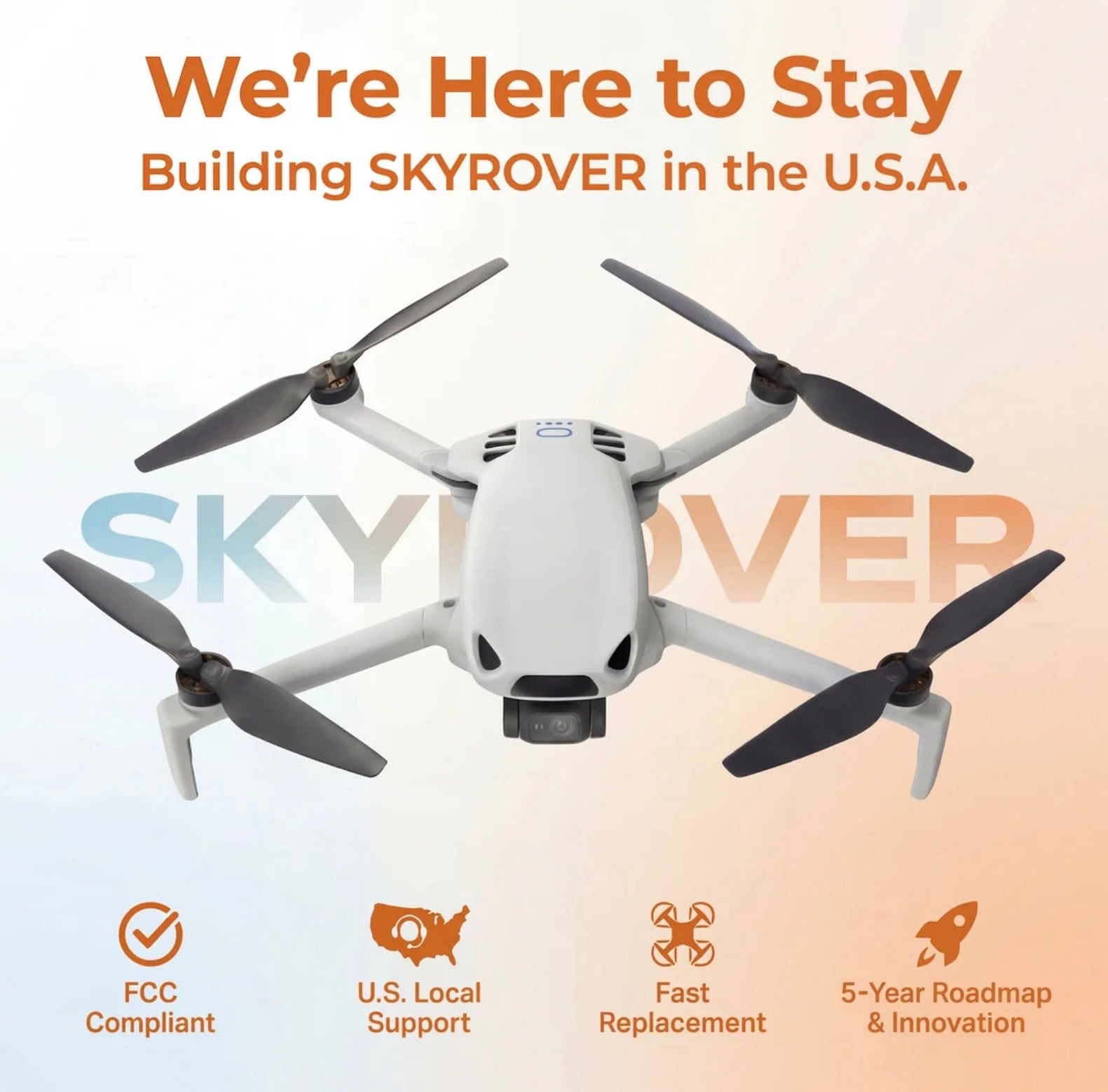
Skyrover posted a “We’re Here to Stay” announcement to its official Reddit community this week, formally titled “A Letter to Our U.S. Customers: Our Long-Term Commitment to the Drone Community.” The statement lays out a five-year roadmap covering FCC compliance, US-based customer support, and a promise to “explore US-based manufacturing and a localized supply chain.” It arrives roughly four months after the Federal Communications Commission banned all foreign-made drones from receiving new equipment authorizations, a decision that left every Chinese drone manufacturer with no path to launching new products in the United States. Skyrover says the right things. The problem is that security researchers documented more than a year ago that its hardware runs DJI’s proprietary technology, and nothing in this announcement addresses that.
The Five-Year Roadmap: Promises vs. Commitments
The announcement breaks into four pillars: FCC compliance, US local support, fast replacement, and a five-year innovation roadmap. Of those, only the first two carry near-term weight. FCC compliance is the legal floor for selling drones in the US, not a differentiator. The replacement-based support model, where Skyrover swaps out defective units rather than routing them through a repair chain, is a practical choice for a brand without a US service depot. These aren’t promises about the product line’s future. They’re promises about what happens when your drone stops working.
The five-year manufacturing target is a different animal. DroneXL covered Skyrover’s Best Buy launch in March 2026, noting the brand had graduated from Amazon-only to the most important physical drone retail channel in the country. That took real supply chain stability. Actually moving manufacturing to the US requires something else entirely. Consumer drone production depends on tightly integrated component supply chains: precision motors, gimbal actuators, custom chipsets that don’t exist at scale in the United States. The FCC’s December 2025 ban swept up motors and batteries produced overseas precisely because the global supply chain is that deeply embedded. “Explore” is the right word for where Skyrover actually stands.
The DJI Connection That Skyrover Hasn’t Addressed
Skyrover’s US commitment lands differently once you understand what security researchers have documented about its hardware. In July 2025, researcher Kevin Finisterre analyzed the Skyrover app and found code referencing DJI’s FlySafe infrastructure, including URLs pointing to DJI cloud services and connections to DJIGlobal, DJISupport, and DJIEnterprise endpoints. Researcher Konrad Iturbe traced the Skyrover X1 to its FCC-registered manufacturer, SZ Knowact Robot Technology Co., Ltd, and identified it as part of a broader network of DJI-linked brands. As DroneXL reported at the time, the Knowact “Caelone 01” drone was sold and branded as the Skyrover X1 to separate brand from manufacturer, with the OEM name rotatable if one entity faced regulatory action.
Iturbe’s October 25, 2025 research paper “To Catch A Vibe” turned that initial finding into a systematic detection methodology. He built an automated GitHub-based system that scans FCC databases daily for DJI’s proprietary OcuSync frequency signatures: 2.4-2.483GHz, 5.15-5.25GHz, and 5.725-5.85GHz. DroneXL covered that research in full when it published. The technical identifiers go beyond frequency bands. Iturbe documented DJI’s proprietary P1 Pigeon chipsets, an OFDM structure with 601 sub-carriers, and DroneID packets broadcast every 640 milliseconds. These are hardware-level details that cannot be changed by rebranding or swapping a company name on an FCC filing. Each drone effectively announces its true manufacturer regardless of what name is on the box. The system identified at least a dozen companies filing FCC applications for drones with identical OcuSync signatures: Cogito Tech, Skyrover, Skyany, Fikaxo, Jovistar, WaveGo Tech, Knowact Robot, Skyhigh Tech, and others. One WaveGo Tech FCC filing included documentation from SZ Knowact, the physical paper trail connecting supposedly independent companies through official federal records.

The congressional attention that followed has been direct. The House Select Committee on the Chinese Communist Party sent letters to the Department of Commerce regarding Cogito Tech and Anzu Robotics. Senator Rick Scott’s office issued a formal letter citing the shell company strategy’s national security implications. Representative Elise Stefanik repeatedly referenced the expanding network in arguing for stricter enforcement. Iturbe’s frequency-based detection gave lawmakers something courts and regulators could act on: technical evidence grounded in immutable hardware specifications in federal records, not corporate disclosures. As DroneXL wrote in January 2026, the shell game didn’t just fail: it accelerated the regulatory pressure that produced the December ban.
Neither DJI nor Skyrover has confirmed any formal corporate relationship. DJI has neither confirmed nor denied involvement, a pattern that has repeated across every entity in the network. That silence is its own signal. An independent company genuinely unconnected to DJI would have an obvious interest in saying so clearly. Skyrover’s “We’re Here to Stay” letter says nothing about who makes its hardware, who controls its software backend, or what happens to the DJI FlySafe endpoints in its app code if DJI’s US position tightens further.

The FCC’s Framework Creates a Problem Skyrover’s Roadmap Doesn’t Solve
The FCC’s December 22, 2025 decision blocked new equipment authorizations for all foreign-made drones and critical components, not only Chinese ones. Existing products authorized before that date, including the Skyrover X1 and S1, remain legal to sell and operate. The wall hits new products. Skyrover’s five-year roadmap implicitly requires launching new models to stay relevant. Without FCC authorization for future hardware, US manufacturing stops being an aspiration and becomes a hard regulatory prerequisite. The four systems cleared through the FCC’s conditional approval process so far, SiFly Aviation Q12, Mobilicom SkyHopper Series, ScoutDI Scout 137, and Verge X1, are all from non-Chinese manufacturers. No Chinese brand has navigated that pathway. Skyrover’s registered manufacturer, SZ Knowact, is a Chinese-incorporated entity; DroneLife has described Skyrover itself as Hong Kong-registered. Either way, it sits outside the profile of every company that has cleared conditional approval to date.
One thread worth watching: DroneXL’s April 4 coverage of the DJI Lito leak noted that community members have pointed to strong form-factor similarities between the leaked DJI Lito S1 and the Skyrover S1. Nothing is confirmed. But if DJI’s Lito line shares hardware with Skyrover’s S1, the FCC’s conditional approval framework would treat them as a single product from a Chinese manufacturer, which closes the exemption pathway entirely before it opens.
DroneXL’s Take
I’ve been tracking Skyrover since Shawn at Air Photography reviewed the X1 last summer and the community immediately started asking the obvious questions. DroneXL has covered the Knowact connection, Iturbe’s OcuSync frequency fingerprinting, the DJI logos found in FCC filings, and the broader shell company network across more than a dozen articles over the past year. The “We’re Here to Stay” letter doesn’t change any of that documented technical evidence. What it does show is Skyrover making a public commitment to the US market at the exact moment that market has no real DJI shelf presence left. That timing is deliberate. The community response on Reddit ranged from genuine enthusiasm from satisfied X1 and S1 owners to pointed skepticism, with at least one commenter noting flatly that the drone is DJI hardware under a new label and asking what is actually different.
Here’s the part that stops me cold. In June 2019, DJI announced it would assemble drones at a repurposed warehouse in Cerritos, California, to comply with the US Trade Agreements Act and qualify for government procurement. DJI VP of North American operations Mario Rebello told reporters at the time: “We’ve planned to invest in America but right now the time is right.” That Cerritos facility assembled the Mavic 2 Enterprise Dual for government-edition customers, but the broader US manufacturing ambition never materialized. Regulatory pressure kept compounding, and by December 2025 DJI was on the FCC Covered List entirely. Now, six years on, Skyrover is announcing that it will “explore US-based manufacturing.” If Skyrover is operating as a DJI-affiliated entity, as Iturbe’s research and Finisterre’s app analysis document, then DJI’s technology may end up being assembled in the United States after all. Just without the DJI logo, without a press conference, and without any of the transparency that came with the 2019 Cerritos announcement. The company that tried to reach the US market the right way in 2019 might be reaching it through the back door in 2030.
That question matters more than the five-year roadmap. If Skyrover is a DJI-controlled entity operating under alternative branding, its FCC compliance, its local support team, and its replacement warranty all flow from a company the US government has classified as a national security concern. The FCC’s October 28, 2025 vote gave the agency retroactive authority to pull authorizations from devices containing components from Covered List companies, meaning the DJI OcuSync chipsets inside Skyrover hardware could theoretically be the basis for revocation, not just a regulatory inconvenience. Skyrover’s letter would be more credible if it disclosed its manufacturing relationships, named the entities in its supply chain, and explained what happens to its app infrastructure if DJI’s position tightens further. Until that transparency exists, the FCC’s conditional approval pathway is the real test. Watch for a formal exemption application before the end of 2026. If none comes, the five-year roadmap has a hard ceiling the company isn’t acknowledging publicly.
DroneXL uses automated tools to support research and source retrieval. All reporting and editorial perspectives are by Haye Kesteloo.
Discover more from DroneXL.co
Subscribe to get the latest posts sent to your email.
Check out our Classic Line of T-Shirts, Polos, Hoodies and more in our new store today!

MAKE YOUR VOICE HEARD
Proposed legislation threatens your ability to use drones for fun, work, and safety. The Drone Advocacy Alliance is fighting to ensure your voice is heard in these critical policy discussions.Join us and tell your elected officials to protect your right to fly.

Get your Part 107 Certificate
Pass the Part 107 test and take to the skies with the Pilot Institute. We have helped thousands of people become airplane and commercial drone pilots. Our courses are designed by industry experts to help you pass FAA tests and achieve your dreams.

Copyright © DroneXL.co 2026. All rights reserved. The content, images, and intellectual property on this website are protected by copyright law. Reproduction or distribution of any material without prior written permission from DroneXL.co is strictly prohibited. For permissions and inquiries, please contact us first. DroneXL.co is a proud partner of the Drone Advocacy Alliance. Be sure to check out DroneXL's sister site, EVXL.co, for all the latest news on electric vehicles.
FTC: DroneXL.co is an Amazon Associate and uses affiliate links that can generate income from qualifying purchases. We do not sell, share, rent out, or spam your email.