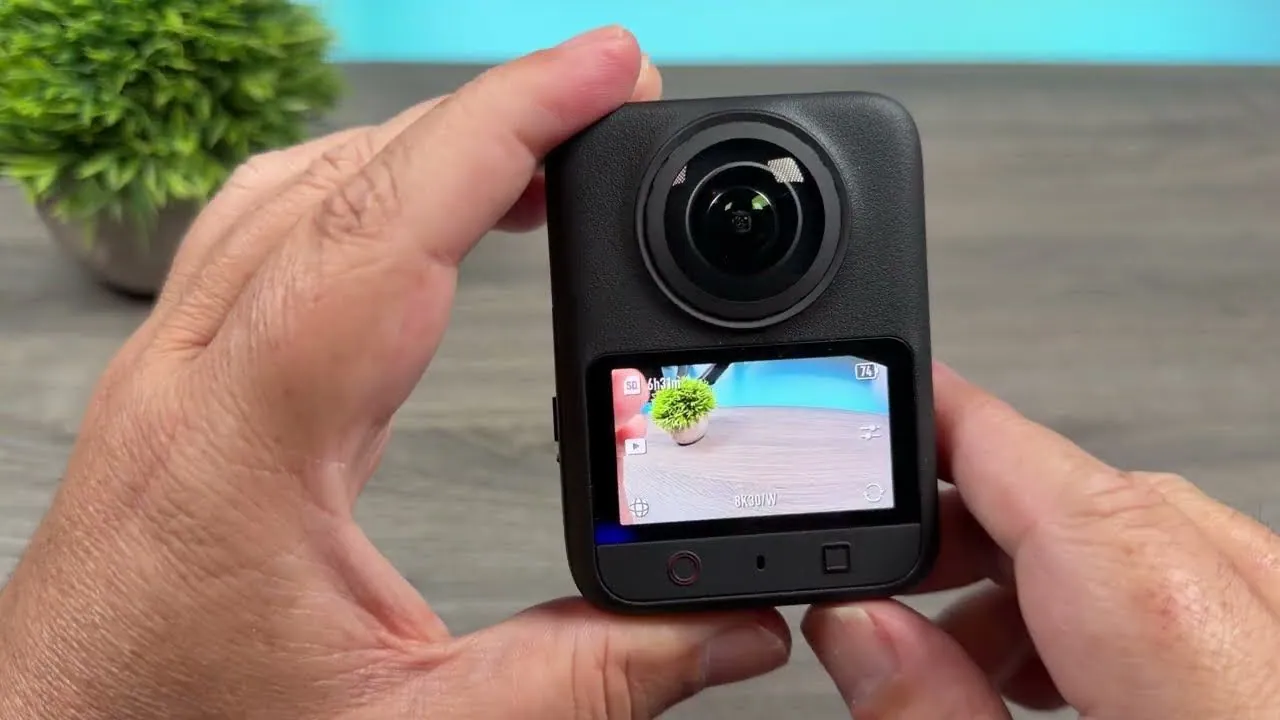
Insta360 launched the X6 on Wednesday, August 12, 2026 at 9 a.m. Eastern, pricing its new flagship 360 camera at $699.99 for the Standard Bundle. That is $150 more than the Insta360 X5 cost when DroneXL covered its launch on April 22, 2025, and $150 more than DJI charged for the Osmo 360 that arrived three months after it.
The hardware earns some of that. Custom dual Sony 1/1.1-inch square sensors record 8K at 50fps in 360 mode, a 2600mAh battery is rated at 140 minutes of 8K30fps capture, and Insta360 says the X6 is the first 360 camera with native in-camera Dolby Vision. It goes on sale today through Insta360’s store, Amazon and authorized retailers.
The date is the part worth reading twice. DJI unveils the Osmo 360 II tomorrow, August 13, at 12:00 UTC, which is 8 a.m. Eastern, roughly 23 hours behind Insta360. DJI set that date on August 7, after Insta360 confirmed its own. American buyers will be able to order exactly one of these two cameras.
Insta360 Matches A Sensor Format DJI Shipped In July 2025
The X6’s dual 1/1.1-inch square Sony sensors deliver what Insta360 calls full 1-inch equivalent 360 imaging, with 33 percent more sensor area than the X5 that launched in April 2025 and roughly four times the light intake per frame. DJI’s first Osmo 360 shipped that same square format on July 31, 2025 at $549.99.
Behind the glass sits a triple AI chip: one 8-core 3.3GHz 4nm processor paired with two imaging chips. Insta360’s launch announcement rates the combination at 500 percent more computing power than the X5 with 35 percent lower power draw.
AdaptiveTone 2.0 is the upgrade that should matter most in real shooting. It meters each lens independently and captures two exposures per frame. When Shawn from Air Photography ran the Osmo 360 against the X5 for DroneXL, the Insta360 camera blew out skies under tree canopy that DJI’s held onto. Per-lens metering aims straight at that weakness.
Dolby Vision is the one item on the list nobody else has. Dynamic metadata gets analyzed frame by frame and paired with 10-bit color, so the file leaves the camera already graded rather than waiting on a colorist. Founder JK Liu framed the product simply: “X6 is the camera we always wanted to build.”
Three Cameras In One Body Is The Actual Pitch
Insta360 built the X6 to work as a 360 camera, a subject-tracking gimbal camera and a single-lens action cam, switching between all three in one tap. InstaFrame 2.0 locks onto people, pets and objects and writes clean flat 4K with no reframing step afterward.
Single-lens mode records up to 5K60fps, widening to 170 degrees at 5K30fps, with slow motion at 4K120fps. The new Foldable Selfie Stick Remote Kit adds joystick control that turns tracking into gimbal-style shooting without a gimbal in the bag.
More than 100 accessories connect through the same magnetic mount system, which stays compatible with X5, X4 Air and Ace series hardware. That compatibility decides whether an upgrade costs $699.99 or $699.99 plus a drawer of replacement mounts.
Battery And Storage Numbers Decide Whether The Upgrade Pays
The 2600mAh Xtreme Battery runs 140 minutes of 8K30fps 360 video, 51 percent longer than the X5, and charges from empty to 80 percent in 24 minutes. It stays reliable down to -20°C (-4°F). The 2.32-inch OLED screen peaks at 1200 nits and stays always-on.
The storage line deserves a closer read than it will get. Insta360 lists 64GB of built-in memory, of which 47GB is usable. That is 17GB of overhead before a single frame is recorded, and at 8K50fps the remainder disappears quickly. Treat internal storage as a backup, not a plan.
Replaceable Lens 2.0 is five times more scratch resistant and 60 percent cheaper to replace than the previous generation, which is the number that matters on any shoot where the camera rides a helmet or a handlebar. The body is waterproof to 20m (66 ft) bare under IP68, and to 60m (197 ft) inside the Invisible Dive Case Pro.
PanoMind Runs The Edit On The Camera Instead Of In The Cloud
Insta360 built PanoMind in house, training it on more than 10,000 hours of footage across 30-plus shooting scenarios, and calls it the first 360-native AI model that reads a full spherical scene rather than a flat frame. Its AI Director assembles highlight edits while the camera charges.
Where that processing happens is the detail worth noting. Insta360 states the analysis runs on the camera rather than in the cloud, and that the feature can be switched off at any time. Moments Pro works the opposite way, generating video with Google Gemini from files uploaded to Insta360+ Cloud, which offers up to 2TB with opt-in backup.
Anyone who has read an FCC Covered List filing should notice that split. On-device inference with an opt-out is the architecture regulators say they want. Cloud upload to a Shenzhen company’s servers with a generative layer on top is the architecture they say they fear. Insta360 shipped both inside one product today and drew no scrutiny whatsoever.
DJI Answers Tomorrow, And Probably Not In America
DJI unveils the Osmo 360 II on August 13 at 12:00 UTC. Its Hong Kong and Canada storefronts carry the teaser under the tagline All Angles. All Epic. The US storefront carries no Osmo 360 II page at all, and the reason is regulatory rather than commercial.
The Federal Communications Commission added all foreign-made drones and drone components to its Covered List on December 22, 2025, blocking new equipment authorizations. DJI’s April 15 brief in the Ninth Circuit counted five drone models and nine non-drone products already blocked, with 25 more 2026 launches in limbo and roughly $1.56 billion in lost US revenue this calendar year.
That pattern now runs the length of DJI’s non-flying catalog. The Osmo Pocket 4 skipped the US in April. The O4 Wide Air Unit skipped it in June. The Mic Mini 2S launched worldwide on August 4 with no US page and no US price. A 360 camera that has no rotors and never leaves the operator’s hand is the next name on that list.
Antigravity Inherits Whatever The X6 Proves
Antigravity is an Insta360 brand, and the Antigravity A1 runs the same shoot-first, frame-later workflow the X series spent a decade building. The imaging stack introduced today is the parts bin any second-generation 360 drone would draw from.
When Marques Brownlee reviewed the A1 in June, he flagged a faint stitch line on the horizon of the footage. Stitch quality comes down to sensor overlap, optics and processing, which is precisely the list Insta360 rebuilt for the X6. The company has announced nothing about an A1 successor. It has now shipped the components one would require.
The A1 Standard Bundle launched at $1,599 in December 2025 and has settled at $1,279, a floor Insta360 has held for months against a DJI Avata 360 that opened US orders at $719.
DroneXL’s Take
The most revealing number in today’s launch is not on the spec sheet. It is the date on DJI’s invitation.
Two Shenzhen companies are launching competing 8K 360 cameras 23 hours apart. Same city, same class of product, same class of data flows. One will be on American shelves tomorrow. The other, on every signal available today, will not be, and no agency has published a single technical finding explaining why the line falls where it does.
I am not arguing that Insta360 belongs on the Covered List. That is the wrong fix and it would leave American creators holding nothing. I am arguing that the list is doing competitive work here while the security case does none of it. If Chinese-made consumer cameras with cloud services and onboard AI are a national security problem, then the X6 is that problem and somebody at the Commission should say so on the record, in a filing, with evidence. If they are not a problem, then DJI’s exclusion is protectionism wearing a security badge. Washington has had nearly eight months to pick one and has picked neither.
American buyers cover the difference in cash. The X5 launched at $549.99 in April 2025. DJI’s Osmo 360 matched that price three months later and has been discounted repeatedly since. That is what two competitors inside one market look like. The X6 launches at $699.99 with its closest rival unable to reach a US retail shelf. Call it a generational price increase or call it the ban’s tax. The receipt reads the same either way.
Worth owning: I got a call wrong in March. I predicted Insta360 would cut the Antigravity A1 below $999 before the end of Q2 2026 once DJI’s Avata 360 landed. It never happened. The A1 Standard Bundle bottomed at $1,279 during Prime Day and has stayed there. Insta360 does not discount under pressure, and today’s $699.99 tells you the company has a clear read on how little pressure it is actually facing.
DJI publishes the Osmo 360 II spec sheet tomorrow at 8 a.m. Eastern. Read the US storefront before you read the sensor size. A US product page and a US price would mean something changed at the FCC that nobody has announced. Their absence means $699.99 is what a flagship 360 camera costs in a market with one fewer company in it, and every American who buys one today is paying that difference without ever seeing it itemized.
Sources: PR Newswire, Insta360, DJI Osmo 360 announcement, Imaging Resource, RedShark News, US Court of Appeals for the Ninth Circuit Case 26-1029.
DroneXL uses automated tools to support research and source retrieval. All reporting and editorial perspectives are by Haye Kesteloo.