

Zipline sent DroneXL written answers to its drone delivery safety questions at 2 p.m. Eastern on September 16, one day after the deadline and eight days after the questions went out. Amazon Prime Air and Wing received the same questions on the same terms. Neither has sent a word.
The answers, attributed to Zipline at the company’s request, cover the P2’s weight and payload, its two parachutes, what happens when the delivery tether fails, and how its cameras work. They leave the incident count, the decibel figures, the weather limits and the liability question for a safety document Zipline says it will release separately. DroneXL published every line, unedited, on Zipline’s tracker page, next to the questions it does and does not answer.
That makes Zipline the only one of the three US delivery operators with anything on the record, on a set of questions written so that all three could answer them.
Three Operators Got the Same Questions on the Same Deadline
DroneXL sent each operator 15 generic questions on September 8, among them weight and payload, recovery system, collision behavior, single points of failure, delivery method, drop-zone checks, incident record, sound, cameras, liability and weather limits. Wing and Zipline also got 15 questions specific to their aircraft, all due September 15.
Amazon had already been through one round. Eight written questions sent on September 3, after the company declined to put an engineer on the record at Commercial UAV Expo in Las Vegas, went unanswered at their September 5 deadline. Amazon’s communications team replied twice on September 4, about whether the emails had arrived. On September 10, DroneXL sent Amazon two more questions, on MK30 fleet flight hours and the aircraft’s battery, with the same September 15 date, together with an offer to correct DroneXL’s September 8 article on the FAA’s national environmental finding if Amazon could point to an error. Amazon’s total stands at 25 questions across three rounds and no answers.
Wing’s total is 30 questions and no answers. Zipline got on the phone on September 11 and followed up in writing five days later.
Zipline Put Weight, Parachutes and Cameras on the Record
Zipline’s P2 weighs 55 pounds (25 kilograms) empty and 63 pounds (29 kilograms) with its full 8-pound (3.6-kilogram) payload, cruises at 70 mph (113 km/h), and lowers packages on a tether from roughly 300 feet (91 meters). The aircraft carries a parachute, and so does the delivery pod.
The most useful answers describe failure. If a customer pulls on the tether or tangles it, the pod and aircraft separate on their own, the customer keeps the pod and its line, and Zipline’s local team is notified. The pod can deploy its own parachute if something goes wrong while it is unstowed and too high to land safely. If the aircraft decides it has to leave the airspace, it deploys its parachute, stops its propellers and sounds an audible alert. Zipline says its aircraft run more than 500 safety checks a second and have no single points of failure among flight-critical systems.
On cameras, Zipline gave the clearest statement any of the three operators has made. “All cameras are in a fixed position and cannot pan, tilt, or zoom.” There is no live video feed and no joystick piloting on any flight, and retained footage is restricted to trained staff with a defined business purpose, such as investigating an unusual flight. Zipline also says it does not collect patient data on its medical deliveries, only weight, volume and handling requirements.
On the tracker’s reading, five of the 30 questions are answered in full, ten in part, and 15 are not yet addressed. Each question carries its mark on Zipline’s tracker page, with the full statement beneath so readers can check the reading.
Zipline Left the Numbers DroneXL Asked For to a Later Document
The questions Zipline did not answer are the ones with figures in them: how often the P2 has come down in US service, its sound level in decibels, the weather limits that stop flights, and who pays when one lands on a road. A safety document is coming, Zipline says.
On the incident count, Zipline answered with its worldwide record instead: more than 140 million autonomous miles since 2016 without injury, a figure from the company that DroneXL has no way to test. Miles without injury is a different quantity from the number of parachute deployments, and it does not explain the Greenville, Texas landing on July 26 or the Highway 6 landing in Cypress on September 4, both of which DroneXL asked about by name.
Sound came back as a description. Zipline says its 300-foot delivery altitude keeps the aircraft quieter than a lower hover would, that its custom propellers produce a softer, steadier sound, and that the dynamic flight trajectories update DroneXL reported on September 11 cuts noise in cruise. DroneXL asked for decibel levels at 50, 100 and 250 feet. None came.
Weather limits, the liability chain after a parachute landing, and the FAA paperwork behind the Beachwood, Ohio and Houston-area operations were also not addressed. Zipline told DroneXL that some of what was asked is proprietary. Those 15 questions stay marked pending on the tracker until the document arrives.
Amazon and Wing Have Sent Nothing on 55 Questions Between Them
Amazon’s MK30 is the heaviest of the three aircraft at 83 pounds (38 kilograms), drops its package from about 13 feet (4 meters), and carries no parachute. It has seven US incidents in DroneXL’s record, more than the other two combined. Amazon has let three deadlines pass on 25 questions.
The latest of those seven was a precautionary landing on Florida Boulevard in Baton Rouge on September 10. Amazon has said nothing to DroneXL about any of them.
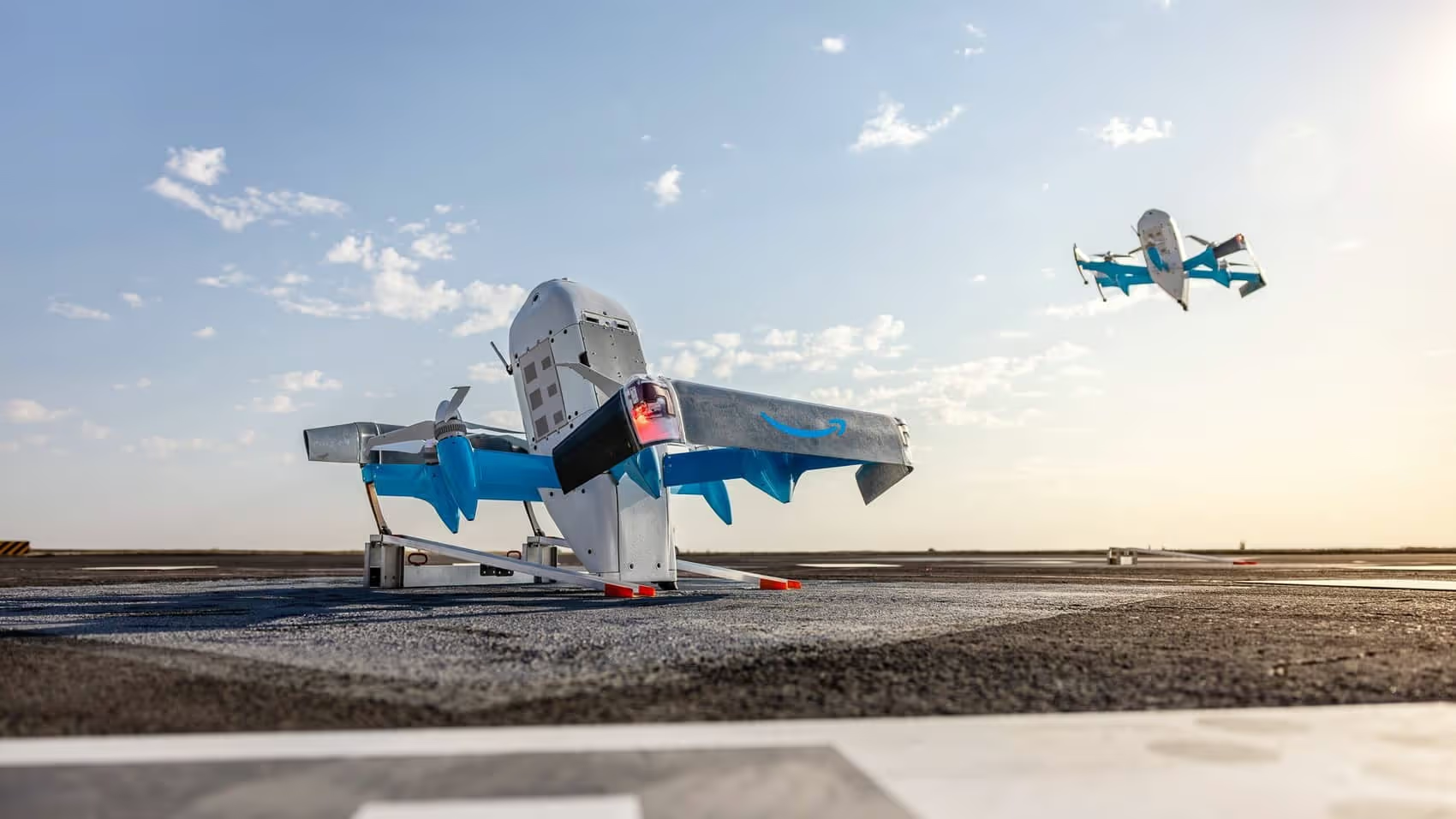
Wing has no US incident in DroneXL’s record and did not use the questions to say so. Wing’s public statements in the same two weeks were about scale: more than one million deliveries worldwide, the largest residential drone network in the US, thousands of deliveries a day. A company with that record and a light airframe had an easy set of questions in front of it. It sent nothing.

Both companies’ tracker pages now read the same way: sent, deadline, no answer.
The tracker is a living document. Its pages update the day a story publishes: a new hub or market moves onto the map when DroneXL reports it, an incident lands in the table with its story attached, and the day Amazon or Wing sends answers, those answers go up in full, unedited, marked question by question, exactly as Zipline’s did. The questions stay open, and so does the offer.
DroneXL’s Take
Zipline answered, and that is the news. Not everything, not by the deadline, and with no spokesperson named. But a US drone delivery operator took hard questions from a publication that covered both its parachute landings this summer, and wrote back with specifics about how its aircraft fails.
Those specifics are the ones a town council meeting is supposed to produce, and Zipline produced them in an email. A pod that detaches if a kid yanks the line is a better answer than I got in half an hour off the record at Amazon’s booth in Las Vegas this month.
The questions Zipline skipped are the ones I most want answered. A worldwide mileage figure does not tell Greenville what happened over its yards, and “softer, steadier” is not a decibel reading. If the safety document Zipline has promised carries the incident count and the noise numbers, it will have put more on the public record than any of the three operators has managed so far. If it doesn’t, the pending marks stay pending, and I’ll say so.
Amazon and Wing had the same list. Amazon has let three deadlines pass on 25 questions. Wing has no US incident in DroneXL’s file and would not put a single sentence about that record on paper. My read is that both companies have decided the questions go away if they wait. They don’t. They sit on the tracker, dated, next to Zipline’s answers, where every town on Amazon’s list of 500 cities can compare the three columns.
The questions go out again to every operator each January. Zipline has set the bar for what a reply looks like, and it is not a high one: a company saying, in its own words, what its drone does when something breaks.
Sources: Zipline written statement to DroneXL, Sept. 16, 2026; DroneXL Drone Delivery Tracker.
DroneXL uses automated tools to support research and source retrieval. All reporting and editorial perspectives are by Haye Kesteloo. Read our editorial standards.


