Zipline’s delivery drones now fly a different shape through the sky, and the change arrived as a software download. Co-founder Ryan Oksenhorn posted on September 5 that an over-the-air update Zipline calls “Dynamic Flight Trajectories” cut the median mission by 48 seconds, left an average of 40.6 watt-hours more in the battery on landing, and brought the hottest hover motor home 8.9°C (16°F) cooler. Zipline’s noise model also shows each flight spending 19 seconds less, and 530 meters (1,740 feet) less, at peak noise.
No new hardware of any kind. The aircraft climb while moving toward the customer, dip to pick up speed, deliver from altitude, and climb again to slow down before they hover. Gravity now does work that the motors used to do.
I have written about Zipline’s fight with noise since the Platform 2 reveal in March 2023, when the company’s answer was hardware: a long tether that keeps the aircraft 300 feet (91 meters) up while a small droid comes down to the porch. This update attacks the same problem from the flight-control side, and the physics of why it works are worth a plain-language walk-through.
Zipline’s Update Changes the Shape of Every Flight
Zipline’s old flight profile was a flat-topped box: climb straight up in hover, cruise level on the wing, then stop and come straight down. The new profile is a wave. The drone climbs while already heading out, dips to accelerate, cruises, then climbs again on approach to shed speed.
The diagram in Oksenhorn’s first post labels the four moves as climb while moving, descend to accelerate, deliver from up high, and arrive smoothly. He put it in one sentence: “We let gravity do more of the hard work.”

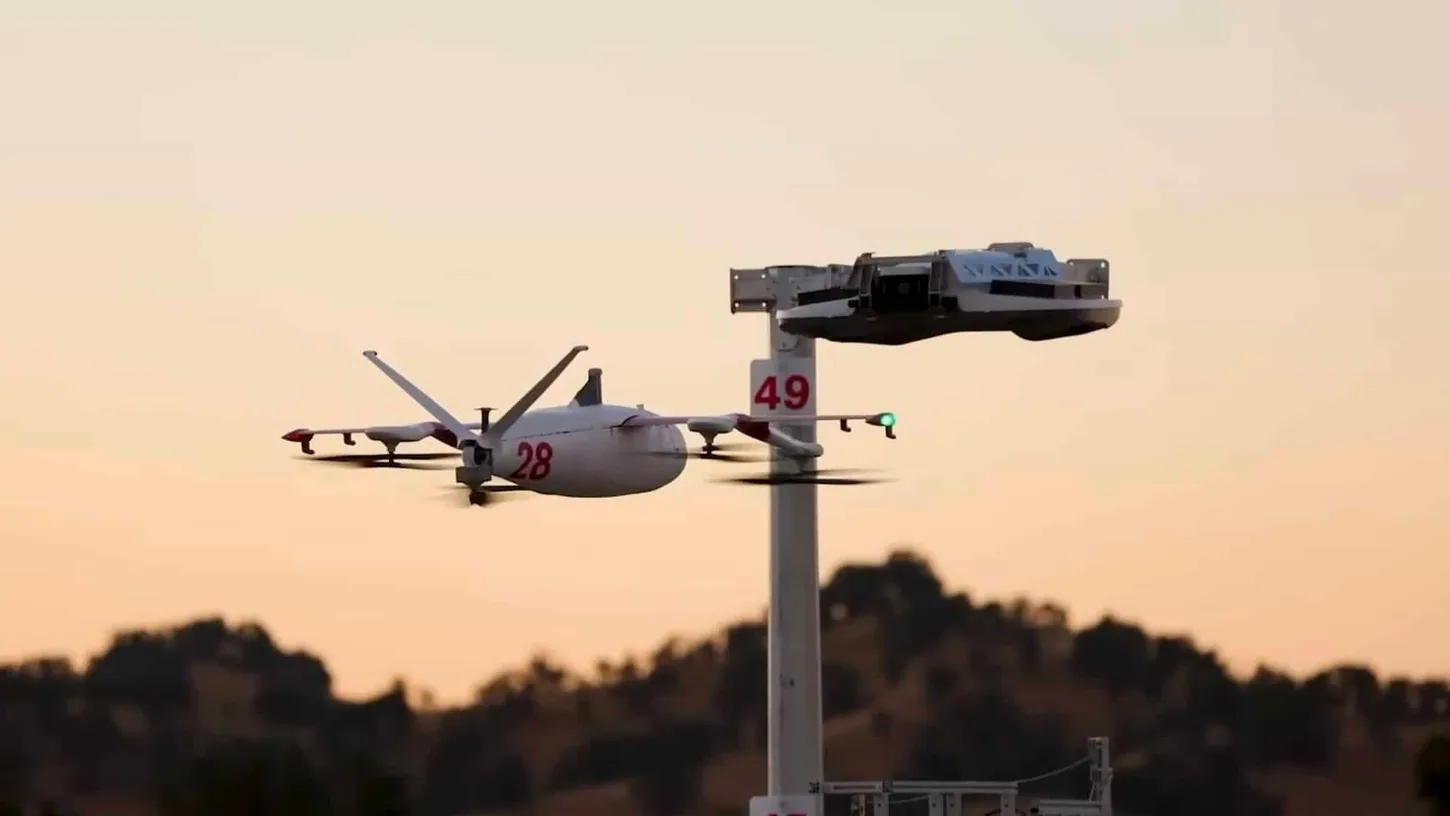
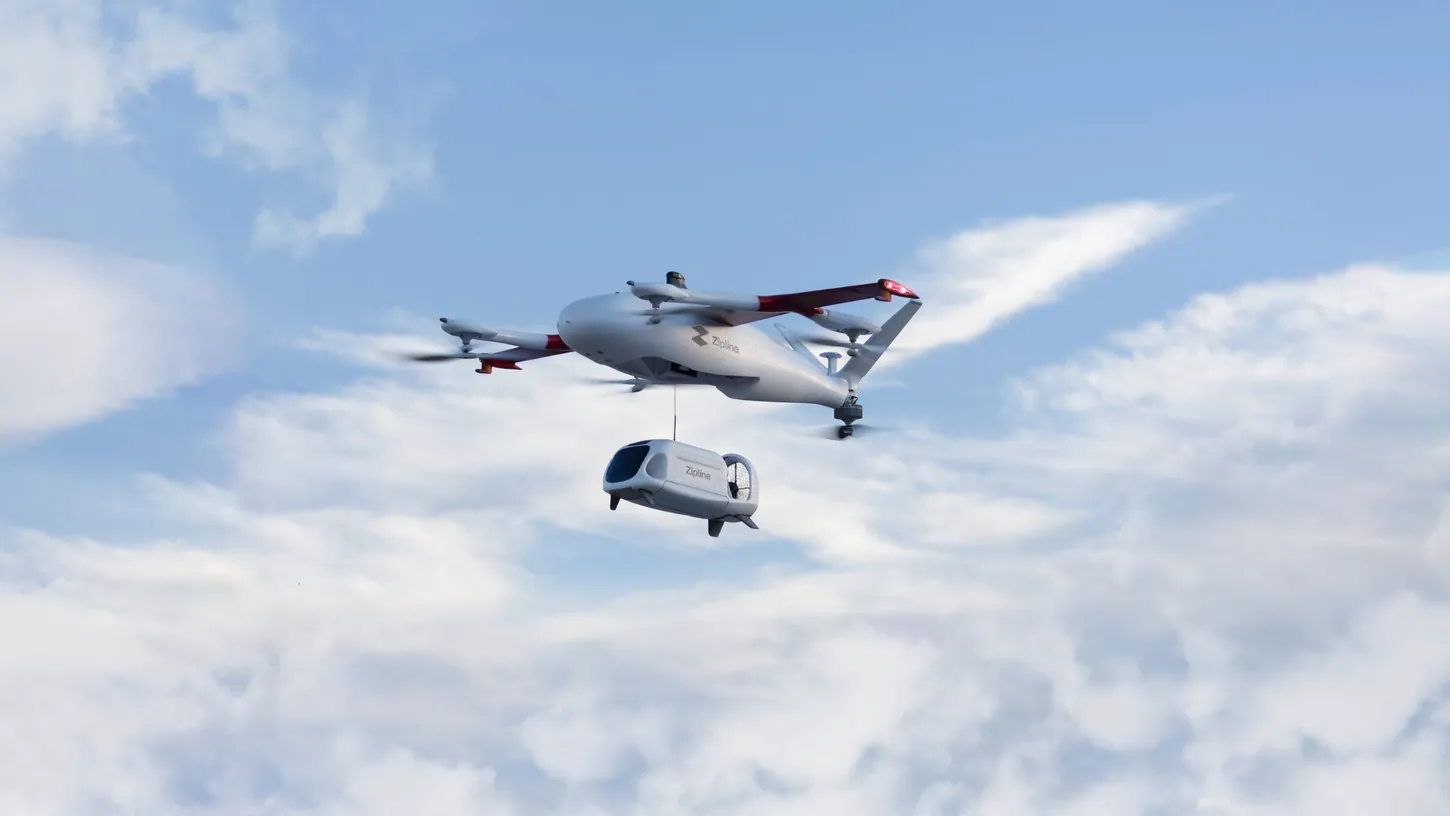
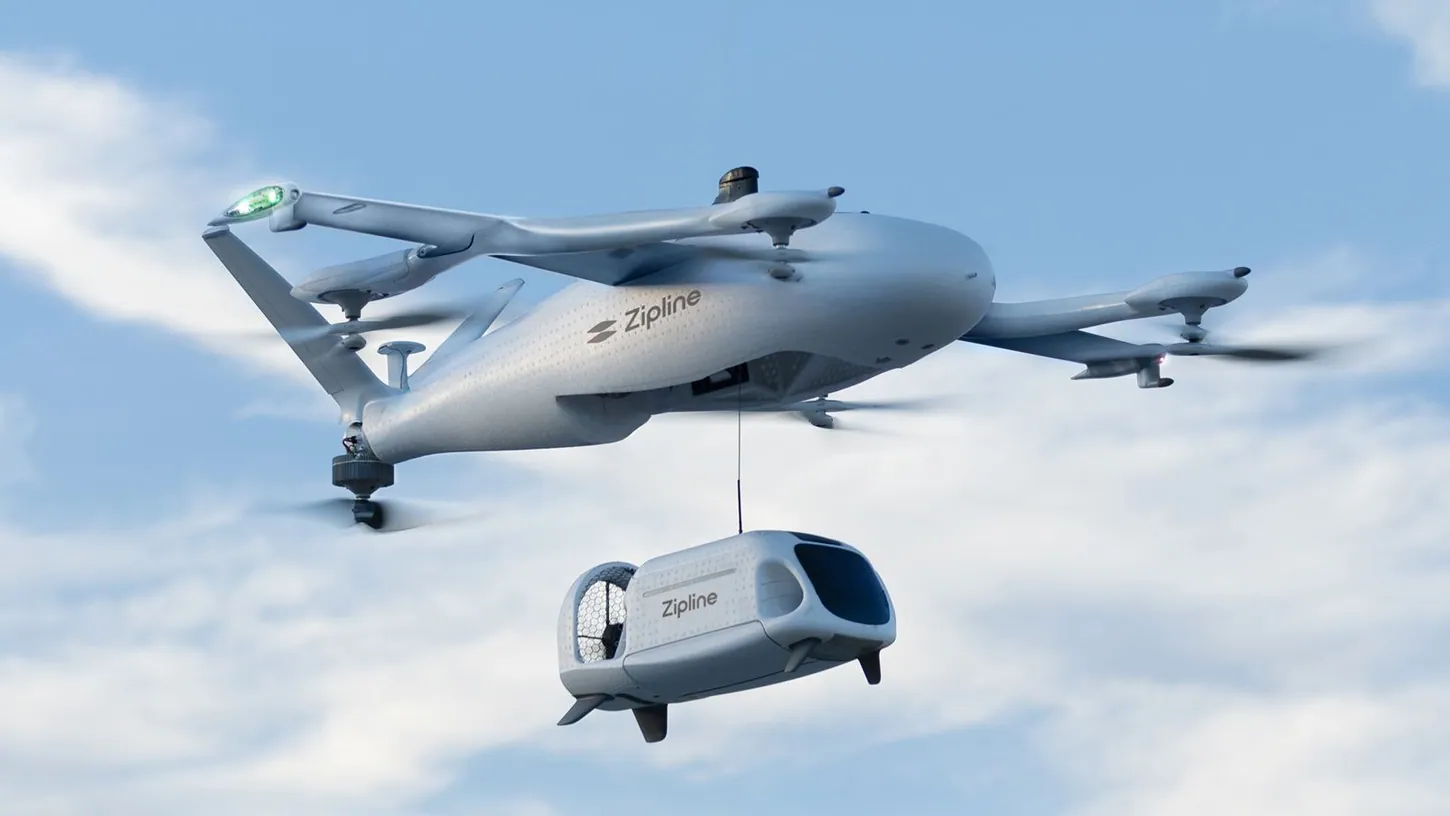
The Platform 2 aircraft, the one Zipline flies in Texas and other US markets, is a hybrid. Lift propellers get it off the pad and hold it in a hover, then it tilts onto a fixed wing and flies like a small airplane. For the delivery itself the aircraft stays high and lowers its droid on a tether, a design I covered in detail when Zipline unveiled Platform 2.
The numbers Oksenhorn posted are Zipline’s own fleet data, and the noise figures come from the company’s noise-at-ground model rather than from microphones under the flight path. Median time to pickup fell 8.2 seconds, time to delivery 24 seconds and the full mission 48 seconds. The mixed-use motors landed 4.9°C cooler and the battery pack 2.4°C cooler.
Gravity Works as a Free Battery
A delivery drone stores energy as battery charge, as height above the ground, and as speed through the air. Motors move energy from the battery into the other two and waste some as heat every time, while gravity trades height for speed, and speed for height, at almost no cost.
Think of a cyclist at the top of a hill. Coasting down converts height into speed without touching the pedals. Pointing the bike back uphill converts that speed into height without touching the brakes. A rider who does both spends less energy than one who sprints on the flat and then grabs the brakes.
Zipline’s drones used to sprint on the flat. They climbed to cruise altitude in hover, then had to buy every bit of forward speed with propeller thrust while sitting in the least efficient part of the flight. On arrival they had to throw that speed away, again with thrust and drag, before they could hover.
The new profile climbs a little higher first, then tips downhill. Stored height becomes airspeed while the wing takes over the lifting. On the way in, the drone climbs instead of braking. The speed it no longer needs turns back into height, and the aircraft arrives at its hover point with far less momentum to kill.
The Transition Phase Is Where Hybrid Drones Get Loud and Hungry
A hybrid VTOL aircraft has two comfortable states. In a pure hover the lift propellers do all the work, and they are built for it. In wing-borne cruise the wing carries the weight and the propellers only fight drag. The transition between them is where the noise and energy go.
During transition the aircraft is moving too slowly for the wing to carry the full load and too quickly for the hover rotors to be happy. The lift propellers are still holding up much of the weight while the aircraft also tries to accelerate, so they spin hard at high blade loading.
Rotor physics punish that state twice. The power a hovering rotor needs rises faster than the thrust it makes, roughly with thrust to the power of one and a half, so a modest increase in load means a much larger jump in watts drawn and heat dumped into the motor. Propeller noise rises even more steeply with tip speed. Spin the blades a bit faster and the decibels climb a lot.
Cruise on the wing is the opposite case. Lift comes from a large, lightly loaded surface, the propellers only need to cancel a modest amount of drag, and they can turn slowly. Slow-turning propellers are quiet and cheap to run. That is why quieter and more efficient are not a trade-off here: the loudest flight mode and the most wasteful flight mode were the same mode, and the update spends less time in it.
Zipline’s model says the average mission now spends 19 fewer seconds and 530 fewer meters at peak noise. The same change shows up on the thermometer: 8.9°C off the hottest hover motor, which is heat that was being paid for out of the battery. Cooler motors also have slightly lower electrical resistance, so a little of the saving compounds on itself.
Altitude Cuts Noise on the Ground Before the Motors Change
What a person on the ground hears depends on three things: how loud the source is, how far away it is, and how long it lasts. Sound intensity falls with the square of distance, so an aircraft twice as far away delivers a quarter of the acoustic energy.
The new profile pushes the loud transition phase up and shortens it. The climb-while-moving segment means the aircraft is already gaining distance from the takeoff point and the ground while it works through its noisiest seconds, and the descend-to-accelerate segment ends the transition sooner. Even if the aircraft’s peak sound level at the source were unchanged, the dose reaching a backyard would drop.
Neighbors decide whether a delivery company gets to expand. Amazon’s Prime Air learned this the hard way in College Station, Texas, where residents near the depot complained about the buzz. Zipline’s hovering-mothership design already put the loud part 300 feet up. This update keeps it up there for a shorter stretch.
Live Replanning Beats a Fixed Route
The old path was a fixed shape flown the same way every time. The new one is computed on board during the flight. Each aircraft estimates wind, airspeed, lift and drag as it flies and keeps adjusting speed and altitude so the flight stays short and cheap without getting louder.
Wind is the main reason a canned path leaves value on the table. A tailwind at altitude is free ground speed and a headwind is a tax, and wind speed usually changes with height. The best cruise altitude on a given afternoon is wherever the cost of climbing there is paid back, and that answer differs from one flight to the next. Oksenhorn compared the whole approach to hypermiling a car.
Air density does the same thing to the propellers. Hot, thin air makes hover and transition more expensive, so on a Texas summer afternoon an optimizer that knows the temperature will cut the transition even shorter than it would on a cool morning.
A visualization later in the thread showed the difference at a site labeled Princeton, Zipline’s Walmart hub in Collin County, Texas, which went live in December 2025. On September 1, an aircraft on firmware zip-2026.22.2 traced a hard-cornered T in the visualization: straight up, straight across, straight down. On September 2, an aircraft on zip-2026.28 drew a smooth arc out to the customer and back. Same site and same job, on different software.

He also said this was one of a few hundred changes Zipline shipped this month, and that the network is currently overwhelmed with demand. The 40 watt-hours left in the battery buy more deliveries per charge and less time on the charger, which is throughput, and throughput is the number Zipline has been chasing since it set a target of 1 million deliveries a day with Uber.
DroneXL’s Take
Every drone delivery company talks about noise. Zipline keeps shipping things that reduce it, and this one cost the company zero grams of hardware. A flight-control change that makes an existing fleet faster, quieter and cooler at once is the engineering that separates operators from demo programs.
I want to be precise about what is and is not known here. The timing and telemetry numbers come from Zipline’s fleet data, and I have no reason to doubt them, but they are Zipline’s numbers and nobody outside the company has checked them. The noise numbers are different in kind: they are the output of a model, and Zipline has not published ground-measured decibels for the new profile. Until it does, “quieter” means “the model says quieter.” Zipline should put microphones under a flight path in Princeton and publish the before-and-after. It would cost a weekend and end the argument.
Forty-eight seconds off a flight sounds small. It is not, at scale. A drone that lands with 40 more watt-hours and cooler motors turns around faster and flies more missions before it needs a charger, and Zipline’s business case, which I walked through in the economics of drone delivery, rests on volume: how many deliveries a site can push through in a day with the aircraft it already has. Software that raises that number is worth more to Zipline than a new aircraft, because it applies to every aircraft already in the fleet the moment it downloads.
The contrast with Amazon is hard to miss. Prime Air’s aircraft has to descend to yard level to drop a package, and the College Station complaints were about an aircraft doing exactly that. Zipline chose a two-part system in 2023 and has been layering software gains on top of it since. When a Zip came down under its parachute near Houston last week, the story was how gracefully the failure mode worked. This week the story is how much performance the company squeezed out of aircraft it had already built.
Public acceptance of drone delivery will be won or lost in backyards, by people who never asked for a drone overhead. The company that makes its aircraft boring to live under wins, and boring is a physics problem before it is a marketing problem. Zipline just solved a chunk of it with gravity.
Source: Ryan Oksenhorn on X, City of Princeton, Texas
DroneXL uses automated tools to support research and source retrieval. All reporting and editorial perspectives are by Haye Kesteloo. Read our editorial standards.