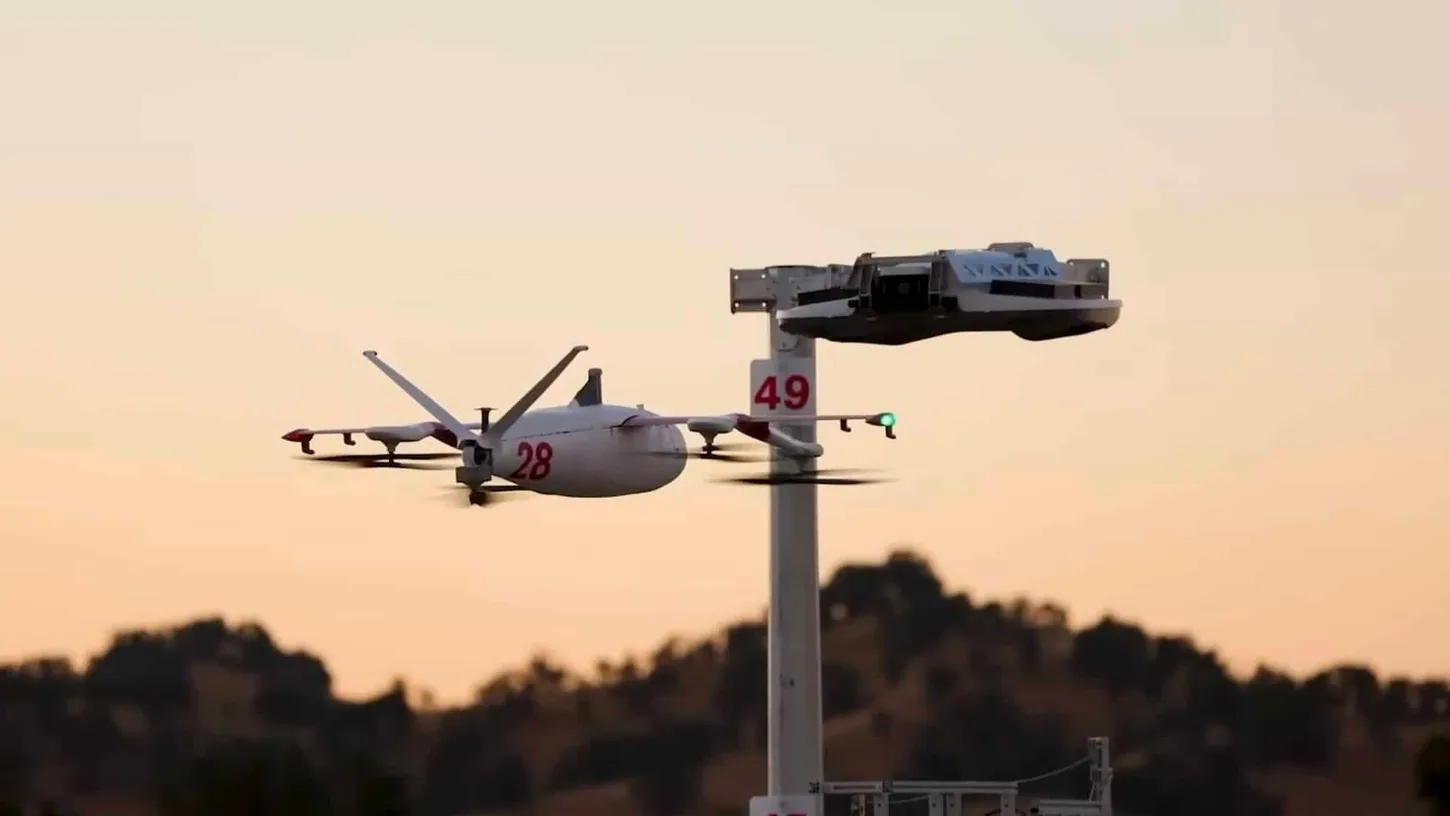
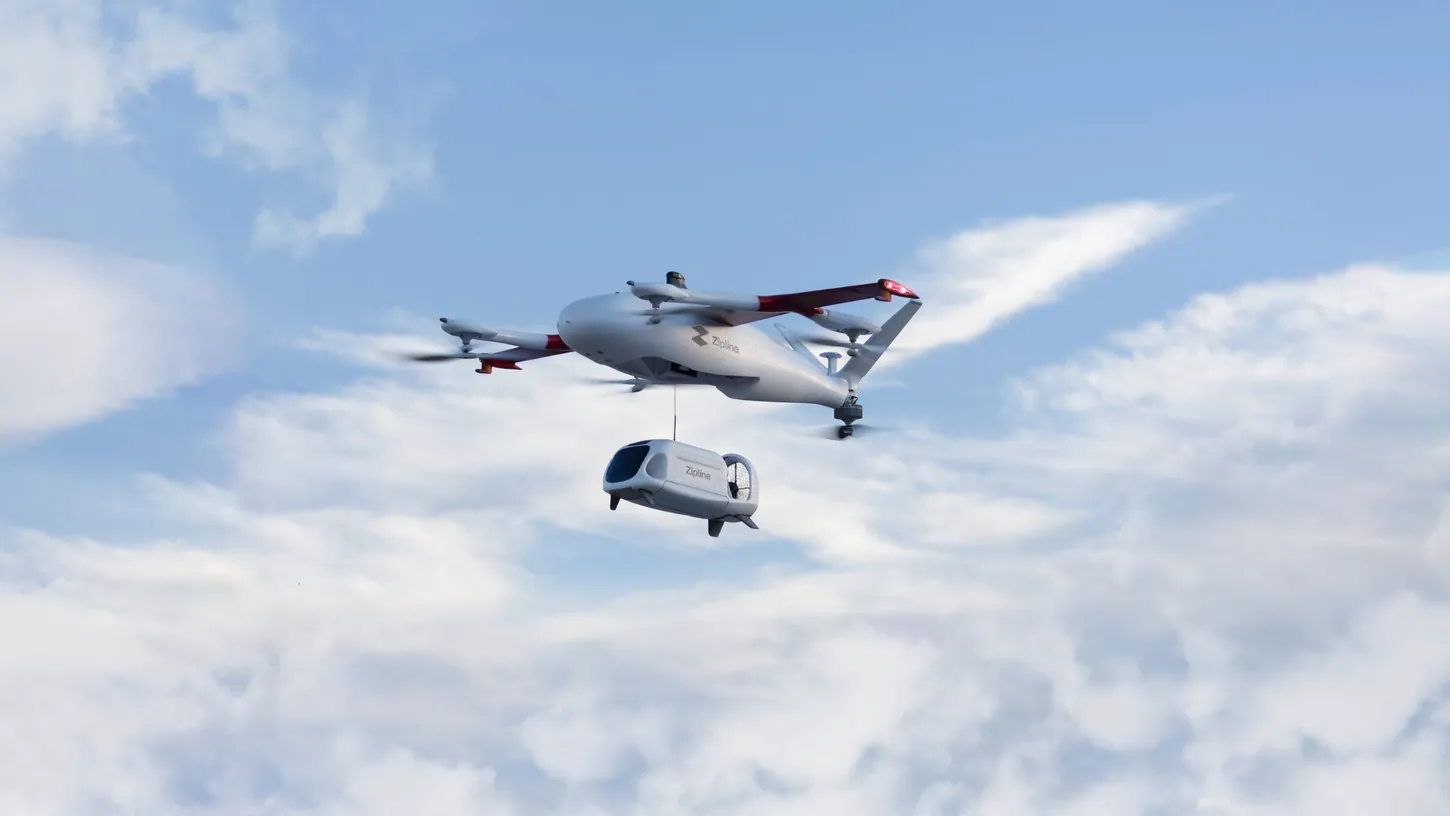
A Zipline delivery drone flying for Walmart deployed its emergency parachute over a Greenville, Texas neighborhood on Sunday, July 26, and drifted down onto a residential street near Roy Warren Parkway and Joe Ramsey Boulevard, coming to rest about three feet (0.9 meters) from a parked pickup truck. Nobody was hurt, and a Walmart employee showed up quickly to cover the aircraft with a tarp for recovery.
DroneXL has tracked Zipline’s Dallas-Fort Worth expansion city by city since the first Mesquite flights in April 2025, and Greenville, about 50 miles (80 km) northeast of Dallas, joined that network in mid-2025. Sunday’s descent gives the industry something it rarely gets: a clear, resident-photographed look at what Zipline’s last-resort safety system does in a real neighborhood, over real driveways, with real people watching.
A Loud Pop, Then A Slow Ride Down
Greenville resident Tammy Mitchell was working in her garage when she heard a loud pop overhead, then watched the drone descend under its parachute and settle on the street a few feet from her neighbor’s truck. She posted her account to the eGreenvilleExtra.com - Hunt County Scanner Facebook group, where it drew hundreds of reactions within hours.
Mitchell wrote that the Walmart Zipline drones fly over her home “like they always do,” so the sound stood out immediately. After the aircraft came down, she and her neighbors moved it to the side of the road and she called the number she found for Zipline. Her message to the company: “one of your friends is laying in our yard.”
A guy from the local Walmart showed up quickly and covered the aircraft with a tarp. Mitchell’s verdict, delivered with a grin, was that the delivery drones are impressive but watching one come out of the sky is a little wild.
Zipline Designed The Parachute As Its Last Line Of Defense
Zipline builds its Platform 2 aircraft to end a bad flight exactly this way: if onboard systems detect an issue the drone cannot resolve, it deploys a parachute, sounds an audible alert, and floats down while a recovery team is dispatched. That is the published protocol on Zipline’s safety fact sheet, and Sunday’s sequence in Greenville matched it step for step, from the alert Mitchell heard to the fast retrieval.
The P2 performs more than 500 safety checks per second in flight and can cancel a delivery or return to base before a parachute ever becomes necessary. Zipline says its fleet has flown more than 130 million commercial autonomous miles and completed over 2 million deliveries since 2016 without a serious injury, numbers no other delivery operator approaches, as DroneXL noted when Commerce Secretary Howard Lutnick toured Zipline’s factory in March.
One commenter on the Greenville post, Philip Knox, summed it up in six words: “Looks like the safety system worked.”
Greenville Sits Inside America’s Densest Delivery Drone Market
The Dallas-Fort Worth metroplex is the most concentrated drone delivery market in the country, and Greenville residents have lived under active Zipline routes for over a year. Walmart and Zipline expanded from Mesquite to Waxahachie, Kaufman, and Greenville in 2025, then kept going: McKinney in November, Royse City in December as the 17th DFW location, with Austin now joining as Zipline’s third Texas market and a Wonder partnership that will put restaurant meals on Zipline drones in 2027.
That density is the point. Millions of flights over Texas rooftops means the rare off-nominal flight will happen over somebody’s street, and how the aircraft behaves in that moment is the entire safety argument.
DroneXL’s Take
I’ll say the quiet part: this crash is good news for Zipline.
Compare Sunday’s sequence to what we’ve documented from Amazon Prime Air over the past 18 months. The MK30 has hit a construction crane, an internet cable, and an apartment building wall, and in Richardson, Texas, bystanders filmed propellers still spinning while the wreckage smoked. Amazon dropped 80 pounds of hexacopter into neighborhoods with no parachute. Zipline lowered its aircraft onto a Greenville street slowly enough that a woman had time to walk out of her garage and watch it land three feet from a truck, then joked with the recovery guy about covering up the dead body. One of these failure modes builds public trust. The other one burns it.
But the comment section carries a warning Zipline should read closely. The second most popular reply was a resident telling neighbors to screenshot the post before Walmart wipes it from the internet. That instinct, the assumption that a company’s first move after an incident is to bury it, is the reputational tax every operator pays for the industry’s history of quiet PR management. The fix is cheap: Zipline should publish what happened to this aircraft, in plain language, the way it publishes its mileage stats. A parachute landing you explain is a safety demo. A parachute landing you go silent on becomes a cover-up in the neighborhood’s imagination, even when nothing was covered up.
The FAA’s pending Part 108 BVLOS rulemaking will be shaped by exactly this kind of operational record. Every parachute that opens over a Texas suburb is a data point in that docket, and right now Zipline is generating the kind pilots and regulators can live with.
Source: eGreenvilleExtra.com - Hunt County Scanner (Facebook), Zipline.
DroneXL uses automated tools to support research and source retrieval. All reporting and editorial perspectives are by Haye Kesteloo.