A Zipline delivery drone came down under its emergency parachute onto the southbound lanes of Highway 6 near Timber Creek Place Lane in Cypress, northwest of Houston, on Friday morning, September 4. Nobody was hurt and nothing was damaged, Zipline says, and law enforcement agencies told KPRC 2 News they never got a single call about an aircraft sitting in a traffic lane.
A photo shot through a windshield shows the white Platform 2 Zip lying across the lane, wing and rotor booms still attached, with its orange canopy stretched toward the curb and cars a few lengths ahead. A second photo shows the aircraft on the grass verge with the parachute folded beside it. Zipline says the Zip was on its way to pick up an order when it hit what the company calls a midflight issue and deployed the parachute as designed. The cause has not been determined.
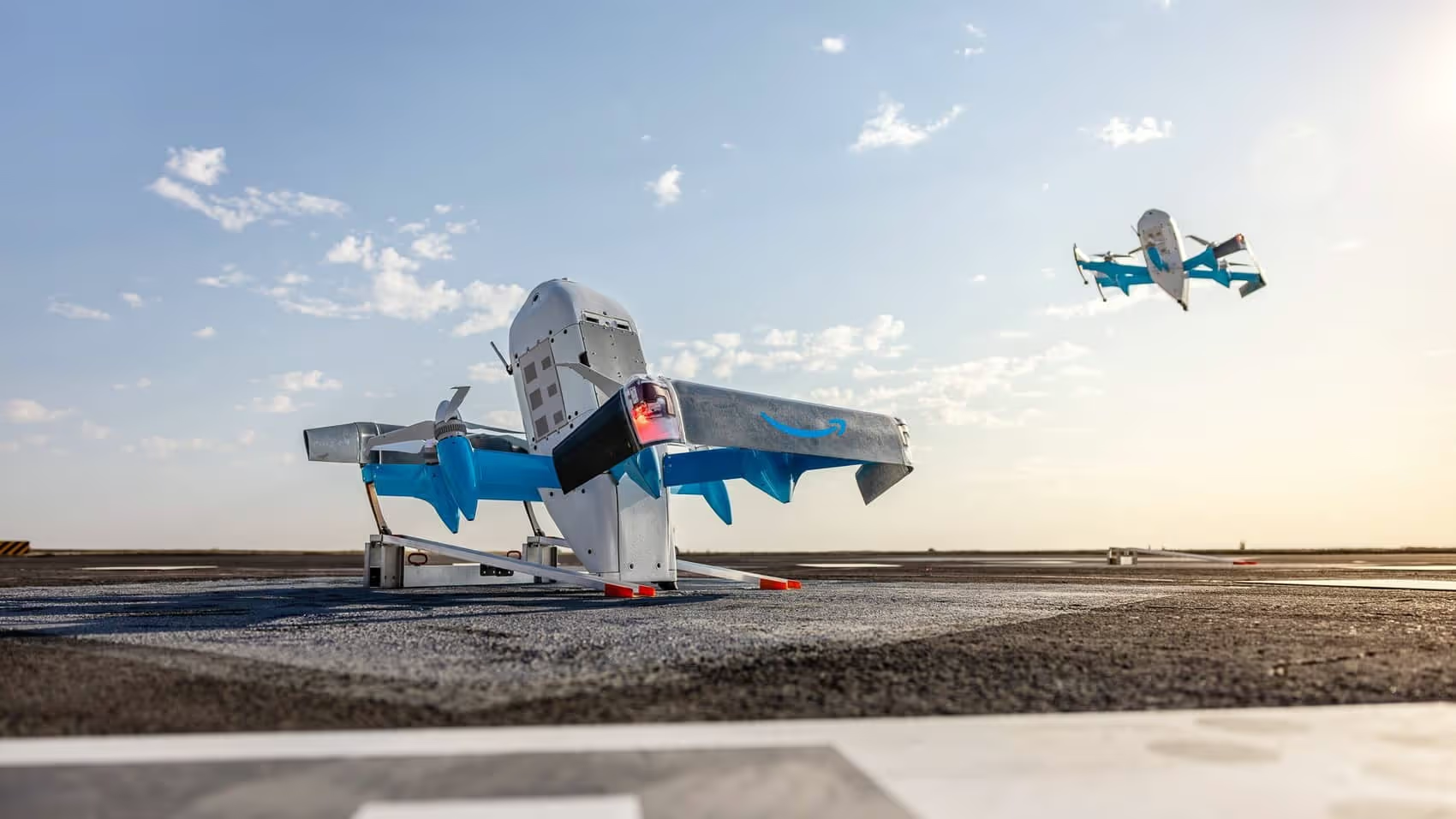
Two days ago I published a piece from Commercial UAV Expo on Amazon Prime Air’s 83-pound MK30, which flies over US neighborhoods without a parachute. Zipline’s aircraft is 20 pounds lighter and carries one.
Zipline Says A Midflight Issue Triggered The Parachute
Zipline told KPRC 2 News the aircraft encountered a midflight issue on its way to a pickup, deployed its parachute and landed without injuring anyone or damaging property. A spokesperson said such landings, which the company calls paralands, are rare and part of the redundant safety system.
The descent followed Zipline’s published protocol. Its safety fact sheet says a Zip that cannot resolve an in-flight problem deploys its parachute and sounds an audible alert on the way down, while a team member is dispatched to retrieve it. The same document puts the fleet’s record at more than 135 million autonomous miles without injury. The statement Zipline gave KPRC on Friday rounds that up to 140 million miles and more than 2.5 million deliveries, and lists the layers under it: redundant propellers, redundant communications equipment, a parachute, and 500 safety checks a second. “Safety is Zipline’s top priority,” the statement opens.

Storms moved through the Houston area on Friday. A company spokesperson said weather is not believed to have played a role. Zipline has not said what did, and KPRC has asked the FAA for comment.
Diana Acosta, a Zipline customer who saw the aircraft on the ground, told KPRC it didn’t hit a car and didn’t fall on anybody. “It made me kind of nervous,” she said, before adding that somebody didn’t get their food on time.
The Zip Weighs 20 Pounds Less Than Amazon’s MK30 And Carries A Parachute
Zipline’s P2 Zip weighs 55 pounds (25 kilograms) empty and under 63 pounds (28.6 kilograms) at maximum takeoff weight, per the FAA’s February 2026 re-evaluation of Zipline’s Arkansas operation. Amazon’s MK30 weighs 83 pounds (37.8 kilograms) at takeoff, per FAA filings. It has no parachute.
I put those figures side by side on Thursday, after Amazon spent two days at Commercial UAV Expo in Las Vegas declining to put an engineer on the record about the MK30 while I was in the same hall. Amazon’s argument is that six motors and redundant flight controllers mean no single point of failure can cause loss of control. The MK30’s actual failures were collisions: two into a crane in Tolleson, one into an apartment wall in Richardson, Texas. Redundancy does nothing for an aircraft that has already hit something, and those MK30s came down at whatever speed gravity chose.
Friday’s Zip came down at parachute speed. Whatever went wrong on board, the aircraft ended its flight slowly enough for the driver who stopped behind it to photograph it through her windshield, canopy on her hood, and the wing was still on the fuselage when it reached the grass. That is the case for carrying a canopy’s weight on a delivery drone, and it is the case Amazon has not answered.
Houston Is Zipline’s Second Texas Paraland In Six Weeks
Zipline launched Houston service in Cypress on April 29, 2026, with a First Flight early-access program for 5,000 residents and partners including Chipotle and Walmart. Friday’s landing is the first Zipline incident DroneXL has recorded in Houston, the second in Texas since July, and the first on a highway.
On July 26, a Zipline Zip flying for Walmart parachuted onto a residential street in Greenville, northeast of Dallas, and settled about three feet (0.9 meters) from a parked pickup. A resident heard the alert, walked out of her garage and watched it land. Nobody was hurt there either, and a Walmart employee arrived quickly to cover the aircraft with a tarp.
The Texas network has grown fast enough that these events were always going to happen over somebody’s street. Zipline spread to more than 20 municipalities across the Dallas-Fort Worth metroplex in under a year, then opened Houston in April and added Austin in June. Zipline says its Zips fly at up to about 300 feet (91 meters), so the canopy had time to open and the aircraft had time to drift. Where it drifted was into the southbound lanes of Highway 6, with traffic visible ahead of it in the photo.
DroneXL’s Take
Two Zipline paralands in Texas in six weeks, both under canopy and nobody hurt, is the safety record working in public. I said the Greenville landing was good news for Zipline, and I’ll say it again about Cypress. The last-resort layer worked after everything upstream of it failed.
The concession is the road. A parachute does not pick its landing spot, and a 60-pound aircraft drifting onto a highway on a Friday morning is a worse place to end a flight than a quiet street in Greenville. Had a car been under it, Zipline’s “no injuries” line would read very differently, and no amount of canopy changes the fact that the Zip was over traffic when it quit. The position survives anyway, because the alternative on offer in this industry is not a delivery drone that never fails. It is Amazon’s, which fails in an aircraft 20 pounds heavier and arrives at terminal velocity. Given a choice between a parachute over Highway 6 and no parachute over Highway 6, every driver on that road on Friday would pick the parachute.
What I keep coming back to is the detail KPRC put in its second paragraph: nobody called the police. A drone landed in a traffic lane with an orange canopy across the asphalt, and nobody thought it warranted a call. Part of that is a soft landing that left nothing on fire. Part of it is that Cypress has had these aircraft overhead since April and has stopped treating them as an event. That familiarity is the most valuable thing Zipline has built in Texas, and it is fragile.
Which is why the silence on the cause matters. Zipline told KPRC the midflight issue has not been determined and that weather is not believed to be a factor, and it has said nothing more specific than those two words. I made the same request after Greenville and I’ll repeat it: publish what happened to this aircraft, in plain language, the way Zipline publishes its mileage numbers. A company that runs 500 safety checks a second has the telemetry to say what tripped on Friday. A parachute landing you explain is a demonstration. One you leave at “midflight issue” becomes whatever the neighborhood decides it was.
The regulatory backdrop makes this worth getting right now. The Transportation Department’s BVLOS rule is delayed, and Amazon intends to fly the MK30 over nearly 500 cities and towns by December. Every paraland that ends with a photo and no injuries is evidence for the version of Part 108 that lets delivery drones fly over neighborhoods. Every unexplained one is evidence for the version that keeps them over fields.
Sources: KPRC 2 Click2Houston, Zipline safety fact sheet, FAA environmental re-evaluations (Zipline Pea Ridge, Amazon Pendleton), Houston Chronicle, Community Impact
DroneXL uses automated tools to support research and source retrieval. All reporting and editorial perspectives are by Haye Kesteloo.