
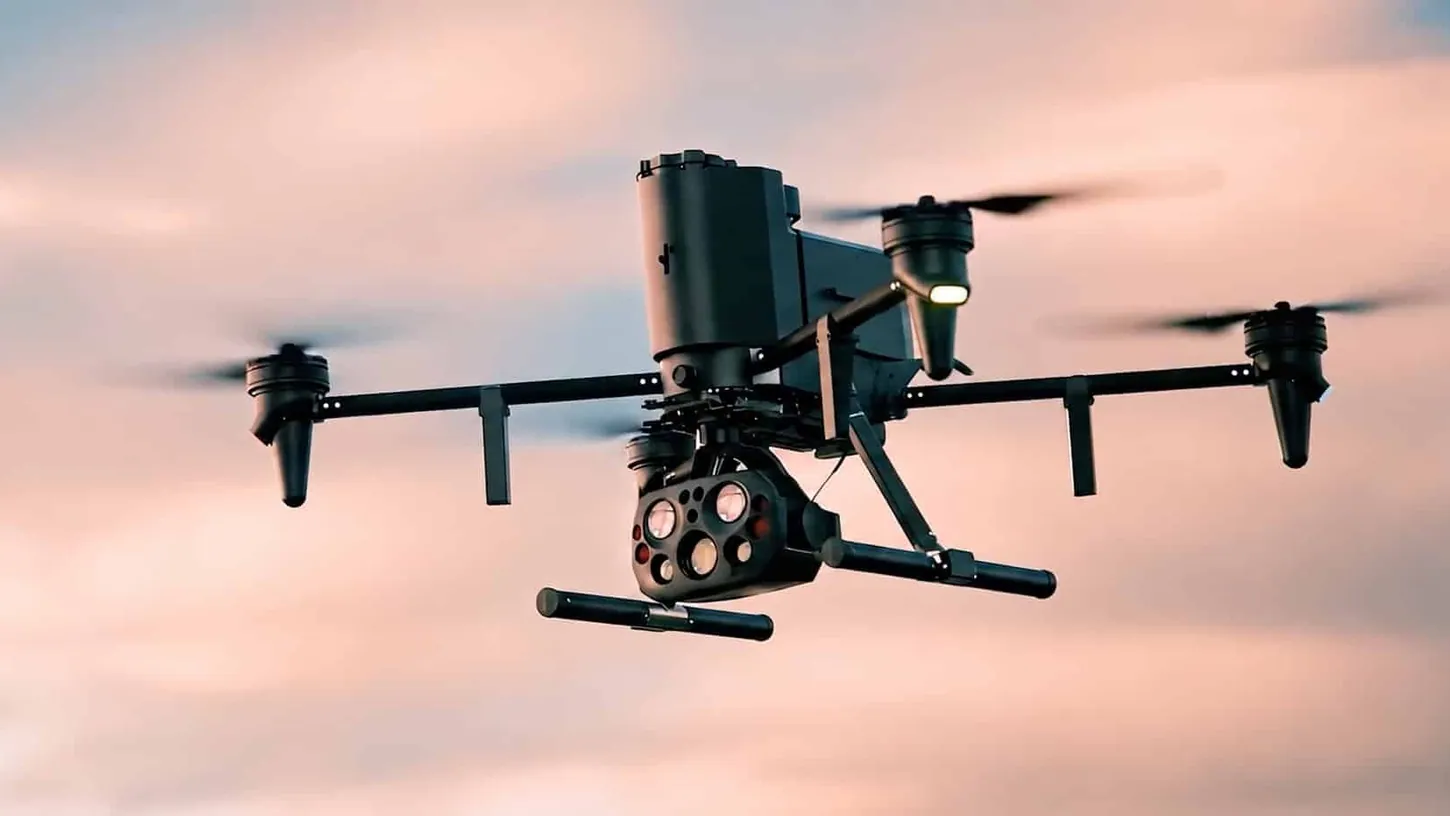
Flock Safety, the Atlanta company whose license plate cameras have been banned by cities and blacked out or painted over across the country, now calls police drones its fastest-growing business. CEO Garrett Langley says drones are set to account for nearly half of the company’s future revenue. Flock, valued at $8.4 billion, has roughly 175 Drone as First Responder customers in the United States.
The bet lands in San Francisco on Wednesday, October 14, when the Police Commission takes up a drone policy for the San Francisco Police Department. The commission put off a vote on an earlier version on September 2. The version posted for Wednesday’s meeting still does not define “public safety response,” the broadest of its grounds for sending a drone up.
Flock’s spokesperson says its drones can’t run automated plate scans. Flock’s own marketing says the Alpha’s camera can read a license plate from up to 2,000 feet (610 meters).
Flock says its drones don’t scan plates, but it sells the camera on reading them
Both claims hold at once because a person does the reading. Paris Lewbel, Flock’s public safety manager, told Fast Company the drones can’t do ALPR scans on their own, and conceded that an officer watching the drone feed could simply call in the plate number.
DroneXL reported the 2,000-foot plate-read claim on June 2, when Flock pushed a new Alpha camera campaign, and noted then that Flock’s product pages for its broader Aerodome platform cited 1,000 feet. Others, Fast Company reports, argue that typing a plate seen through a drone camera into an ALPR system is trivial. Fast Company also describes the link already in use: an ALPR camera flags a plate on a hot list, an officer presses a button to launch the drone, and the drone can then track the car.
Flock’s drone business grows as the company cuts staff
Langley told the All-In podcast that drone tech is Flock’s “fastest-growing business unit right now.” Flock moved into drones by buying Aerodome in 2024. It now sells them to private companies and prisons as well as police departments, and plans to open a factory in Georgia by 2027.
The Aerodome deal was worth more than $300 million, and the Fulton County Sheriff’s Office has since put a Flock drone over its jail. Flock rates the Alpha at 60 mph (97 km/h) with up to 45 minutes of flight between charges. Fast Company says building at home helps Flock win market share after the FCC added foreign-made drones, DJI included, to its Covered List in December 2025, a move it describes as a Trump ban on DJI sales.
Reuters reported on October 9, citing people with direct knowledge of the plans, that about 270 employees, roughly 18% of Flock’s staff, will leave after a voluntary buyout program. Lewbel told TechCrunch it was “a voluntary program, not a layoff.”
Retired Chief Charles L. Werner, founder of the DRONERESPONDERS group, told Fast Company the FAA now issues about 125 new approvals for DFR programs a month. The FOIA list of more than 1,000 agencies the FAA cleared for waivers between April 2025 and February 2026 works out to at least 100 a month, though the two counts don’t measure exactly the same thing.
San Francisco’s rewritten drone order lets pilots clear calls from the air
The amended General Order 10.12 lets SFPD fly drones for “a public safety response,” to assist an active criminal investigation, or for training, and lets pilots clear a call for service with no officer on scene. Footage with evidentiary value is kept for at least two years.
The order posted for Wednesday requires a warrant, or a recognized warrant exception, before an operator intentionally focuses a drone on the inside of a home or an enclosed yard that can’t be seen from ground level in public. It bans “general surveillance,” defined as sweeping, non-targeted observation with no stated purpose. The program manager may share any footage collected during drone operations with “public safety partners.” Public footage can’t be kept past 30 days unless a captain or higher finds a longer period necessary for an open criminal investigation, a limit taken from the city’s Administrative Code. Among its six definitions, the order includes “general surveillance” and “Drone as First Responder” but not “public safety response.”
Commissioner Kevin Benedicto asked for the September delay after the ACLU and the Public Defender’s Office objected, the SF Standard reported. The Electronic Frontier Foundation flagged the same undefined phrase in an earlier revision in a September 28 post, warning that drones could be sent to every call. Beryl Lipton, a senior investigative researcher at EFF, told Fast Company the city’s proposal is a “really atrociously inadequate drone policy.”
The fleet includes Flock models, according to Fast Company, and District Attorney Brooke Jenkins, who puts it at nearly 100 drones, backs the program. SFPD figures cited by Fast Company say its DFR drones responded to 4,000 incidents between March 2024 and August 4, 2026, assisting in more than 1,550 cases and more than 655 arrests. In 2026 alone, drones supported 40 search warrants and more than 70 chases. “We can’t go back to that place out of fear,” Jenkins said.
SFPD’s data handling has a track record. In June, the department disclosed that a May audit found 299 improper inquiries on its Flock plate reader network over about a year, made for out-of-state and federal agencies through two regional information-sharing centers. It cut off their access and said no out-of-state or federal agency ever had direct access. In July, live feeds from five of its Skydio drones turned up on the open internet, where they had been for about six months.
Drone video outlives deletion once it becomes evidence
Flock deletes drone video after seven days by default, but Lewbel told Fast Company that flight records stay in public transparency portals and that drone video often gets classified as evidence and uploaded to agencies’ own evidence systems, where it is kept far longer than any deletion window.
Bryan Cox, head of police accountability at the San Francisco Public Defender’s Office, and others ask whether the analysis drawn from the video (where cars went, which suspects met, where people gathered) is stored somewhere else, which would make deleting the video a formality. Cox argues that surveil-first policing lets police “collect all the data and figure out what the problem is.”
Jenkins argues the opposite. A drone only sees what is visible in public, she says, so there is no expectation of privacy to violate and no warrant to get.
DroneXL’s Take
I’ve backed Drone as First Responder from the start, and SFPD’s numbers show why it works. But San Francisco is weighing rules for nearly 100 police drones, and it has left the broadest reason to launch one undefined. “Public safety response” could cover nearly any call, and a deletion clock means little for footage that is shared with partners or filed as evidence.
My read is that Flock’s plate reader business ran into bans because plate data went places residents never signed up for, and San Francisco’s own audit found inquiries on its Flock network reaching out-of-state and federal agencies. If drones are going to be nearly half of Flock’s future, Flock has as much at stake as anyone in San Francisco defining that phrase on Wednesday.
Sources: Fast Company, San Francisco Police Department General Order 10.12 (amended proposal), SF Standard, Electronic Frontier Foundation, NBC Bay Area, Reuters, TechCrunch
DroneXL uses automated tools to support research and source retrieval. All reporting and editorial perspectives are by Haye Kesteloo. Read our editorial standards.


