
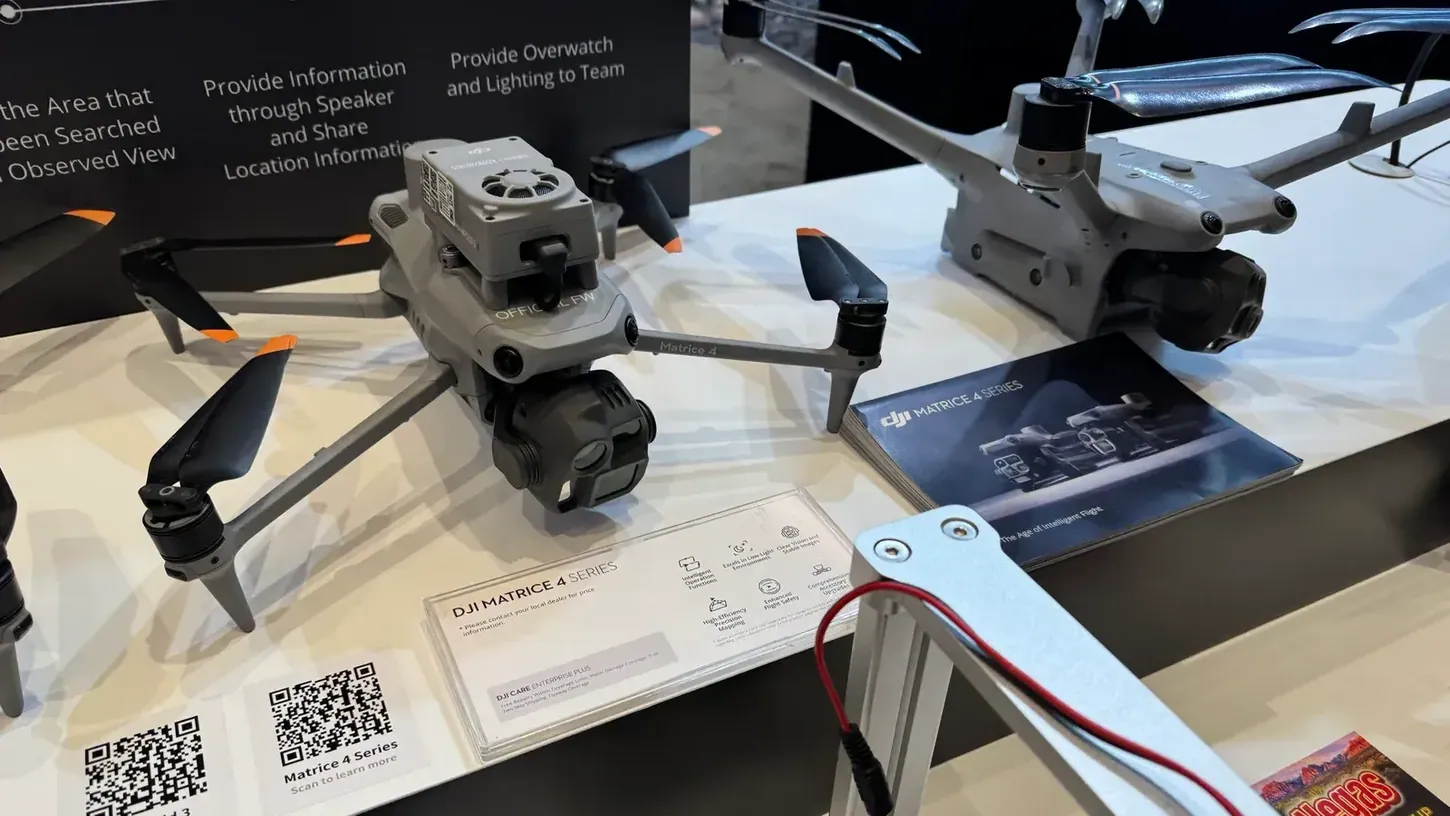
The Federal Communications Commission on Wednesday placed eight letters from the Pentagon to Congress into the record of DJI’s Covered List proceeding, and the only part anyone outside the government can read is three paragraphs that name DJI and identify no specific threat from it. The classified annex, which the Pentagon says holds its analysis, went in under seal. The FCC’s Public Safety and Homeland Security Bureau also wrote that it did not rely on these letters when it added DJI to the Covered List.
Sean Hollister at The Verge spotted the filing on Thursday and wrote that it “sure would be nice if these congresspeople would say why DJI is a threat.” I read all eight pages. They are the same letter eight times, signed by Michael P. Cadenazzi, Assistant Secretary of War for Industrial Base Policy, and the Pentagon told the FCC in an April 6 memo that the report and its classified annex were submitted to Congress on April 3, 2026. The FCC’s notice points to that memo as the filing in which the Pentagon referenced these letters. The FCC had added DJI to the Covered List on December 22, 2025.
The Public Pages Name DJI And Describe No Specific Threat
Each letter runs three paragraphs. The first paraphrases Section 1709 and names DJI. The second says the government has clear national security concerns that foreign drone producers could harm U.S. persons, and announces a classified annex. The third says identical letters went to the other committees.
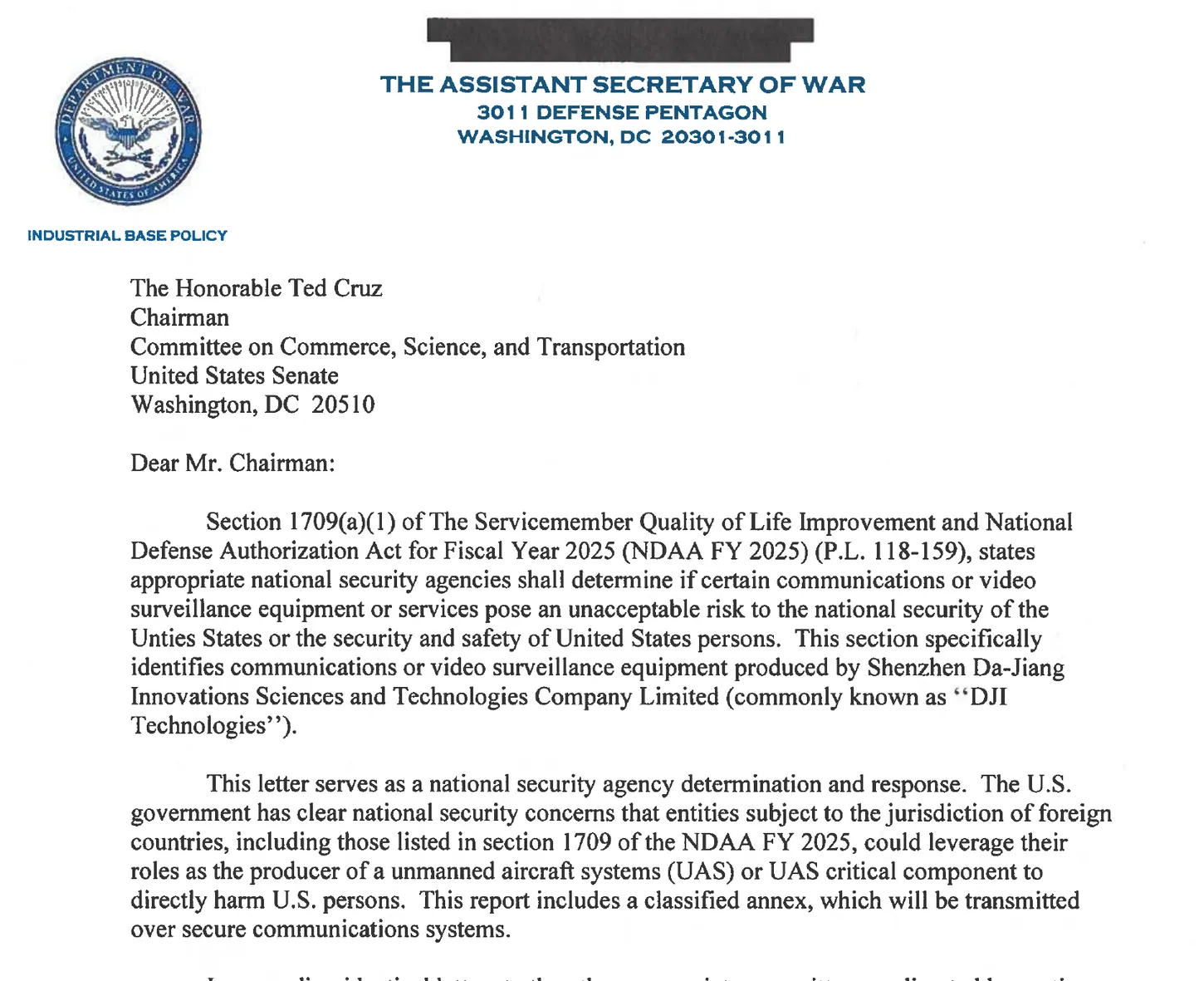
The second paragraph carries the whole public case. The letter calls itself “a national security agency determination and response,” and the filing offers nothing after that beyond the concern that foreign producers of drones or drone components could do harm, plus a promise that the annex “will be transmitted over secure communications systems.” The public version shows no date. The signature is blacked out, and so is the block above the letterhead.
That one sentence of substance is not new. The December 21 determination that the FCC published as Appendix B to its listing notice contains the same sentence, almost word for word: the government “has clear national security concerns that entities subject to the jurisdiction of foreign countries, including those listed in Sec. 1709 of the FY25 NDAA, could leverage their roles as the producer of a UAS or UAS critical component to directly harm U.S. persons.” The Pentagon’s Section 1709 report repeats it, swaps in the full title of the act, and adds the annex.
The chairs are Ted Cruz, Roger Wicker, Tom Cotton and Rand Paul in the Senate, and Mike Rogers, Rick Crawford, Andrew Garbarino and Brett Guthrie in the House, with Maria Cantwell, Jack Reed, Mark Warner, Gary Peters, Adam Smith, Jim Himes, Bennie Thompson and Frank Pallone copied as ranking members. That is where Hollister’s count of 16 lawmakers comes from. Section 1709 names Autel Robotics in the subparagraph right after DJI. The letters never name Autel, though their second paragraph covers entities “listed in section 1709,” a list that includes Autel, and the FCC filed them in Autel’s docket (ET Docket 26-23) as well as DJI’s (ET Docket 26-22).
Both sides let typos through. Each page spells it “Unties States,” the Crawford letter goes to the “Permenent Select Committee on Intelligence,” and the FCC’s own notice describes Cadenazzi as the “Assistant Security of War.” The PDF’s metadata says it came off a Xerox office copier on October 7, the day the FCC’s system logged it as received from the department.
The Pentagon’s Letters Went To Congress 102 Days After The Ban
Section 1709 gave national security agencies until December 23, 2025 to decide whether DJI and Autel pose an unacceptable risk, then 30 days to report to Congress. The FCC listed DJI on December 22 on a White House interagency determination. The Pentagon says it sent the letters April 3, 2026.
The December 22 public notice rests the listing on a National Security Determination the FCC received on December 21 from “an Executive Branch interagency body” convened by the White House. A footnote says the statute asks for a determination by an appropriate national security agency rather than an interagency body, and that the law is satisfied because several such agencies concurred. The determination’s public summary is about securing the FIFA World Cup and the Olympics and about building a domestic industrial base. It makes no finding about DJI by name and reaches DJI through one sentence that folds in everything Section 1709(a)(1) lists.
The Department of War’s one-page opposition memo of April 6, which DroneXL covered at the time, said the department gave full weight to classified and unclassified information during the determination process, and that this information, including a classified annex, went to the committees under Section 1709(b)(1)(B). That memo is the source of the April 3 date, which is 102 days after the FCC’s listing. If the December 21 interagency paper is the determination Section 1709 describes, the 30-day reporting window closed on January 20, 2026, and the letters arrived 73 days after that. If the Pentagon’s own letter is the determination, as its text says, the determination postdates the ban by more than three months.
The bureau filed the letters on October 14 under Public Notice DA 26-1106 and wrote that it “did not rely upon these materials” when it made the related additions to the Covered List. DJI’s Ninth Circuit petition and its January 21 petition for reconsideration both argue that no appropriate national security agency ever made the specific determination the statute requires. The Ninth Circuit denied the FCC’s motion to dismiss on May 28 and paused the case while the Commission acts on that petition, with DJI’s opening brief due November 2 and the FCC’s answer a month later.
Rick Scott Says He Read The Classified Report And It Covers Autel
Senator Rick Scott told Chairman Carr on October 14 that he objects to DJI’s petition and Autel’s application for review, and the FCC filed the letter Thursday. Scott, who sponsored the bill behind Section 1709, says he has read the classified report and it finds both companies an unacceptable risk.
The four-page letter says Congress spent years on DJI through classified briefings from the intelligence community and the Department of War, plus public hearings, and it walks through the record: a 2017 Immigration and Customs Enforcement bulletin, DJI’s 2020 addition to the Commerce Department’s Entity List, Treasury’s December 2021 listing, the Pentagon’s Section 1260H list from October 2022, and Autel’s Entity List and 1260H designations in 2024 and 2025. Scott also argues that Chinese subsidies since 2015 have driven American drone makers out of business.
On the report itself, Scott confirms the sequence the dates already show. The Department of War transmitted the classified report to the committees after DJI and Autel were added to the Covered List, he writes, and it details the threats posed by both companies. “I have read and agree with the analysis detailed in the classified report,” he adds. The public cover letters name only DJI, and Scott’s letter says in plain words that the sealed material addresses Autel. Autel told the FCC in May that it was listed on classified material it never saw and on complaints originally aimed at DJI.
The FCC entered Scott’s letter in both dockets on October 15 under Public Notice DA 26-1112, one day after the Pentagon’s.
DroneXL’s Take
The FCC’s sentence that it did not rely on these letters is the most useful line the government has put in this docket, because as I read it, it settles what the ban rests on. The ban rests on the December paper, which argues from World Cup and Olympic security, cartel and battlefield drone use, and the domestic industrial base, and which reaches DJI only through Section 1709’s list. The letter the Pentagon calls its Section 1709 determination went to Congress in April, after the fact, and its one public sentence of substance was copied out of that December paper. Nine years after the ICE bulletin Scott cites, a recycled sentence is everything the Pentagon’s Section 1709 report says in public.
The Pentagon says it weighed the same classified material during the December determination, and Scott says he has read the classified report and agrees with it. But the D.C. Circuit ruled in August that the Pentagon’s central blacklist finding against DJI, that it contributes to China’s defense industrial base, has no publicly stated rationale at all, and a listing that blocks every new DJI model from U.S. authorization, Mini and Matrice alike, cannot run on “trust us” indefinitely. If the annex holds something specific, the government has had since April to say so in a sentence that survives declassification, and so far it has published a redaction bar instead.
My read is that the FCC filed the Pentagon’s letters and Scott’s within a day of each other because it is tidying the record before it rules on DJI’s petition, with DJI’s opening brief due in the Ninth Circuit on November 2. Watch whether the Commission rules before that brief lands, and whether DJI’s lawyers put the FCC’s own sentence on the first page of their filing, which is where I would put it.
Sources: FCC ECFS filing 26110081553, Department of War letters to Congress, FCC Public Notice DA 26-1106, FCC Public Notice DA 26-1112, Sen. Rick Scott letter to Chairman Carr, October 14, 2026, Department of War opposition memorandum, April 6, 2026, FCC Public Notice DA 25-1086, Public Law 118-159, Section 1709, The Verge
DroneXL uses automated tools to support research and source retrieval. All reporting and editorial perspectives are by Haye Kesteloo. Read our editorial standards.


