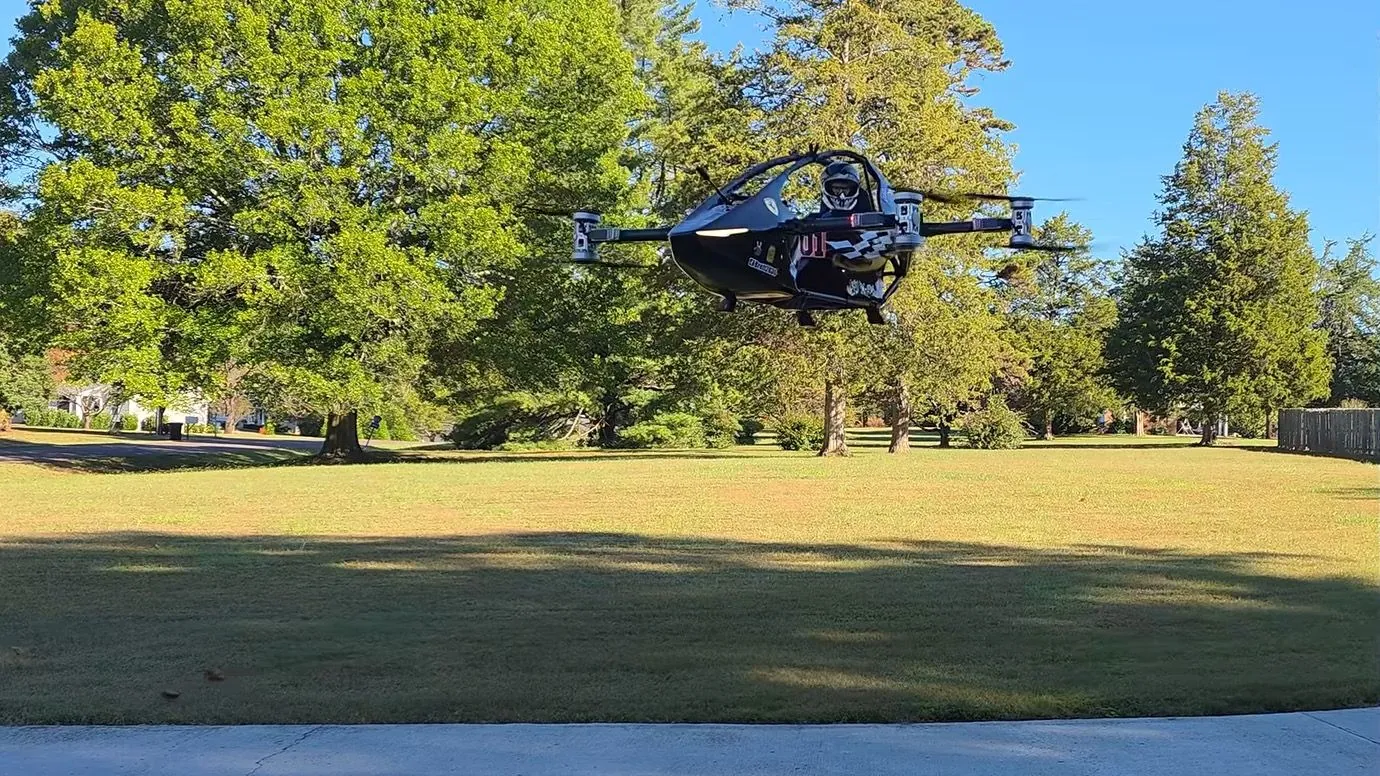
Jimmy, the host of the YouTube channel Jimmy’s World, says the FAA has told him that the human drone he flew for 3.3 million views is illegal. In a video published Wednesday, eight days after the flight video, he lists three problems he says the agency raised with the YiVTOL S-Zero Plus he flew at a dealer’s property in Tennessee: its batteries count toward the 254-pound (115-kilogram) empty weight limit for ultralights, the dealer’s remote-control training mode makes the aircraft a drone rather than an ultralight, and Part 103 keeps it from flying over congested areas and crowds in any case. He does not say who at the agency spoke to him, and the only document he refers to is an FAA letter on battery weight.
The S-Zero Plus sells for $98,000 to the door with a one-year warranty, according to dealer Brett Rayburn of CloudRider865 in Tennessee, and both Rayburn and YiVTOL’s own website say it flies under Part 103, which requires no pilot certificate, no registration and no airworthiness certificate. Jimmy puts each battery on the larger S-Zero Max at 50 to 60 pounds, and the Plus carries two of them.
FAA Has Counted Batteries as Ultralight Empty Weight Since 2012
The FAA’s Office of the Chief Counsel ruled on September 4, 2012 that batteries powering an electric ultralight count toward the 254-pound empty weight limit in Part 103. The letter, written to Rainbow Aviation Services, rejected the argument that batteries are fuel and sit outside the empty weight.
The letter reasons that aviation fuel burns off during a flight while a battery weighs the same depleted as charged, so treating batteries as fuel would let an ultralight carry an unlimited number of them. It quotes the FAA’s 1981 proposal for the rule, which argued for a fuel capacity limit so that range and endurance “should be reasonably limited” for vehicles whose pilots need no certificate and never have to show they know navigation or weather. The conclusion is one sentence: “the weight of those batteries must be included when determining the empty weight.”
If the Plus uses the same packs Jimmy weighed by eye on the Max, its two take 100 to 120 pounds of the 254-pound allowance before the titanium airframe, eight T-Motor motors, propellers, seat and flight computer go on the scale. Whether the whole aircraft clears the limit with the packs installed is a number that neither YiVTOL’s specification page nor either video gives. The page, updated October 20, lists rated payload, flight time and a $79,000 FOB price for the Plus but no empty weight. Rayburn told Jimmy on camera that the aircraft is “under the weight limit of 254” without saying whether that figure includes the batteries. The rule text excludes only floats and safety devices such as a parachute from the empty weight.
The battery point Jimmy describes matches the 2012 letter, and the congested-area point matches the text of Part 103. The remote-control point rests on the rule’s single-occupant definition, as I read it.
YiVTOL Sells the Remote Control Mode Jimmy Says Makes It a Drone
Part 103 defines an ultralight as a vehicle used for manned operation by a single occupant. On my reading, a second person flying it from a handheld transmitter is not that occupant. According to Jimmy, the FAA told him that a remotely controlled aircraft is a drone, not an ultralight.
Rayburn described that mode in the October 27 video: he can put someone learning to fly in the seat, take off from a transmitter, flip one switch to hand over control and flip it back if the student gets into trouble. YiVTOL’s website lists “ground-station remote control (training and sightseeing)” as one of the S-Zero’s two control modes alongside the onboard joystick. Jimmy’s summary of what that does to the aircraft’s legal status: “you’re now a drone. You’re not an aircraft.” The drone rules are no easier: Part 107 covers unmanned aircraft under 55 pounds, and heavier ones go through a Section 44807 exemption or an airworthiness certificate.
The third problem is where it can fly. Part 103 bars ultralights from flying over any congested area of a city, town or settlement and over any open-air assembly of persons, and Jimmy says nobody has worked out yet how a personal eVTOL stays legal under that line.
The S-Zero Max Owner Is Going for an N-Number, Not a Part 103 Flight
The S-Zero Max that Jimmy filmed at Sarasota Avionics is being fitted with an ADS-B transponder and GPS antennas, he says, so its owner can seek an N-number and fly it as an experimental aircraft. The owner has not flown it yet because the FAA has not cleared it.
Jimmy says the Max carries twice as many batteries as the Plus, which by his figures is 200 to 240 pounds of battery alone and leaves 14 to 54 pounds for a titanium airframe, eight motors and a seat under the FAA’s reading of the limit. YiVTOL lists the Max at $139,000 FOB with 50 minutes of flight time. Sarasota Avionics is an FAA-certified repair station headquartered at Venice Municipal Airport in Florida.
The experimental route has its own catches. Under 14 CFR 21.191, an amateur-built certificate requires that the major portion of the aircraft be built by people doing it for their own education or recreation, which on its face a factory-built import does not satisfy, and exhibition certificates cover air shows and film work. Jimmy says the owner is looking at the research and development category, which, he says, the FAA renews a year at a time.
Jimmy says the FAA is also talking about a “vertical lift” license, and he did not say which rule the agency pointed him to. The closest category on the FAA’s books is powered-lift, which got its own pilot certification rules in a final rule on October 22, 2024 written with air taxis like Joby’s and Archer’s in mind.
DroneXL’s Take
The FAA is right on the batteries, and the letter that says so has been public since 2012. Any dealer or manufacturer selling a personal eVTOL as a Part 103 ultralight in the United States has had 14 years to put the empty weight with batteries on the spec sheet. YiVTOL’s spec sheet does not carry it, and Rayburn’s “under 254” leaves the one number that decides the question unspoken. I am not saying the Plus is over the limit. I am saying neither the spec sheet nor the sales video shows it is under, and a buyer wiring $98,000 deserves better than a figure with an asterisk nobody mentions.
Jimmy’s complaint that 20 minutes of flight is not enough fun is fair, and it is the trade the rule makes: the FAA wrote in 1981 that an ultralight’s range should be limited because nobody checks whether its pilot can fly. The same no-certificate pitch carried the BlackFly to its first customers and the Jetson ONE down the California coast, so this is bigger than one Shenzhen factory. If you have a deposit down on one of these, get the empty weight with batteries in writing before it ships, and never let anyone else hold a transmitter while you are in the seat.
Sources: Jimmy’s World (YouTube, November 4 and October 27, 2026), FAA Office of the Chief Counsel letter of September 4, 2012, 14 CFR Part 103, 14 CFR 21.191, YiVTOL, CloudRider865, Sarasota Avionics.
DroneXL uses automated tools to support research and source retrieval. All reporting and editorial perspectives are by Haye Kesteloo. Read our editorial standards.