
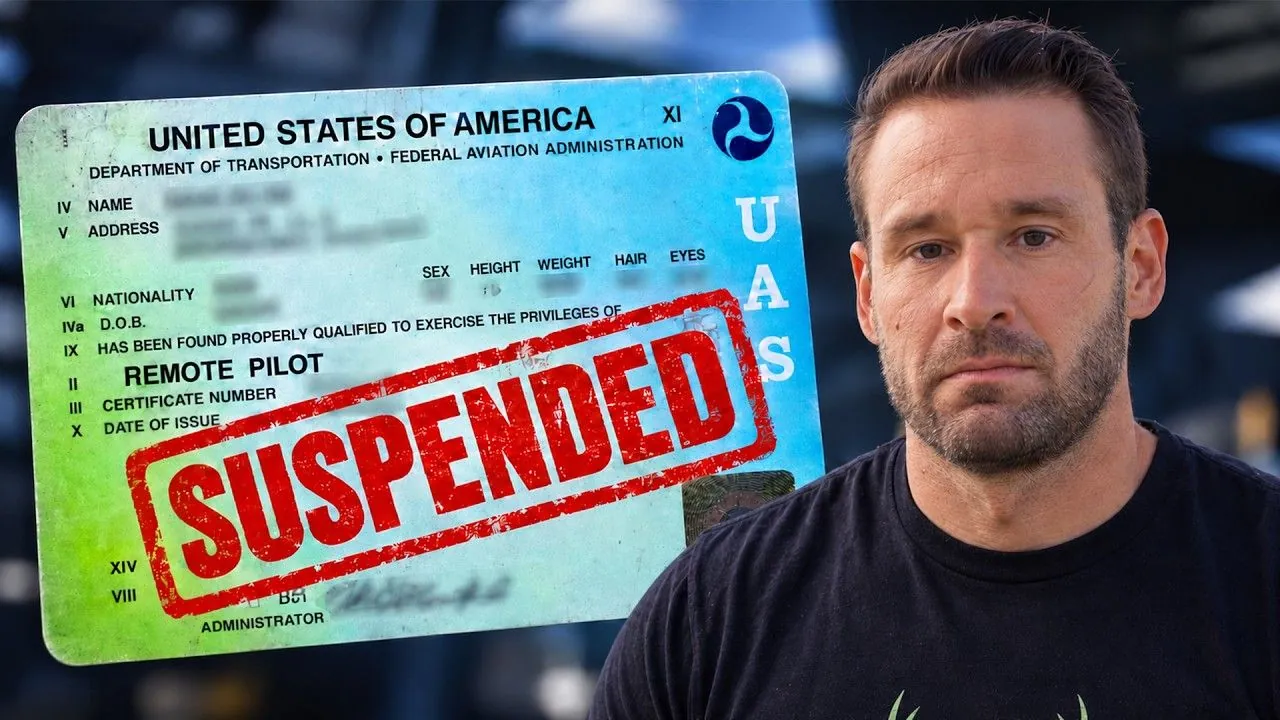
Mike Yoder, co-owner of Ohio agricultural drone company nuWay Ag, says he has agreed to a 180-day FAA suspension of his remote pilot certificate. He announced the settlement in a video posted October 13 that passed 300,000 views in two days. Yoder also founded Drone Deer Recovery, which lost its 2025 First Amendment challenge to Michigan’s drone hunting law.
The case grew out of three of his own YouTube videos: a heavy-lift drone hauling a deer carcass out of the woods, a drone lifting logs off a tree job, and one pulling a person on a sled. Yoder expects his certificate back around April 2027. Until then he cannot act as remote pilot in command, which rules out flying anything over 55 pounds.
He says he spent about a year asking the FAA for a legal way to fly those lifts before the case turned into enforcement. The FAA inspector who first contacted him in September 2024 said the deer work did not look like agriculture under his exemption, and could not say what would cover it.
Part 137 Covers Dispensing, and the FAA Says Deer and Tree Lifts Don’t Qualify
Drones over 55 pounds can’t fly under Part 107, so ag operators like nuWay fly them under an FAA exemption plus a Part 137 certificate, which covers dispensing pesticides, fertilizer, seed and similar substances. Hauling a deer carcass or a log dispenses nothing.
That is the definition in 14 CFR 137.3, and Yoder plays an FAA official reading it aloud in the video. At a later informal meeting, Yoder’s side argued that moving a generator or cutting a tree can be farm work, pointing to growers who raise Christmas trees. The FAA held to the definition.
The 2024 call was informal. Yoder plays a recording in which the inspector says he found the nuWay channel while looking into a complaint about someone else, and that he would be watching it. Asked what exemption would cover deer lifts, the inspector answered: “I just don’t know what it would land under.”
Yoder’s team then petitioned the FAA for heavy-lift work. Each round took about three months to come back, he says, and each asked for more information about the operation. About a year after the call, Yoder told his partners they would keep moving forward and posted a tree-removal job (he used to work as an arborist). He believes the inspector was still watching, because the formal investigation followed.
Yoder Says FAA Letter Named Him, His Cousin and Both Companies
According to Yoder, a certified FAA letter cited all three videos. It pursued four parties: Yoder, his cousin and business partner Jason Miller, nuWay Ag and Drone Deer Recovery. He recalls proposed civil penalties of around $70,000, and the FAA also proposed suspending his private pilot certificate.
The FAA’s initial proposal targeted that airplane certificate rather than his remote pilot certificate, Yoder says, treating the flights as Part 91 operations and alleging careless or reckless operation. He disputes that, saying every flight was on private land with nobody present who was not part of the job. The sled video, he says, tested whether a large drone could tow a big-wave surfer in a rescue, for a professional lifeguard he was working with.
The informal conference the letter offered stopped before it reached the substance. Yoder was recording the video call, and the FAA’s principal operations inspector said the agency would not accept a recorded meeting, that a response could only come in writing, and that he needed to seek further guidance. The FAA later asked to meet in person at the Cleveland Flight Standards District Office. Yoder hired attorneys, and an informal meeting did take place, which he says didn’t get far.
Yoder Says He Took a Drone Suspension To Protect His Airplane Certificate
Yoder says he accepted the 180-day remote suspension to keep a reckless-operation finding off his private pilot certificate, because he may want a commercial pilot certificate in the future. The FAA had already cut its proposed private certificate suspension from 275 days to 180, he says.
He also says he offered to pay double the proposed penalty against Miller if the FAA left his remote certificate alone, and the FAA declined. The video does not say what became of the proposed penalties against Miller, nuWay Ag or Drone Deer Recovery.
Yoder can still fly smaller drones under 14 CFR 107.12(a)(2), which lets a person without a valid certificate manipulate the controls of a small drone under the direct supervision of a remote pilot in command who can immediately take over. Heavy-lift spraying and demos are out. Yoder says the FAA has 20 days from the video’s posting to show the suspension on his record, and that the video’s release is part of the deal.
nuWay sells a Part 137 Fast Pass program at $800 a month for 55-pound-plus spray drones. It lets qualified custom applicators spray as contractors under nuWay Ag’s existing Part 137 certificate while their own application is processed. The video does not say whether the settlement affects that company certificate.
Yoder says he has hired attorneys to write new exemption petitions for practical farm lifts, such as flying an irrigation pump to a center pivot or a tire to a tractor. Between those petitions and fighting the FAA, he puts his attorney costs at tens of thousands of dollars. “We are nowhere further than we were when we started,” he says.
Rescue Crews Hit the Same 55-Pound Line Unless They Fly as Government
A search and rescue crew flying a heavy-lift drone to a team in the field or a stranded person runs into Yoder’s problem unless it flies as a government agency. Above 55 pounds, a civilian operator needs an exemption written for that operation, and an ag exemption is not one.
Government agencies have the cleanest path. A sheriff’s office, fire department or state agency can fly as a public aircraft operation under an FAA Certificate of Waiver or Authorization (COA), and 49 U.S.C. 40125 lists search and rescue as a governmental function. The agency certifies its own pilots and aircraft, so a DJI FlyCart 30, rated at 209 pounds (95 kg) maximum takeoff weight, can carry rope, radios or a medical kit to a team if the COA covers it. That status belongs to the operator, not the mission, so a volunteer nonprofit doesn’t get it for doing rescue work.
Civilian teams can fly under Part 107 as long as drone and payload together stay under 55 pounds. Dropping gear is legal if it creates no undue hazard to people or property under 14 CFR 107.23(b), but 107.36 bars hazardous material, which takes in signal flares and compressed-gas cylinders. The Ocean County M300 that dropped a rescue tube into a rip current in July worked inside that weight class.
A civilian spray operator who flies an ag drone over 55 pounds to a rescue is outside Part 137, the same way Yoder’s deer lift was. The FAA’s emergency Special Governmental Interest process can approve search and rescue flights within minutes for operations in visual line of sight, but the FAA describes each approval as an amendment to an existing COA or remote pilot certificate. Its page, checked October 15, says nothing about widening a Section 44807 exemption.
DroneXL’s Take
The FAA read its own rule correctly. Part 137 is a dispensing rule, a deer carcass is not a dispensing load, and Yoder posted the tree job after an inspector had told him his deer lifts didn’t look like agriculture under his exemption. I can’t defend how the FAA handled the year between that 2024 call and the letter, though. A farmer who asks the regulator how to legally fly an irrigation pump to a center pivot should get a process, and by his account Yoder got an inspector who didn’t know and a petition queue that came back roughly every three months with more questions. When the only answer to “how do I do this legally” is “I don’t know,” enforcement becomes the policy. Looking at the FAA’s 2025 enforcement report and DETER, its fast track from violation to penalty, I can see which half of that the agency is putting its effort into. If you fly a 55-pound-plus ag drone, read what your exemption actually authorizes before it lifts anything that isn’t being dispensed, a rescue load included, until the FAA writes the rule its inspector couldn’t name in 2024.
Sources: nuWay Ag on YouTube, 14 CFR 137.3, 14 CFR 107.12, 49 U.S.C. 40125, FAA Emergency Situations, DJI FlyCart 30 specs, nuWay Ag Part 137 Fast Pass
DroneXL uses automated tools to support research and source retrieval. All reporting and editorial perspectives are by Haye Kesteloo. Read our editorial standards.


