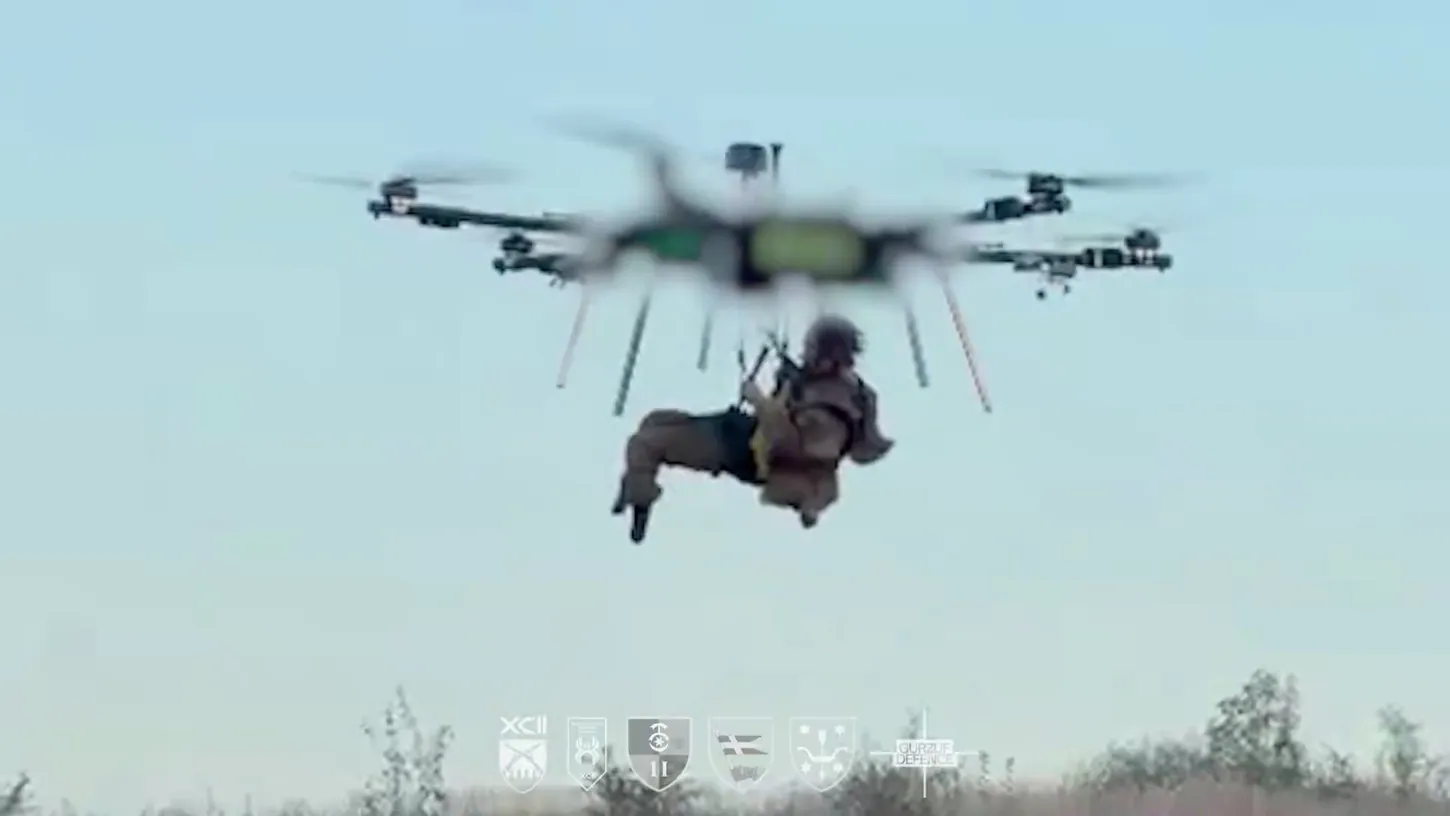
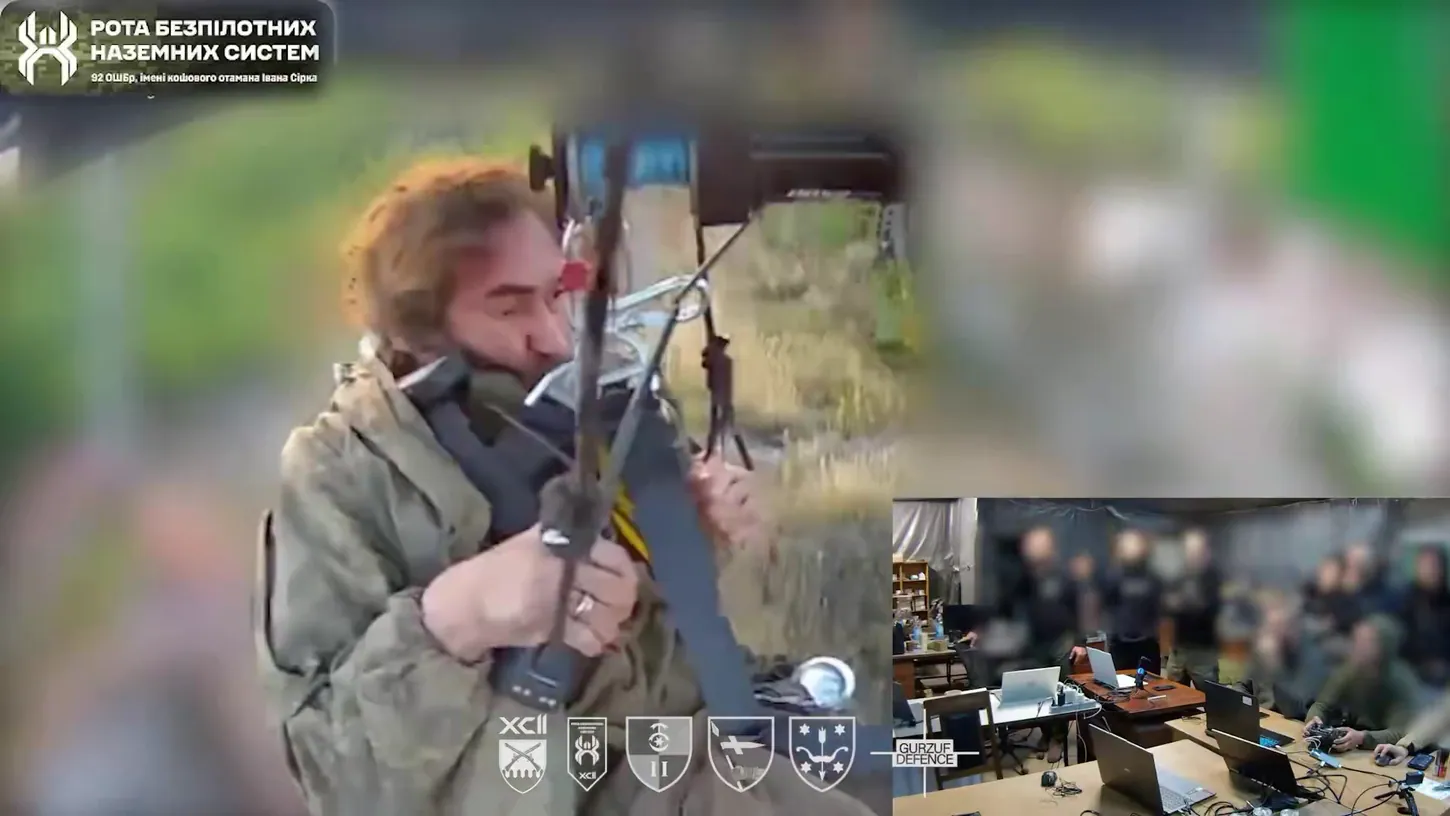
Ukraine’s 92nd Assault Brigade flew a wounded infantryman out of a front-line position hanging in a harness under a heavy hexacopter, and on Monday it called the flight the first aerial evacuation of a casualty from the line of contact anywhere. The soldier, from the 30th Mechanized Brigade, had been wounded at a position where mines and Russian drone activity had stopped the ground robots Ukraine normally sends into the kill zone. A 30th Brigade drone operator flew the aircraft. The brigade says the man is in treatment and rehabilitation and that his life is no longer in danger.
The aircraft was not built for the job. It was a bomber from Ukrainian maker Gurzuf Defence, lent to the unit for free, and the brigade did not say when or where it flew the mission.
The 92nd Modified a Gurzuf Defence Bomber So a Hanging Soldier Would Not Swing
The 92nd’s ground robot company worked with Gurzuf Defence on a fix that kept the bomber steady under a hanging person without tipping or swinging. They tested it on the maker’s sites and planned the flight with the 30th and 14th Brigades and the 10th Army Corps, the brigade said.
The brigade’s video, which the X account Special Kherson Cat reposted on Monday, shows no stretcher and no pod. The soldier sits in a climbing-style harness clipped to a line under the hexacopter’s center frame, holding the rigging with both hands as the drone crosses an open field. The aircraft itself is blurred in every shot, a step Defence Blog notes Ukrainian units take so Russian forces cannot study a system’s configuration and control gear. The video says he had been alone at the position the whole time, still carrying out tasks, while the unit flew him medicine and food, and the brigade’s account is the only word on his wound. “This is a historic event, at least for our unit for sure,” Napalm, a squad commander and programmer in the company, said in its post.
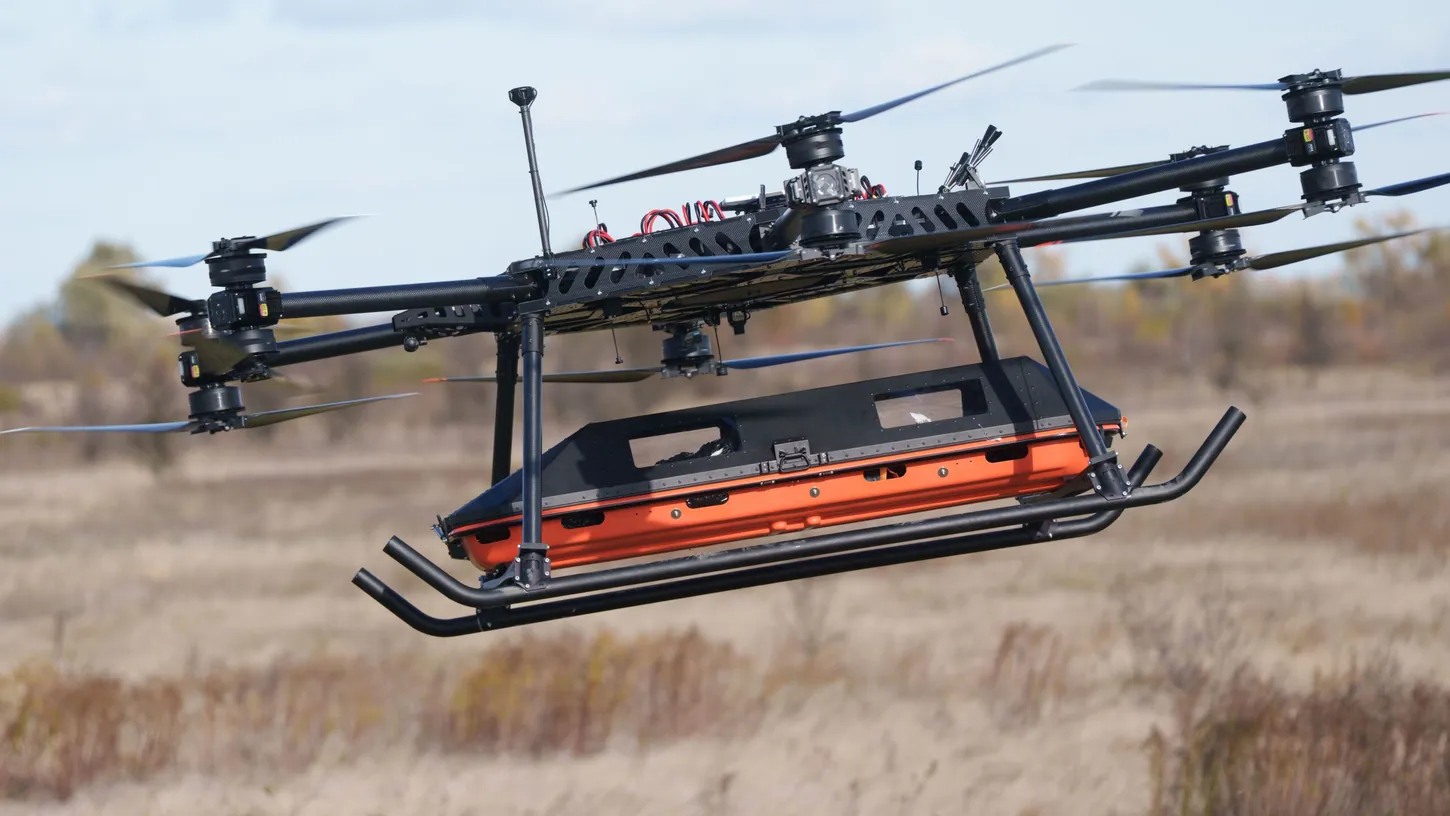
Neither the brigade nor Gurzuf Defence has named the airframe. Gurzuf’s best-known product is the Heavy Shot night bomber, rated for up to 66 pounds (30 kilograms) of munitions, which DroneXL covered in July when one delivered a KFC order to a front-line position. That is not enough to lift a man. In March the company showed Texty a six-motor platform called Ayudag-6, just under 220 pounds (100 kilograms), rated to carry 154 to 198 pounds (70 to 90 kilograms) up to 15.5 miles (25 kilometers) with a return, and said then that it might one day evacuate the wounded. It is the only Gurzuf aircraft shown in public that could lift a man, and the brigade has not said it was the one it flew.
A Harness Under a Bomber Carried a Real Casualty Before StarGate Did
SkyFall’s purpose-built StarGate medevac drone went to a combat brigade for evaluation last week. Its stretcher pod is rated for 330 pounds (150 kilograms), and the Associated Press watched a demonstration on October 14. The 92nd’s flight is the first such airlift any unit has reported.
Ukraine has been testing the idea since spring. In May, Militarnyi reported a heavy multicopter carrying a person playing a casualty, with no unit or maker named. Until this flight, the work of pulling wounded soldiers out of positions that vehicles cannot reach fell to ground robots, which ran more than 9,000 armed front-line missions in March alone. The 92nd knows their limits from its own missions. In September 2025 its ground robot crews drove three wounded soldiers of the 154th Brigade out through a mined sector after the men had spent more than 40 days at a forward position.
The brigade’s post does not give the distance flown, the altitude, or what covered the drone against Russian FPV attacks on the way in and out.
DroneXL’s Take
This is the result StarGate is still waiting for, and it came from a lent bomber and a climbing harness. A harness only works for a soldier who is conscious enough to clip in and hold on, so the man on the stretcher still needs SkyFall’s pod. In May a 93rd Brigade drone expert asked how long one of these would survive with a person on board, and one unit has now flown the mission and brought the man back. I’d trust Napalm’s version of the claim over the headline version: a first for his unit is documented, and a first for the world is not something one brigade can know. I said last week that SkyFall should publish its numbers, and I want the same from the 92nd, because the next unit that tries this needs the flight profile more than the announcement.
Sources: 92nd Assault Brigade, Defence Blog, Euromaidan Press, Militarnyi, Texty.
DroneXL uses automated tools to support research and source retrieval. All reporting and editorial perspectives are by Haye Kesteloo. Read our editorial standards.