A federal judge ruled, in an opinion dated November 3, that the US Navy improperly threw Saildrone out of its $2.1 billion Medium Unmanned Surface Vessel (MUSV) competition, and ordered the service to reevaluate the Alameda, California company’s proposal, including a new chance at the at-sea demonstration it was denied, the New York Times reported. Judge Philip S. Hadji of the US Court of Federal Claims wrote that the Navy “engaged in disparate treatment, and thus acted in an arbitrary and capricious manner” in its review of Saildrone’s proposal.
Until the Navy completes that evaluation, it may obligate no more than $1.5 billion of the program’s money for MUSV construction. That leaves about $600 million the service cannot spend for now. Blue Water Autonomy, which sued alongside Saildrone in the consolidated case, lost: Hadji found the Navy’s elimination of its proposal reasonable and denied its protest.
The ruling arrives five weeks after the Navy awarded production agreements for 30 MUSVs to three of Saildrone’s rivals, at roughly $40 million a boat.
Navy dropped two of its three strikes against Saildrone before the judge rejected the third
The Navy found Saildrone non-compliant on all three evaluation criteria in May, then abandoned two findings once the company challenged them, according to Saildrone’s statement. Hadji rejected the third, and in Saildrone’s account the Navy applied criteria to it that it applied to no other bidder.
The Navy issued the MUSV solicitation on March 26, 2026 under its “other transaction” prototype authority, with money from the reconciliation bill President Trump signed in July 2025. It wanted a production-ready boat that could carry two 40-foot shipping containers and a 25 metric ton payload for 2,500 nautical miles (2,877 miles) at 25 knots in sea state 4, and it said it was no longer interested in paying industry to build prototypes. More than two dozen designs came in. The Navy said on May 22 that it had picked seven for at-sea testing and named them a week later: Leidos, HII, Sea Machines, Saronic Technologies, Galliano Marine Services, PacMar Technologies and Birdon. Saildrone and Blue Water Autonomy were not among them.
Saildrone and Blue Water each sued in late June. The government moved to dismiss in August, and the Navy spent most of its September oral argument contending the court had no power to hear the case, Inside Defense reported in October.

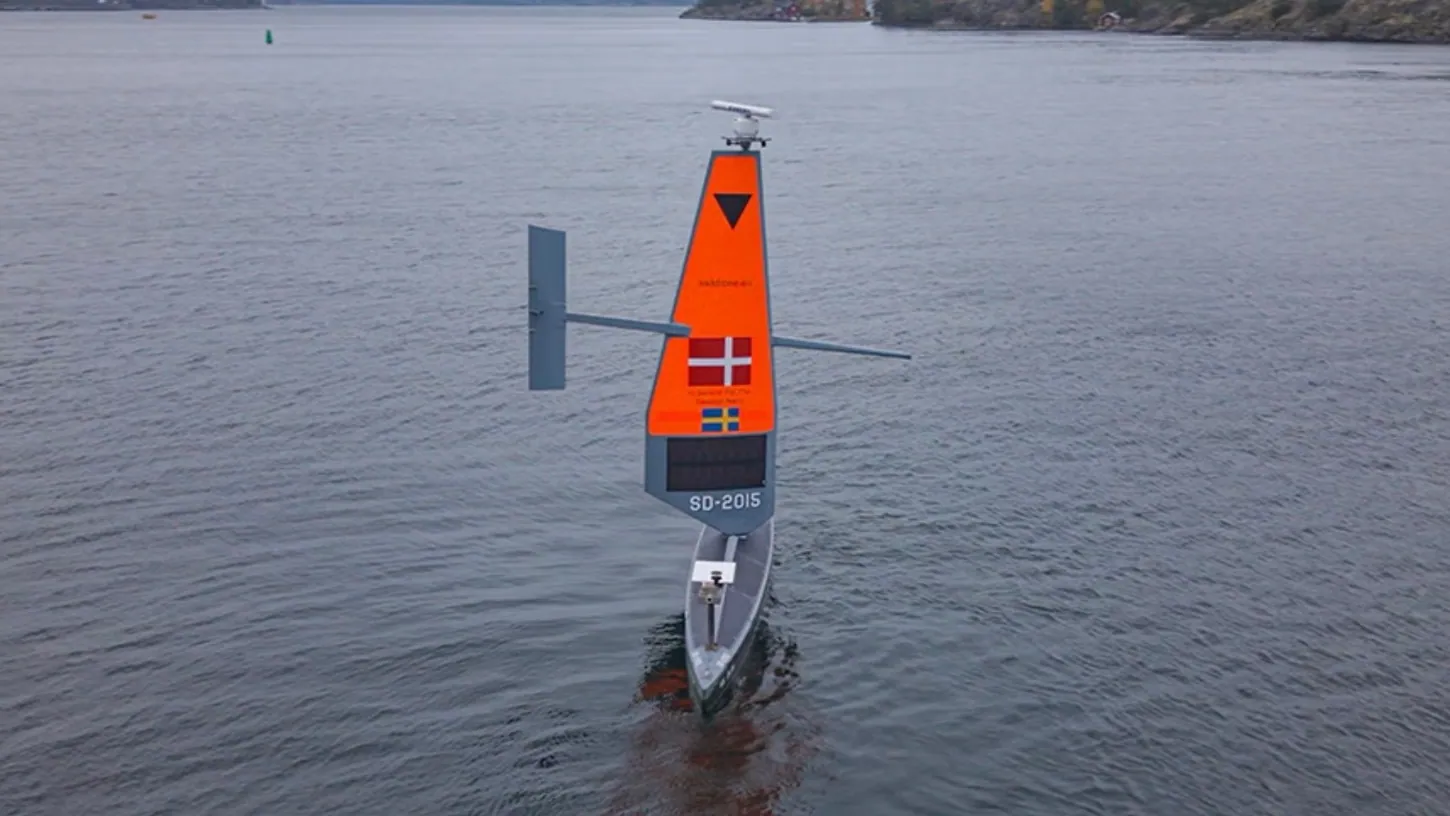
Saildrone founder and CEO Richard Jenkins said in the company’s statement that naval warfare’s future “will be fought on the water, not in a courtroom,” and that the company wants to get back to delivering maritime autonomy for the Navy. Saildrone had fired its first missiles from a Surveyor at the Navy’s RIMPAC exercise in August, as DroneXL reported, and last week began a year-long Baltic Sea patrol for the Swedish Navy with four Voyager vessels.
A Navy spokeswoman did not immediately respond to the New York Times’ request for comment. The service had declined to discuss the pending litigation with Inside Defense in October.
Tony Mazzeo, a former Navy lawyer who represents contractors at Woods Rogers in Norfolk, Virginia, told the Times that winning a bid protest “is an uphill battle.” The Government Accountability Office sustained 14 percent of the protests it decided on the merits in fiscal 2025, its annual report shows, and the Court of Federal Claims applies a higher legal threshold than GAO, Mazzeo said.
The Navy had already ordered 30 boats from three rivals before the ruling
The Navy awarded Galliano Marine Services, HII and Saronic Technologies agreements on September 29 for 10 MUSVs each at roughly $40 million a boat, with deliveries expected to begin by the end of fiscal 2027. Leidos, PacMar Technologies and Sea Machines passed testing and got $15 million. Birdon did not.
At roughly $40 million apiece, the 30 boats come to about $1.2 billion by my arithmetic, under the $1.5 billion obligation ceiling Hadji set. HII, Leidos and Saronic had all intervened in the lawsuit on the government’s side. The Navy’s shipbuilding plan counts on 39 MUSVs in the fleet by fiscal 2027, according to the court’s October opinion. Saildrone and Blue Water both remain eligible for the Navy’s second MUSV solicitation, published September 23, Inside Defense reported.
Saronic is the company whose Corsair pulled two Army Apache crew from the Strait of Hormuz in June, the first time a US sea drone rescued American troops. The Navy has been trying to stand up a drone boat fleet for years, and its earlier effort stumbled through collisions, software failures and leadership firings in 2025 before the Navy launched the MUSV marketplace in March 2026.
Hadji first rejected the Navy’s claim that the court could not hear the case
On October 29, Hadji denied the government’s motion to dismiss, which argued the Court of Federal Claims has no jurisdiction over “other transaction” prototype agreements. He held that the competition fell within the court’s bid protest statute because the Navy ran it in connection with buying MUSVs.
Other transaction agreements sit outside the Federal Acquisition Regulation and the Competition in Contracting Act, and the Pentagon under Defense Secretary Pete Hegseth has pushed to speed up buying. Mazzeo told the Times the ruling may have expanded the court’s jurisdiction, and that it could soon be hearing more cases like this one. The October 29 opinion lists the cases as Nos. 26-936 and 26-944.
DroneXL’s Take
The Navy wanted speed, and it got a court order instead. I understand the urgency: a Saronic boat fished two Apache aviators out of the Strait of Hormuz in June, and 30 hulls are on order with deliveries due to start next fiscal year. But Hadji found disparate treatment, which in Saildrone’s account meant criteria applied to nobody else. Speed does not excuse that. We back merit-based competition on this site, whether the thumb on the scale belongs to Beijing or to a program office in Washington, and a company that fired live missiles from its hull at RIMPAC and now patrols the Baltic for Sweden earned a sea trial on the merits. My read is that other transaction authority just lost some of its appeal as a way around protests, because Hadji has now ruled that a prototype competition tied to a real buy is a procurement he can review, and then reviewed it. The $600 million now sitting frozen is the price of a shortcut the Navy did not need to take.
Sources: The New York Times, Saildrone, Inside Defense, Breaking Defense, US Court of Federal Claims
DroneXL uses automated tools to support research and source retrieval. All reporting and editorial perspectives are by Haye Kesteloo. Read our editorial standards.