The U.S. Marine Corps has a standing order that tells commanders to use 3D printing and other advanced manufacturing as fully as they can, and it aims to move that production close to the fight. Marine Corps Order 4700.4A is dated May 8, 2026, and it covers Group 1 and 2 drones built that way.
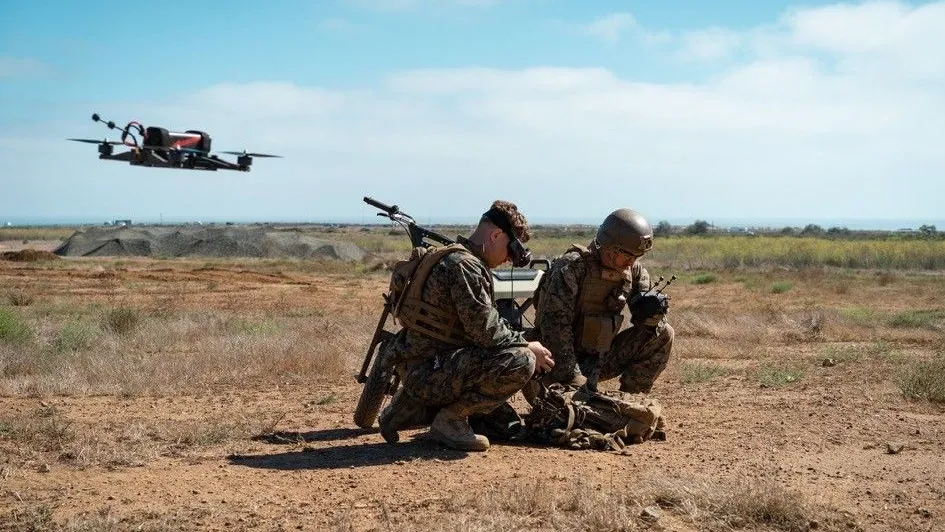
Three months later a Canadian company set up a shipping container at Camp Pendleton, California. Sentinel Advanced Military Solutions says drone frames were printed inside it, assembled on site and flown during an exercise with I Marine Expeditionary Force. On November 18 Sentinel named a U.S. federal reseller for the container, which it sells as Forge-X.
The order ties field manufacturing to technical data rights the Corps holds. Sentinel’s announcement does not say who owns the drone designs stored in its container.
Marine Corps Order 4700.4A Moves Drone Manufacturing To The Unit
Marine Corps Order 4700.4A replaces the Corps’ Additive Manufacturing Policy. It applies to all Group 1 and 2 advanced manufactured small drones and components. It directs commanders at all levels to use advanced manufacturing as fully as possible, and its concept of operations decentralizes production to the point of need.
Group 1 and 2 are the Pentagon’s two smallest drone classes, which top out at 55 pounds (25 kg). Larger drones and crewed aircraft stay under Naval Air Systems Command rules.
The order opens with the reason. “The enemy is now capable of targeting our supply chains and the industrial base,” it says, and it encourages every Marine, whatever the job, to experiment and submit prototypes.
It also changes how the Corps treats risk. The stated goal in training and in conflict is to manage risk and not to eliminate it. Commanders may field printed items unless they judge that a failure would likely cost a life, a limb, eyesight or a major piece of equipment. The order also tells the deputy commandant for installations and logistics to work with two other deputy commandants on removing restrictions on training with and using printed Group 1 and 2 drones on bases and stations.
Marines were building their own drones before the order came out. In February we covered HANX, the 3D printed drone that a sergeant and a small team at 2nd Maintenance Battalion designed in 90 days. In January 2025 we reported that the Army’s 101st Airborne Division had begun printing its own tactical drones at Fort Campbell.
Sentinel Says Forge-X Printed And Flew Drones At Camp Pendleton
Forge-X is a containerized manufacturing system for making drone components and for assembling and repairing drones in the field. Sentinel says frames were printed inside the container, assembled on site and flown in a simulated mission during an August 2026 exercise with I Marine Expeditionary Force at Camp Pendleton.
That account comes from Sentinel’s release. The release gives no count of drones built, no print times and no flight results.
Sentinel is based in Chateauguay, Quebec, and is a subsidiary of CMP Advanced Mechanical Solutions, a Canadian manufacturer with more than 700 employees. Its new partner, Phillips Federal, is a division of Phillips Corporation and becomes the authorized resale and service partner for all U.S. federal purchases of Forge-X and two sister systems, Forge-Extreme and Forge-Expedition. Phillips Federal will also supply component kits to units that run the containers.
The announcement sets up a sales channel, and it names no contract, no order from the Marine Corps and no price. Edward Zimmermann, Sentinel’s chief technology officer, described the pitch this way: “The real challenge isn’t manufacturing the right drone today.” He said the harder job is being able to build whatever drone is needed next.
The Order Ties Field Printing To Design Files The Corps Controls
The order authorizes Marines to manufacture equipment that the Marine Corps holds technical data rights to. One of its five pillars is acquiring technical data packages and license rights for the life of an item. It calls for procurement processes that let vendors make parts from government furnished data packages.
HANX is the in-house example. Marines designed it themselves, and the sergeant who led the project said drones bought through contractors are ones Marines aren’t allowed to modify.
Forge-X is a tool and not a drone design, so it could print government-owned files as readily as a vendor’s. Sentinel says personnel can adapt designs using digital manufacturing files and instructions stored on site, and that service members can produce and iterate on designs in the field. The release does not say whether the files used at Camp Pendleton were Sentinel’s designs, the government’s, or both. It also does not say what rights a unit would hold to change a design and print it somewhere else.
DroneXL’s Take
I think the Marine Corps wrote the right order. A unit that can change a frame and print it the same day will keep up better than one waiting months on a shipment, and a container full of printers is a sensible thing to buy for that. But printers can be swapped out, and a unit lives with the design files for years. HANX came out of a Marine maintenance battalion in 90 days because its builders wanted a drone they were allowed to modify. Before any service orders Forge-X, I’d want the contract to spell out who owns the files it prints and whether Marines can change them.
Sources: U.S. Marine Corps, MCO 4700.4A, Sentinel Advanced Military Solutions, Military + Aerospace Electronics
DroneXL uses automated tools to support research and source retrieval. All reporting and editorial perspectives are by Haye Kesteloo. Read our editorial standards.
Advertise with DroneXLYour company hereReach 200,000+ drone readers a month with a sponsored article, a banner on your beat, or a partnership.See the options →