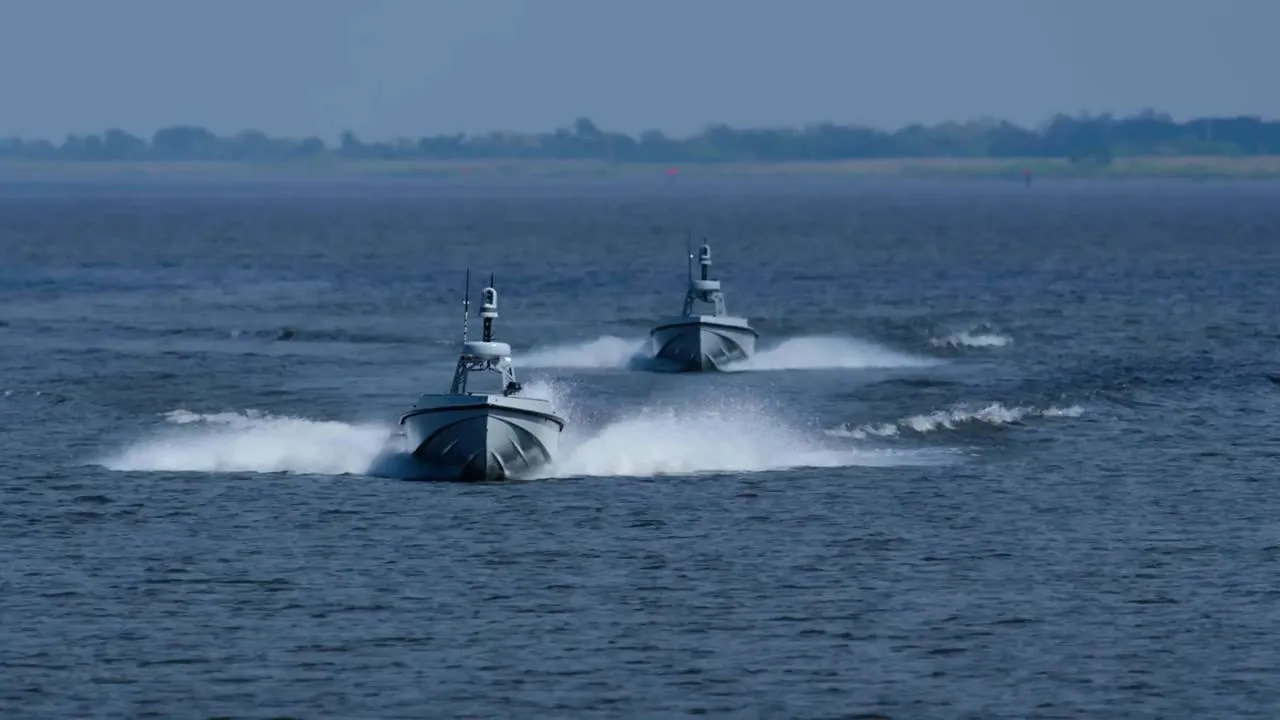
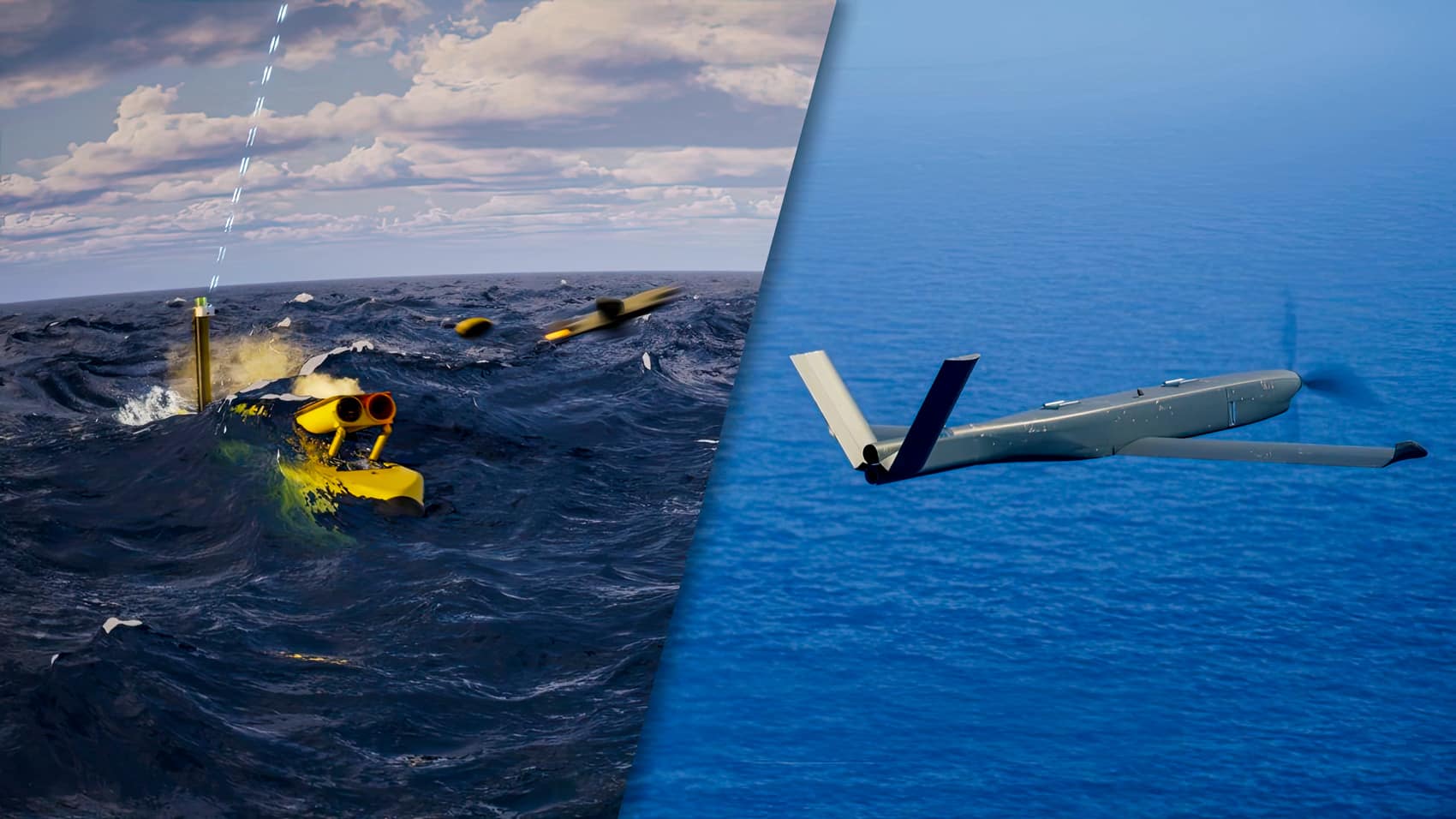
A Saildrone Surveyor fired two Lockheed Martin Joint Air-to-Ground Missiles (JAGM) off the coast of Hawaii during the US Navy’s Rim of the Pacific (RIMPAC) 2026 exercise, the first missile launch ever conducted from one of the company’s wind-powered uncrewed vessels. Saildrone announced the demonstration on August 20, about three weeks after RIMPAC wrapped up on July 31.
Until recently, these hulls were better known for sailing into hurricanes for NOAA than for firing weapons. That résumé now includes live ordnance.
Two Missiles Left the Rail Through the Navy’s ARES Combat System
The Saildrone Surveyor fired both rounds while acting on target data for a surrogate high-speed surface craft, with the Navy’s Adjunct Remote Engagement System (ARES) handling weapons control. The launches took place in coordination with the USS Theodore Roosevelt (CVN-71) Carrier Strike Group.
ARES matters here. It is a remotely operated combat system, which means a human, not the robot ship, made the shoot decision. The 66-foot (20-meter) Surveyor supplied the platform, the persistence, and the sensor picture; the kill chain still ran through Navy hands. The demonstration was sponsored by the US Navy Fleet Experimentation Program, the Navy’s fast lane for testing new technology inside real exercises, according to Saildrone’s announcement.
Lockheed Martin bills JAGM as the in-production successor to the Longbow Hellfire, so the munition itself is thoroughly proven. What changed is what it was bolted to (a mission set Ukraine’s improvised sea drones forced onto every navy’s whiteboard). Richard Jenkins, Saildrone founder and CEO, said the test paired a trusted munition with “the most operationally deployed class of USV on the planet.”
Lockheed Martin’s October Investment Produced a Live Launch in Six Months
Lockheed Martin put $50 million into Saildrone in October 2025. Six months of joint engineering later, the integrated launcher fired live rounds at sea. The demonstration ran under the US Navy Fleet Experimentation Program, which sponsors rapid tests of new technology during fleet exercises.
The October partnership made Lockheed Martin the lead mission integrator while Saildrone kept shipbuilding. The RIMPAC event was the payoff both companies promised at signing: an on-water, live-fire demonstration in 2026, delivered with months to spare. Lockheed has been buying its way across the unmanned maritime domain at speed; DroneXL covered its Lamprey autonomous submersible in February, and the company closed a $3.45 billion deal for sonar maker Ultra Maritime in July.
The Surveyor did more than shoot. During the same exercise it deployed a passive electronic warfare sensor that identified a surrogate threat radar while working with an MH-60 helicopter, the kind of quiet listening job these hurricane-hardened hulls were doing for scientists long before anyone armed one. Paul Lemmo, Vice President and General Manager of Sensors, Effectors and Mission Systems at Lockheed Martin, said the companies will keep working to “invest in new capabilities ahead of need.”
The 170-Foot Spectre Carries the Bigger Payload Ambition
Saildrone’s 170-foot (52-meter) Spectre, the first of which is under construction, is designed to carry Lockheed Martin’s containerized Mk 70 launcher and towed sonar arrays for anti-submarine warfare, with a concealed deck sized for up to five 20-foot containers. RIMPAC was the warm-up.
Saildrone says the Spectre will displace around 330 tons (300 tonnes) fully loaded and reach 30 knots, with two variants: one with the company’s signature wing sail for near-silent transits, one without for a lower profile at speed. The anti-submarine ambition is not new territory for the company either. Saildrone was already testing towed sonar with Thales in April 2025, well before Lockheed’s money arrived.

The Surveyor that fired at RIMPAC stays in the fight as the smaller sibling: a multi-mission vessel built to hold station for months at a time, now with a JAGM dual launcher on the bow.
DroneXL’s Take
Extending the fleet’s missile magazine is the mission commanders most want from uncrewed surface vessels. Saildrone and Lockheed Martin just showed the shortest route there: bolt a combat-proven munition onto a hull family Saildrone says has logged more than 2 million nautical miles.
I don’t think the missile is the story here. The calendar is. A defense prime and a commercial drone builder went from signed deal to live rounds at a fleet exercise in well under a year, while conventional shipbuilding programs measure schedules in decades. Lockheed’s own write-up ties the effort to the Navy’s push for affordable mass by 2027, and this is what affordable mass looks like when someone actually builds it instead of briefing it.
Yes, this was a scripted shot at a surrogate target with a human on the ARES trigger and nobody jamming the link; combat conditions will be meaner. Saildrone has at least been operating in GPS-denied and spoofed waters in the Middle East, which answers part of that objection, though not all of it. The concept still holds. Ukraine proved cheap sea drones change naval math; the Pentagon is now buying that lesson in American form.
Watch whether a Mk 70 round leaves a Spectre deck before RIMPAC 2028. The first hull is under construction and the integration is already on both companies’ roadmap. If that shot happens, a wind-powered robot ship will be carrying the same missile cells as an Arleigh Burke destroyer.
Source: Saildrone
DroneXL uses automated tools to support research and source retrieval. All reporting and editorial perspectives are by Haye Kesteloo.