
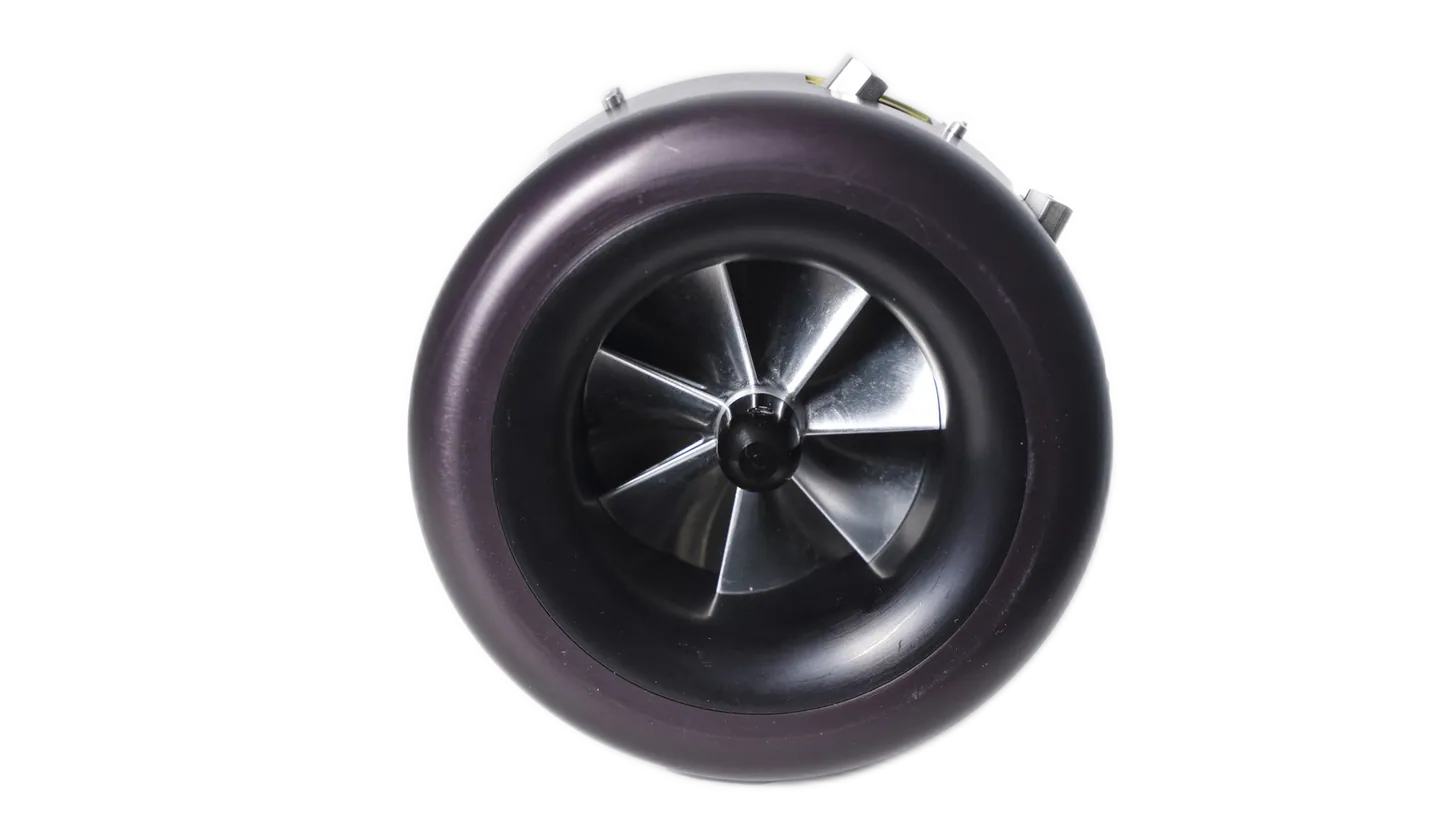
Acutronic, the Swiss defense manufacturer that builds shoebox-sized jet engines for military drones and missiles in Austin, Texas, plans to double its U.S. workforce over the next three years. Chief executive Florian Aigrain told the Financial Times, in an interview published November 17, that it also wants to raise output from hundreds of engines a year to thousands next year.
About half of Acutronic’s roughly 400 employees work in America. Aigrain said the company is also considering engine production in Europe, where it has sites in Germany and France. He is not sure he would start a jet engine business today in Switzerland, where Acutronic was founded more than 50 years ago.
The FT puts the fundraising behind the expansion at $100 million, backed by U.S. investors InterAlpen Partners and Hale Capital. Acutronic has announced only the $25 million those two firms invested in April, which its press release called a first close.
Acutronic Has Announced $25 Million Of The $100 Million
Acutronic’s newsroom lists no funding announcement after the April 13 press release that put the first close at $25 million. Everything posted since then is trade shows, advisory board appointments and a new facility in India, so the $100 million figure rests on the Financial Times report alone.
The April release said the money would pay for new products, more production capacity and working capital, and Aigrain told the Austin Business Journal it might also fund acquisitions. InterAlpen is a private equity firm based in Nebraska, and Hale Capital Partners is a New York investor that focuses on defense technology. The same story, which InterAlpen republished, called it the first outside investment in Acutronic’s history.
A first close normally means more money follows in the same round, which would account for the difference. Neither Acutronic nor its investors has published a total, and the FT’s report does not say how the $100 million breaks down.
The Engines Come From Austin, And A Bastrop Factory Is Next
Acutronic develops, tests and assembles its micro-turbines at its Aerospace Components Division headquarters in Austin. A dedicated factory is planned in Bastrop, about 30 miles (48 km) southeast. The company announced in June 2024 that it had bought 13.84 acres (5.6 hectares), committing at least $4 million and 50 jobs.
The company called that site the only jet engine manufacturing facility in Texas. The Austin Business Journal reported in April that about 60 people worked at the Austin building, that the Bastrop plant would start at 20,000 square feet (1,858 square meters), and that Acutronic planned to break ground by the end of this year.
Acutronic says its Austin facility is one of the only ones in the United States able to mass-produce small jet engines, and that it has been selected to supply engines for a number of platforms in U.S. defense programs. It has not named them. “Jet engines are a bottleneck across the allied world,” Aigrain told the FT.
When RFE/RL took apart a Russian jet drone in September, DroneXL reported that the Geran-4 runs on a $25,000 Chinese hobby turbojet, and that Ukraine was stopping 55 percent of the jet-powered Shaheds against more than 90 percent of the propeller ones.
Swiss Neutrality Rules Keep Sending Defense Firms Abroad
Aigrain told the FT he is not sure Acutronic would start a jet engine business in Switzerland today, citing high costs and political limits. The FT reports that neutrality-linked export controls and banking restrictions make it harder for Swiss defense companies to export and move money.
He also said Switzerland remains an important base for Acutronic because of its skilled and stable workforce, and the company described itself in April as headquartered in both Zurich and Austin.
Other Swiss-founded drone companies have already made the move. Auterion, the drone software company that started in Zurich, moved its headquarters to the United States and was already a U.S. company when Rheinmetall bought a stake in it last year. Destinus, a drone maker that supplies Ukraine, was based in the Netherlands by the time it agreed to buy Zurich’s Daedalean for $223 million.
DroneXL’s Take
Europe is in the middle of its biggest defense build-up in a generation, and one of its own engine makers is doing its hiring in the United States. I don’t blame Acutronic for that. A company builds where it can sell and ship, and by its own chief executive’s account Swiss rules make both harder. If European governments want the supply-chain sovereignty Aigrain talks about, they will have to compete for these factories with orders and workable export terms, because the United States already does. For American drone makers this is good news, since a small jet engine built in Texas by an allied company is one fewer part to import. Acutronic told the Austin Business Journal in April that it would break ground in Bastrop by the end of this year. Six weeks are left, and I’ll be checking.
Sources: Financial Times, Acutronic, Austin Business Journal via InterAlpen Partners
DroneXL uses automated tools to support research and source retrieval. All reporting and editorial perspectives are by Haye Kesteloo. Read our editorial standards.


