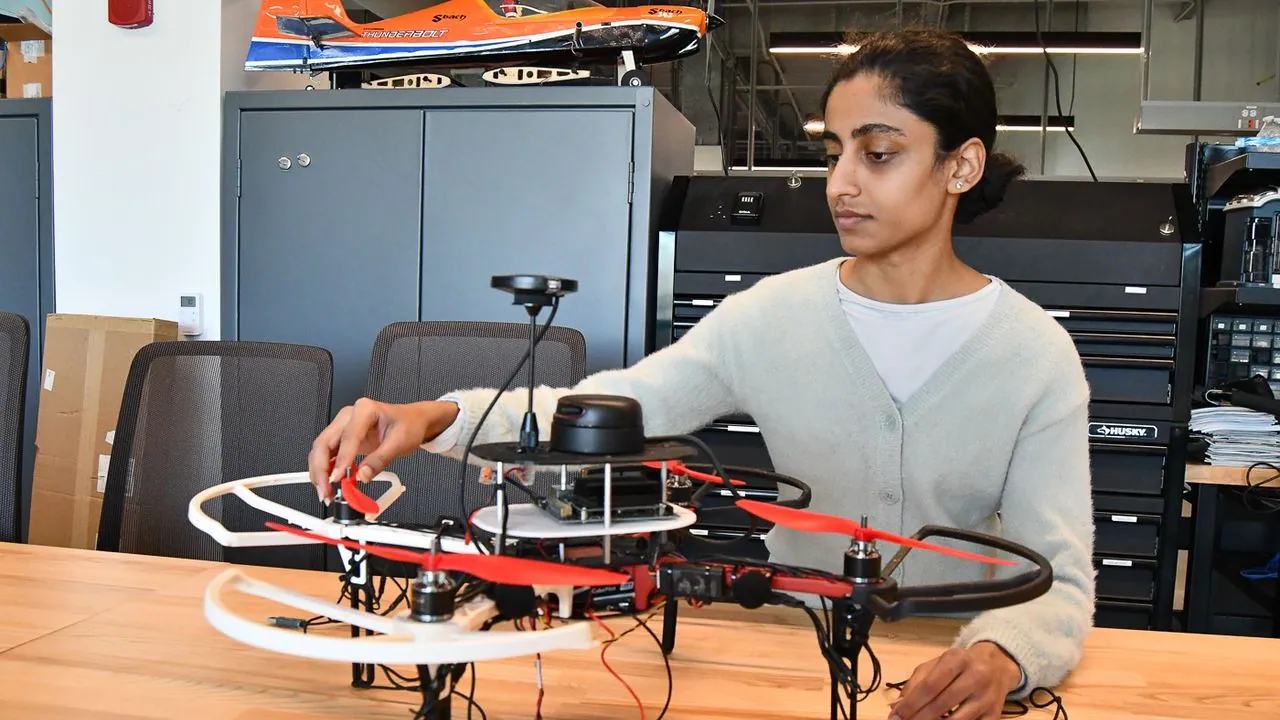
University of Cincinnati students working with a researcher at NASA Ames Research Center have built a preflight check that listens to a drone’s motors and tells the operator whether the aircraft is fit to fly. The team runs each motor on the ground, one at a time, and records it with microphones placed near the motors and propellers. A machine-learning model then decides whether the sound is healthy.
The students presented the work at the 2026 Modeling, Estimation and Control Conference in Phoenix, held October 25 to 28. The paper’s abstract reports about 97% precision and 92% recall. The model learned from healthy motor recordings alone, with no labeled examples of a fault.
The Model Learns Only What A Healthy Motor Sounds Like
The Cincinnati model is a one-dimensional convolutional autoencoder trained on recordings of healthy brushless motors, taken across nine operating maneuvers. Any sound that does not match what it learned gets flagged as a fault, so the team did not have to collect and label a recording of every possible failure.
That choice fits the problem. Prissha Chawla is the student behind the work, and the University of Cincinnati’s October 29 release lists chipped propellers, cracked propellers, and grit in a motor bearing that can make it seize. Chawla told Spectrum News 1 that a faulty motor sounds different depending on how bad the fault is. Now a doctoral student and the paper’s first author, she described the model’s logic to the university in December 2025, when she was still an undergraduate: “anything that does not look healthy is considered faulty.”
The paper is titled “Acoustic UAS Powertrain Monitoring: An Empirical Semi-Supervised Anomaly Detection for UAS Powertrains,” and it is listed in the conference program. Chawla’s co-authors are UC mechanical engineering professor Manish Kumar, UC students Siddharth Urankar and Luke Busse, Manuel Arias Chao of the Zurich University of Applied Sciences, and Chetan Kulkarni of NASA Ames.
The two headline numbers mean different things for a pilot. If a fault counts as the positive result, precision of about 97% means roughly three in every 100 fault warnings are false alarms. Recall of about 92% means about eight of every 100 faults are missed. The abstract does not name the aircraft or say how many microphones the team used, and the full paper is not yet on arXiv or NASA’s technical reports server.
The Check Is Built Around Preflight Tests NASA Already Runs
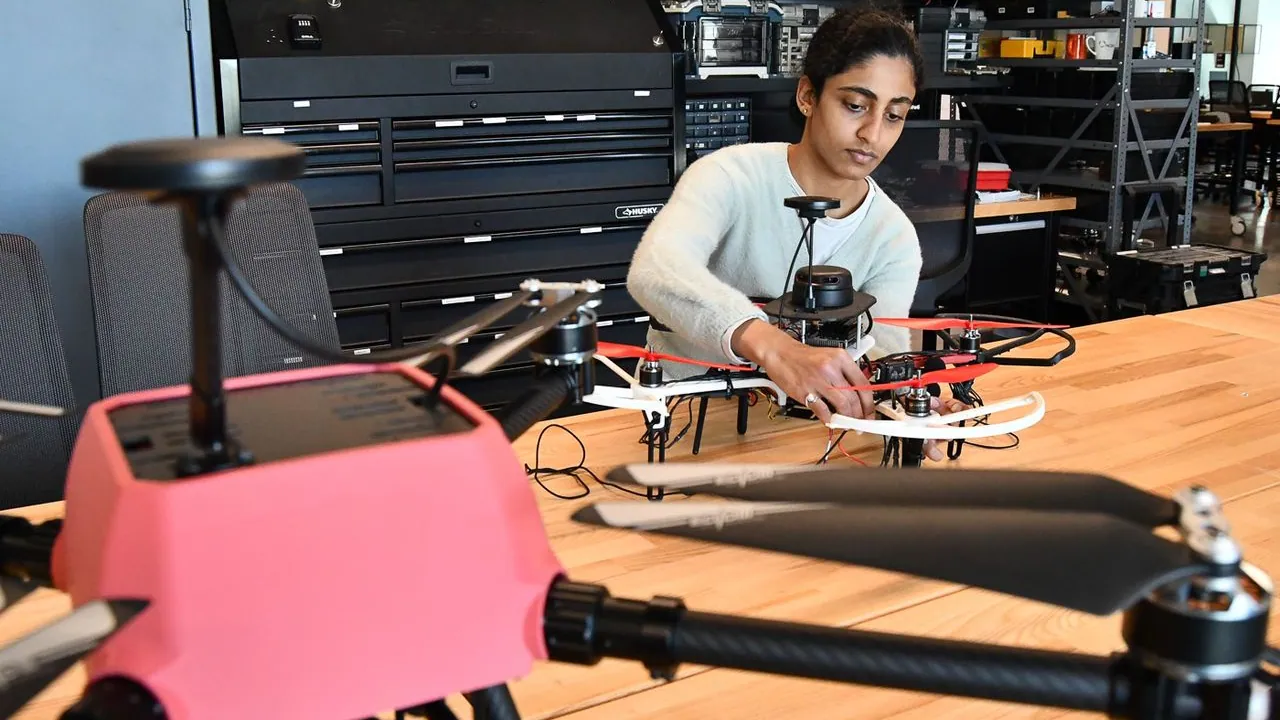
The project started in 2024 with NASA’s interest in catching motor problems before takeoff, Chawla told the university. It is built around preflight tests the agency already runs. Kulkarni, the NASA co-author, is a KBR researcher in the Diagnostics and Prognostics Group at NASA Ames in California.
That group researches fault detection and health management for unmanned aircraft. The abstract says the results support adding real-time acoustic diagnostics to In-Time Aviation Safety Management Systems, the NASA concept behind the hazard-prediction software DroneXL covered in April 2025. For now the analysis runs on a computer at a ground station, which alerts the operator before takeoff.
The work is still moving. Busse told the university that a drone-in-a-box dock could carry the sensors and run the check on its own. UC student Taha Momayiz told Spectrum News 1, which visited the lab for a report published November 17, that the team tests a drone on the bench before sending it anywhere, “to see if it’s healthy enough to fly.” Chawla told the station she hopes autonomous drones will one day use sound alone to detect damage to their own rotors.
DroneXL’s Take
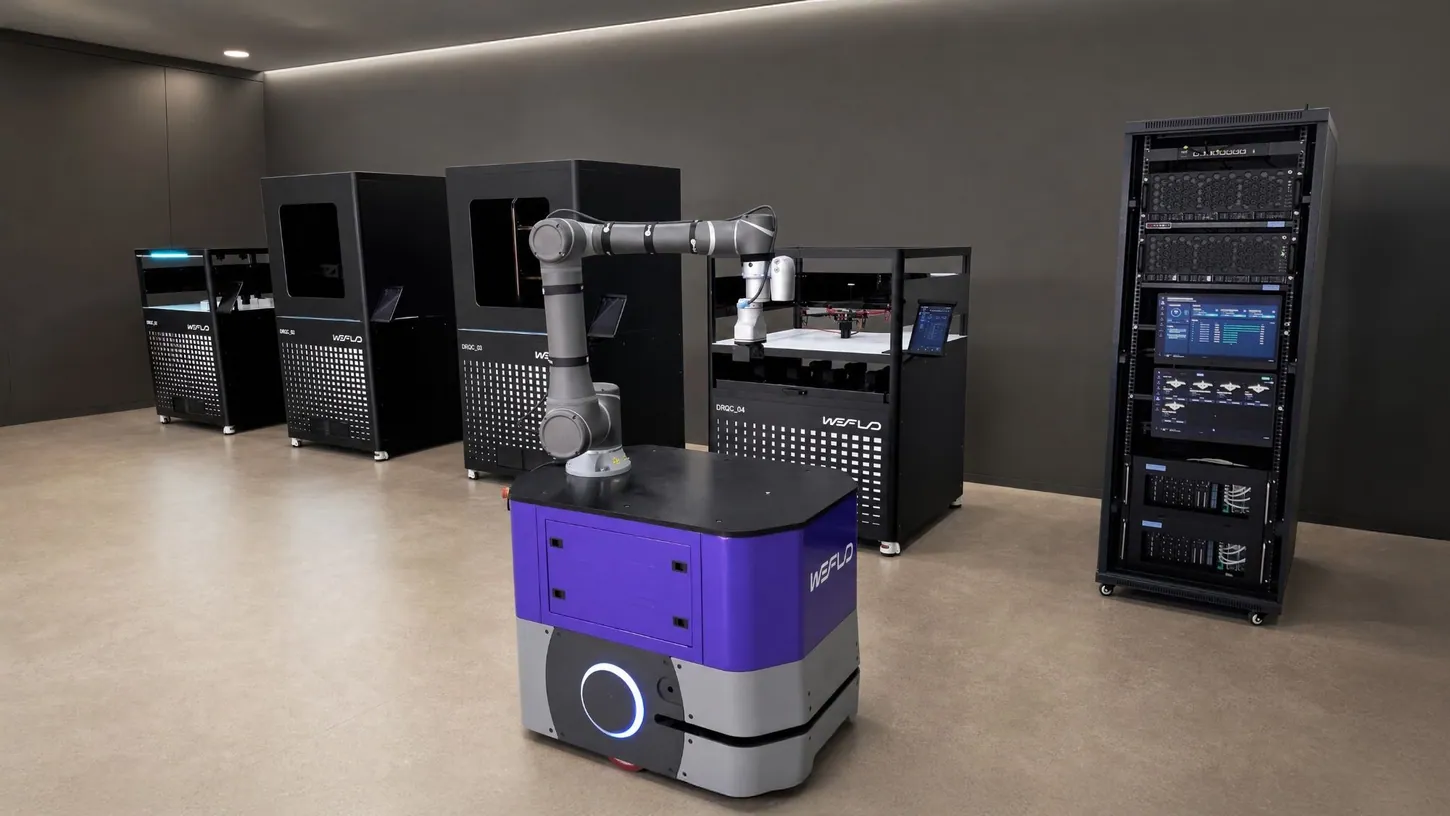
The dock is where I’d put this first. Part 107 makes the remote pilot check that the aircraft is in a condition for safe operation before every flight (14 CFR 107.15), and on a dock-based police or delivery drone there is nobody standing next to the props to do it. A microphone is cheap and light. Duke’s SonicFly drone, which we covered in August, carried a four-microphone array that weighs 10 grams. The idea is also already for sale: South Korea’s WEFLO says it has 34 diagnostic pads running acoustic and vibration checks for drone delivery programs. Cincinnati’s abstract puts numbers on a check that uses sound alone, and those numbers say about eight faults in 100 still get through. I think that makes it a second opinion for the pilot’s own inspection and not a replacement for it.
Sources: Spectrum News 1, University of Cincinnati, 2026 Modeling, Estimation and Control Conference program, NASA
DroneXL uses automated tools to support research and source retrieval. All reporting and editorial perspectives are by Haye Kesteloo. Read our editorial standards.