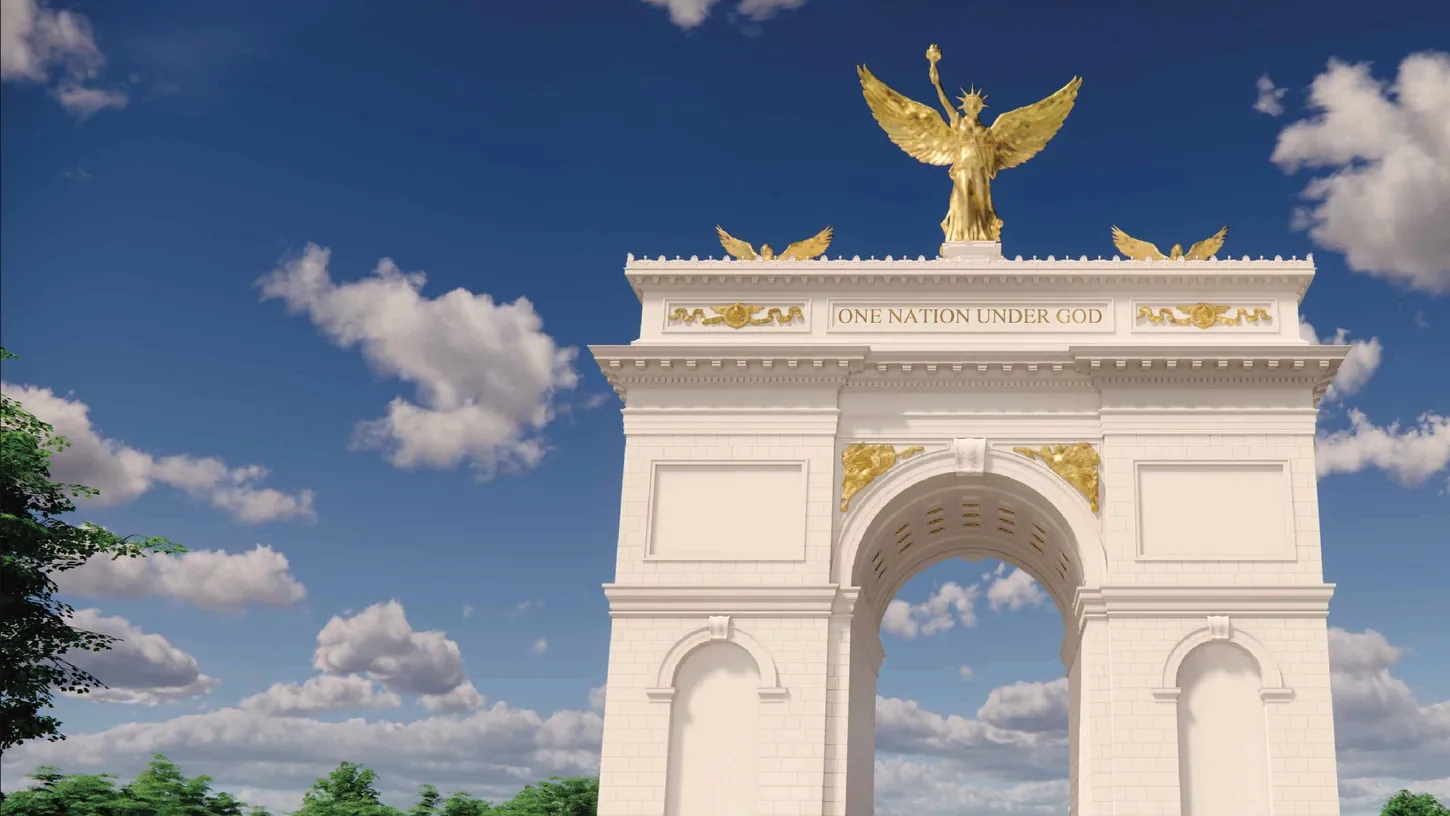
A federal judge in Virginia has blocked construction of President Trump’s 250-foot Triumphal Arch at Memorial Circle. In the same ruling she said the administration’s national defense argument for the arch, which rests on fighting drones, lacks credibility. U.S. District Judge Leonie Brinkema granted Arlington County a preliminary injunction on November 20 and refused to pause it while the government appeals.
The drone argument came from the top. Trump wrote in September that, at the military’s request, the arch would house and rapidly use “large numbers of drones, plus Snipers.” In October, Secretary of War Pete Hegseth and Homeland Security Secretary Markwayne Mullin swore in court that it would serve as a counter-drone node for the capital. The Park Service’s own decision record, filed by the government in the same case, says its environmental analysis “does not consider any potential future uses of the Arch for national security purposes.”
Hegseth Swore the Arch Would Hold Counter-Drone Sensors, Ammunition and Drones
Hegseth’s sworn declaration, filed October 28, calls the arch a generational national defense opportunity and a dual-purpose structure. It promises counter-UAS sensors above the city’s buildings, command space, protected power, and secure storage for ammunition and counter-UAS drones, all part of the National Capital Region’s air defenses.
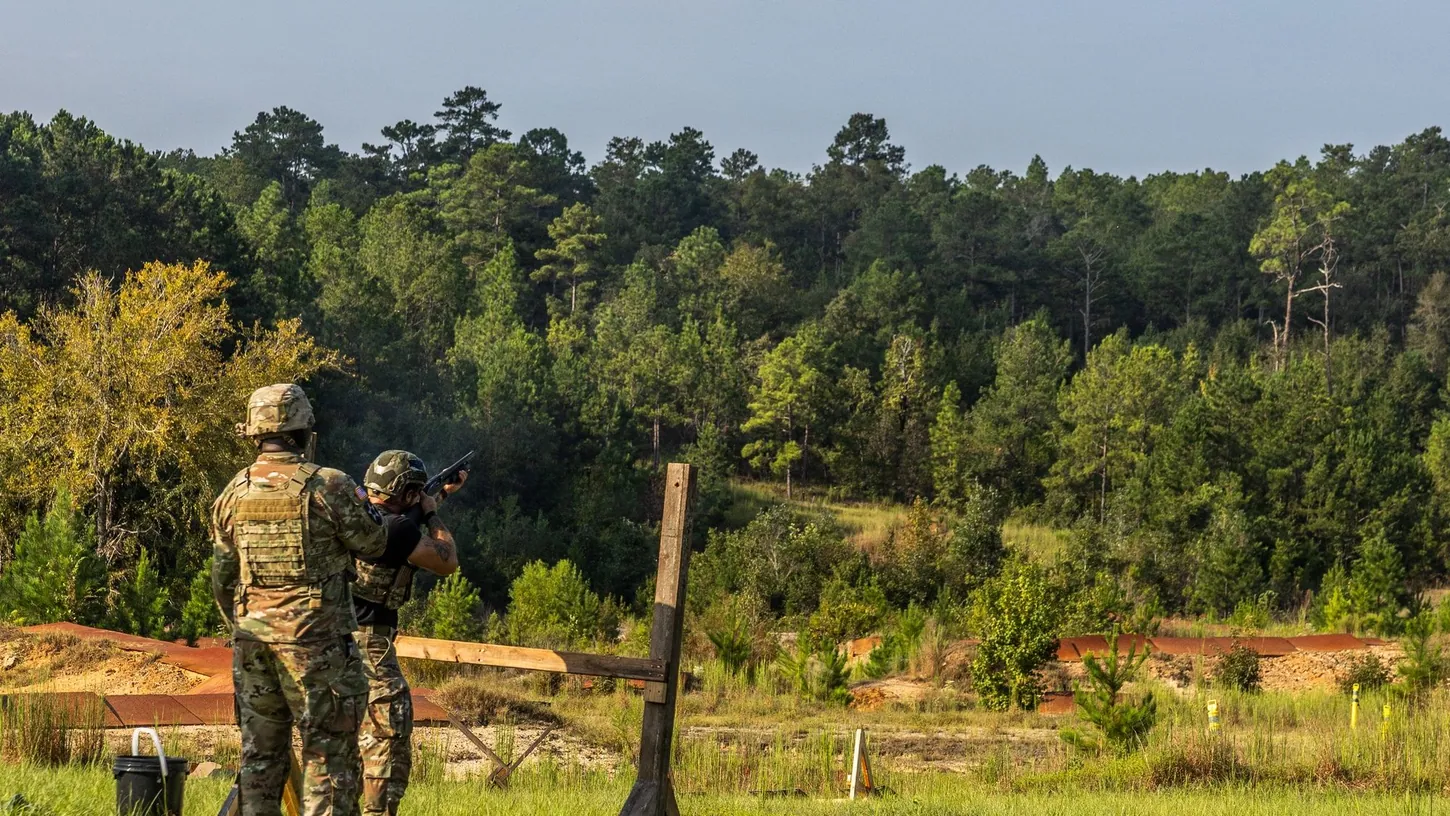
Hegseth opens by listing his current counter-drone initiatives: Joint Interagency Task Force 401, its Domestic Shield program, and Project Agincourt, the pathway to the four-star Autonomous Warfare Command. He also says the elevated position can support protective-overwatch and counter-sniper personnel. That reads like the sniper half of Trump’s September post, in Pentagon language.
His case rests on a gap he describes himself. Counter-drone coverage in the capital can be episodic, he wrote, surged during National Special Security Events and then pulled back. DroneXL covered exactly that model on the National Mall this summer, when Secret Service counter-drone teams worked the first July 4 NSSE.
The declaration says the systems will be built into the arch’s load-bearing, power and data systems “from the outset,” and that none of it requires changes to the existing plans. Mullin’s declaration contains the same no-changes sentence word for word. Neither says where the equipment goes in the design.
Mullin Built DHS’s Case on Hobbyist Drones and Remote ID
Mullin’s declaration, dated October 27, opens with the size of the drone fleet. He cites a projection that the commercial fleet alone could reach 1.015 million drones by 2027, and says import data suggests FAA registration numbers “significantly underestimate” the recreational fleet.
From there he argues that the five agencies with counter-drone authority (DHS, the CIA, the Justice Department, the Department of War and the Energy Department) struggle to tell authorized drones from threats over Washington. He blames missing tracking infrastructure, naming Remote ID, and the lack of a shared database. The FAA has enforced its Remote ID rule since March 16, 2024. As I read it, the gap Mullin describes is on the receiving end: who collects those broadcasts across the capital, and who shares them.
His answer is a central, elevated node where agencies work side by side, with sensors above the city’s buildings. Mullin says that once the arch is properly equipped, DHS could use its own counter-drone authority under 6 U.S.C. § 124n there to detect, track and, if necessary, mitigate drones. DHS already set up a permanent counter-drone program office in January.
Brinkema Said the Defense Claim Surfaced After the Lawsuits Began
Brinkema’s memorandum opinion says any national defense need for the arch “lacks credibility as it first was raised after litigation” began. She adds that the Park Service did not consider the proposed security uses in its review. The government had filed both declarations as exhibits in her court.
She did not rule on whether the arch would work as a counter-drone site. The legal core of the ruling is Congress. Brinkema found the county likely to win under the Commemorative Works Act and the Park Service’s Organic Act, because Congress never approved this structure. The government says a 1925 law covers it. That law approved a plan with two columns 166 feet high on Memorial Bridge, framing the view of the Lincoln Memorial from the Lee Mansion, now called Arlington House. The arch body itself is about 166 feet, Mullin’s declaration says, and its observation deck and gilded figures take it to about 250. Brinkema wrote that a century-old approval was not a blank check to build a different structure in the same general location without going back to Congress.
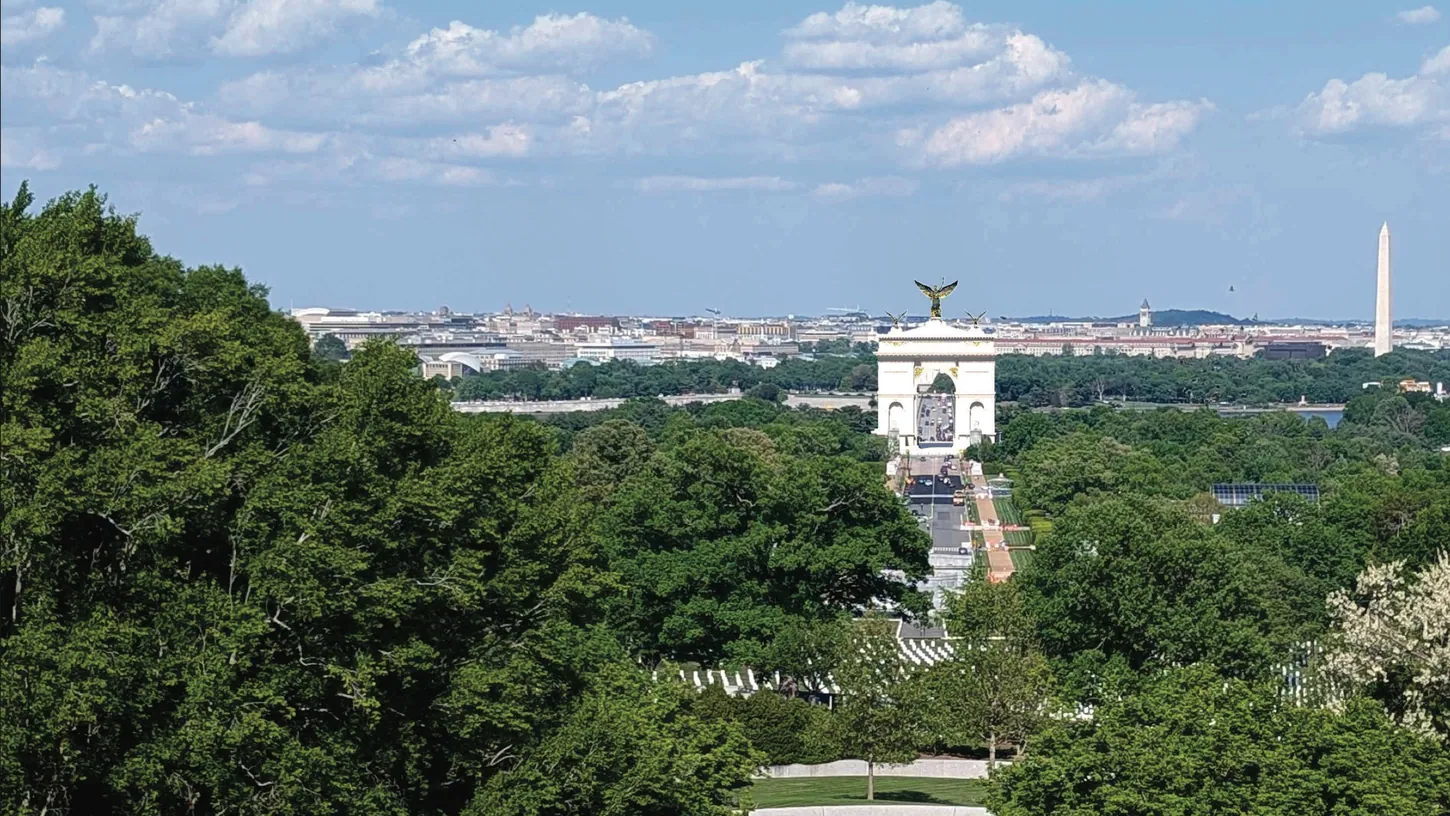 The “after” view from Arlington House, the Lee Mansion of the 1925 plan, in the arch’s NCPC submission. Image credit: Harrison Design / U.S. Department of the Interior via NCPC
Her order bars construction and any site preparation, surveying, excavation, equipment placement, road closures or barriers for the arch at or near Memorial Circle. It runs until the case is decided or the order is lifted. The government filed a notice of appeal to the Fourth Circuit on November 21.
The arch is also on hold in Washington. In Lemmon v. Trump, brought by Vietnam veterans, an architectural historian, Virginia and the District of Columbia, Judge Tanya Chutkan extended her temporary restraining order through December 3. That is the case where Hegseth and Mullin first filed their declarations. Nine members of the Kennedy family are asking to join it.
DroneXL’s Take
I’d back a permanent, funded counter-drone network for the capital, because the gap over Washington is real. Two cabinet secretaries told a court under oath that protection outside big events is episodic, and in June the FBI disrupted an alleged explosive-drone plot against the White House UFC event.
But this is the wrong way to get one. The defense requirement first appeared in court filings over a monument, and the Park Service then approved the project in November without considering it. To me that reads like a litigation argument more than a defense plan, and Brinkema found it lacked credibility for the same reason. If the capital needs an elevated counter-drone node, the Pentagon and DHS can ask Congress for it on its own merits, with a budget and a site review. Tying it to the arch puts Washington’s drone defense on hold over a 1925 bridge plan and the view from Arlington House.
Drone pilots should read Mullin’s declaration too. To make the case for the arch, DHS led with the size of the hobbyist fleet and how little the government knows about it. I expect that framing to outlast this lawsuit, whatever the Fourth Circuit and Judge Chutkan decide about the arch.
Sources: Memorandum Opinion and Order, County Board of Arlington County v. National Park Service, E.D. Va. No. 1:26-cv-03372, Declaration of Pete Hegseth and Declaration of Markwayne Mullin in Lemmon v. Trump, D.D.C. No. 1:26-cv-00544, ABC News, National Capital Planning Commission.
DroneXL uses automated tools to support research and source retrieval. All reporting and editorial perspectives are by Haye Kesteloo. Read our editorial standards.
Advertise with DroneXLYour company hereReach 200,000+ drone readers a month with a sponsored article, a banner on your beat, or a partnership.See the options →