
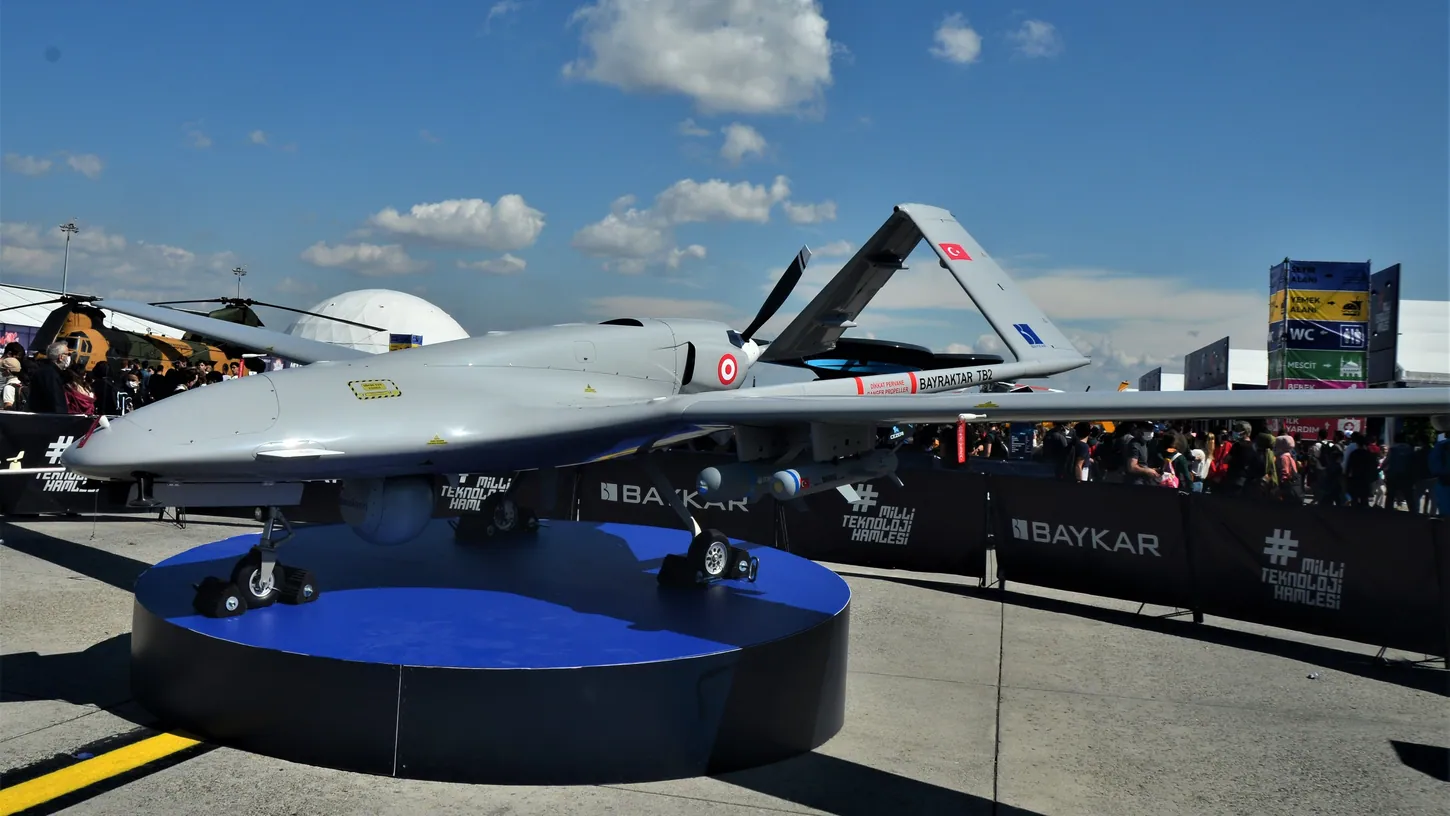
Bomb fragments from a strike that killed a pregnant woman and her three daughters in a cave in northern Somalia on May 21 came from a Turkish-made munition, according to an investigation The Guardian published on November 25. Independent analysts at Armament Research Services identified the pieces as a MAM-series bomb built by Roketsan, Turkey’s state-owned missile maker. One of them, N.R. Jenzen-Jones, said the bomb was probably dropped by a drone, most likely a Bayraktar TB2.
The family was herding 250 goats near Baxaya, in the Golis mountains of Puntland. Saynab, who was due to give birth within days, died with Fadumo, 14, Anab, 13, and Aman, 12. Her husband, Mohamed Iid Ismael, survived with shrapnel wounds and burns and dragged himself toward a phone signal about 3 miles (5 kilometers) away.
Turkey, the United Arab Emirates and Somalia’s federal government all fly Bayraktar drones over Somalia. None of the three answered when The Guardian asked which of them dropped the bomb.
The Baxaya Strike Has No Owner Six Months Later
Bomb fragments can name a weapon’s maker but not the crew that released it, and no government had claimed the May 21 strike by November 25. Somalis call these “ghost strikes.” Several air forces hunt Islamic State fighters in the same mountains, and few of them publish where they bomb.
Baxaya had been designated a safe zone by Puntland’s regional government, The Guardian reported, a status confirmed by Ashkir Nuur, Somalia’s deputy ambassador to Tanzania and the representative for the constituency. He said Puntland has neither apologized to nor compensated the survivor. The 36 men from the coastal town of Buruc who walked about 19 miles (30 kilometers) to recover the bodies found no fighters at the site, one of them told the paper, and The Guardian reviewed their photos and video of the aftermath. Drones in the TB2’s class carry infrared cameras that, The Guardian notes, should make it easy to tell a fighting force from a family with a herd of goats.
The United States has flown hundreds of strikes in the region, with its own drones rather than Bayraktars. U.S. Africa Command announces declared strikes in press releases, and New America’s November 8 tally of those releases shows the last declared U.S. strike against ISIS-Somalia on May 6, fifteen days before Baxaya. The same analysis lists two strikes reported locally in Puntland this year that AFRICOM said it did not carry out. The UAE publishes no data on how many strikes it has flown in the area, and Turkey and Somalia publish so little that it is hard to confirm when or where they strike, The Guardian found.
Turkey Supplied 21 of the 28 Newest Armed Drone Operators
Drone Wars UK counts 54 states flying armed medium-altitude, long-endurance drones, with eight more close to joining, in a dataset update published November 25. Of the 28 states that became operators in the past five years, 21 imported armed drones from Turkey.
The Guardian’s investigation draws on the same data. The growth is slowing. Operators more than doubled from 20 to 43 between the start of 2021 and the end of 2023, and the count has risen by about a quarter since. The Guardian ties the spread to price. A Turkish drone in the TB2 class runs $2 million to $5 million, the paper reports, against $80 million to $300 million for a U.S. fighter jet.
Baykar, the TB2’s maker, arms its drones with Roketsan’s MAM family of small guided bombs. A MAM-L was seen on a TB2 reported downed over Ethiopia’s Oromia region in 2024. DroneXL mapped how Turkish drones filled the Gulf and North African market after Washington refused to sell, in August’s look at Turkey arming the Arab world. Somalia, Sudan and Ethiopia all appear on Turkey’s customer list. A Turkish diplomatic representative told The Guardian that exports come with guarantees of compliance with international law, and that there is “no verified information” of misuse by Sudan’s army or in Somalia.
The UN Says Drones Killed More Than 1,630 Sudanese Civilians This Year
Drone strikes caused more than 80% of the at least 1,390 civilian deaths the UN Human Rights Office confirmed in Sudan between January and June 2026, its report released November 17 found. Through October, the office confirmed more than 2,230 civilian deaths, over 1,630 of them from drones.
The office says the real figures are likely higher, and its release does not say who built the drones. Kordofan took more than two-thirds of the documented casualties, and Darfur most of the rest. In the first half of the year the office logged at least 39 drone strikes on markets, 20 on civilian vehicles, 17 on fuel tankers and depots, and 16 on health facilities. It attributes 29 strikes on electricity facilities and fuel stations in 11 states between October 20 and November 4 to the Rapid Support Forces, the paramilitary fighting Sudan’s army, and says they set off widespread blackouts.
DroneXL reported RSF long-range kamikaze drones near Nyala airport in Darfur last year. Ethiopia’s Tigray region shows the same pattern, according to The Guardian: dozens of civilians were killed in drone strikes there in October, with Tigrayan, Ethiopian and Eritrean forces all flying drones and none claiming the attacks.
DroneXL’s Take
I think Ankara’s “no verified information” line holds mostly because the operators publish so little that anyone could verify. The UAE releases no count of its strikes. Turkey and Somalia release next to nothing. AFRICOM’s press releases are far from a complete record, and New America has listed locally reported strikes the command says it did not fly, but they at least give a researcher a date and a place to check a cave in the Golis mountains against.
DroneXL covered the TB2’s arrival in Ukraine in 2022 as help for a country under invasion, and I still think a cheap, capable armed drone in the hands of a country defending itself is a good thing. The aircraft is not the problem in Baxaya. If the analysts are right and a TB2 flew that strike, its crew had infrared sensors that should tell a fighting force from a family with 250 goats, and the bomb fell on the family.
Turkey’s export guarantee means little to me unless buyers have to say where they strike. Until they do, every undeclared strike in Puntland is deniable, and Mohamed Iid Ismael has no one to ask why his family is dead.
Sources: The Guardian, Drone Wars UK, UN Human Rights Office, New America
DroneXL uses automated tools to support research and source retrieval. All reporting and editorial perspectives are by Haye Kesteloo. Read our editorial standards.
Advertise with DroneXLYour company hereReach 200,000+ drone readers a month with a sponsored article, a banner on your beat, or a partnership.See the options →


