Anduril FURY Combat Drone Production Starts at Ohio’s Arsenal-1 as US Military Urgency Grows

Check out the Best Deals on Amazon for DJI Drones today!
Anduril Industries will begin building its FURY “loyal wingman” high-speed combat drone within days at its new Arsenal-1 facility in Pickaway County, south of Columbus, Ohio, according to a Reuters report published March 19, 2026 (paywalled). The nearly $1 billion autonomous systems campus is projected to employ more than 4,000 people over the next decade, starting with roughly 250 workers by the end of this year, company officials said Thursday. That start date is roughly four months ahead of the July 2026 initial production target Anduril announced when it first unveiled Arsenal-1. The acceleration comes as U.S. military interest in unmanned aircraft grows, driven by battlefield results in Ukraine and elsewhere.
Arsenal-1 Begins FURY Production First
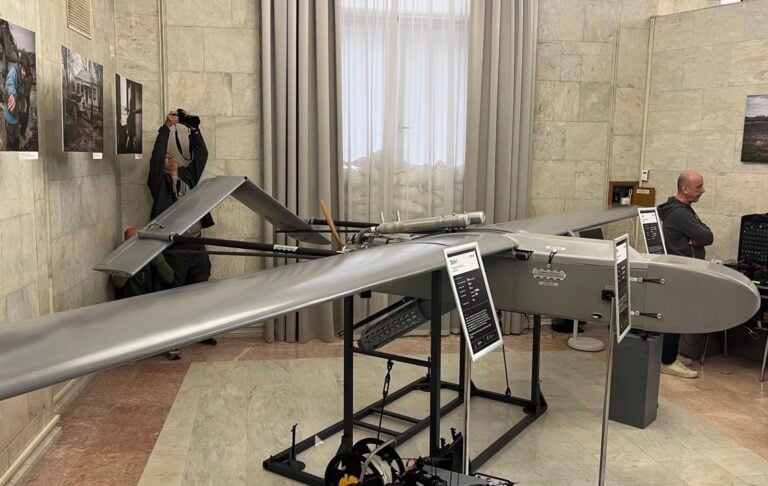
The FURY is Anduril’s entry into the U.S. Air Force’s Collaborative Combat Aircraft (CCA) program, which pairs uncrewed platforms with crewed fighter jets. The drone flies alongside human pilots, extending their reach without putting additional aircrew at risk. DroneXL covered the FURY’s public debut at the 2025 Paris Air Show, where Anduril framed it as a high-endurance platform designed for intelligence, surveillance, and strike missions in contested airspace.
FURY production at Arsenal-1 is first in line. By year-end, the factory is also expected to produce Anduril’s Roadrunner interceptor, the Barracuda cruise missile family, and at least one classified program, per Reuters. That is a wide product range for a facility that has not yet formally opened, and it reflects how aggressively Anduril has accumulated Pentagon contracts.
Anduril Builds for Manufacturing, Not Just Performance
Matt Grimm, Anduril’s co-founder, says the company designs with production in mind from prototype one, a direct contrast to how traditional defense contractors have typically worked. Where legacy primes design for performance first and figure out supply chains later, Anduril locks in manufacturability before the first test article flies.
Concrete choices back that claim, per Reuters. The FURY program uses aluminum instead of titanium, composite techniques borrowed from recreational boat manufacturing, and a commercial business jet engine selected in part because its supply chain and maintenance network already exist at scale. Those decisions lower per-unit cost and reduce the single-source supplier risk that has plagued other defense programs. When the Air Force swapped AI systems mid-flight on the YFQ-44A earlier this year, it demonstrated that Anduril’s software architecture is modular enough to treat autonomy as a reconfigurable layer rather than a fixed feature, which pairs directly with this manufacturing philosophy.
From Ohio Farmland to a Nationwide Production Network
Arsenal-1 is the largest single facility in Anduril’s growing production network, but it is not the only one. The company currently operates factories in Mississippi, Rhode Island, Colorado, Atlanta, North Carolina, and Southern California. Anduril announced an additional nearly $1 billion commitment to a Long Beach campus in January 2026, raising questions about how the Ohio and California sites divide program responsibilities. The Ohio plant appears to be the volume manufacturing hub; Long Beach leans toward engineering and advanced development.
The Pickaway County site, surrounded by cornfields and horse farms near Rickenbacker International Airport, reflects a deliberate site selection strategy. Lower land costs and available industrial labor both factored in, as did proximity to Rickenbacker’s Ohio Air National Guard infrastructure. Local opposition did materialize in early 2025, with protesters gathering outside Rickenbacker to object to the plant, though that pushback did not slow the project.
Pentagon’s New Vendor Strategy Puts Anduril at the Front
Anduril sits at the center of a deliberate Pentagon effort to diversify its supplier base away from the five or six primes that have dominated defense procurement for decades. The Trump administration has publicly signaled it wants newer firms to deliver next-generation weapons faster and at lower cost. That framing benefits Anduril directly, and the company has moved to lock in production capacity before competitors can catch up. The YFQ-44A’s first flight in October 2025 gave Anduril a hardware milestone that few rivals can match this quickly in the CCA timeline.
The broader backdrop is hard to ignore. China’s PLA demonstrated a 200-drone swarm controlled by a single operator in January 2026, a capability display that sharpened urgency in Washington. Ukraine’s war has shown, consistently, that cheap mass-produced uncrewed systems change tactical math faster than any platform that takes a decade to field. Arsenal-1 is Anduril’s answer to that lesson applied at the high end of the performance spectrum.
DroneXL’s Take
I’ve been watching Anduril’s Ohio plans since the original Arsenal-1 announcement in January 2025. When we first covered the nearly $1 billion Ohio factory, the July 2026 initial production target read as aspirational marketing. Starting production roughly four months ahead of that schedule, with a credible ramp plan, is a different story. Anduril didn’t just hit its timeline — it beat it.
The manufacturing philosophy matters as much as the facility itself. Choosing a commercial jet engine for the FURY because the supply chain already works is the kind of unglamorous engineering decision that determines whether a defense program delivers 50 units or 5,000. Lockheed and Boeing have spent careers ignoring that logic. Anduril is betting production discipline is the actual competitive moat.
The CCA program still has to survive budget cycles and potential requirement changes, and Anduril has never produced a jet-speed combat aircraft at volume before. Those are real risks. By the end of 2026, Arsenal-1 will either have delivered on the Roadrunner and FURY production targets announced Thursday, or the Pentagon’s enthusiasm for this new-vendor strategy will cool fast. The facility and the program are now directly tied together, and that accountability is exactly what the defense industrial base has been missing.
DroneXL uses automated tools to support research and source retrieval. All reporting and editorial perspectives are by Haye Kesteloo.
Discover more from DroneXL.co
Subscribe to get the latest posts sent to your email.
Check out our Classic Line of T-Shirts, Polos, Hoodies and more in our new store today!

MAKE YOUR VOICE HEARD
Proposed legislation threatens your ability to use drones for fun, work, and safety. The Drone Advocacy Alliance is fighting to ensure your voice is heard in these critical policy discussions.Join us and tell your elected officials to protect your right to fly.

Get your Part 107 Certificate
Pass the Part 107 test and take to the skies with the Pilot Institute. We have helped thousands of people become airplane and commercial drone pilots. Our courses are designed by industry experts to help you pass FAA tests and achieve your dreams.

Copyright © DroneXL.co 2026. All rights reserved. The content, images, and intellectual property on this website are protected by copyright law. Reproduction or distribution of any material without prior written permission from DroneXL.co is strictly prohibited. For permissions and inquiries, please contact us first. DroneXL.co is a proud partner of the Drone Advocacy Alliance. Be sure to check out DroneXL's sister site, EVXL.co, for all the latest news on electric vehicles.
FTC: DroneXL.co is an Amazon Associate and uses affiliate links that can generate income from qualifying purchases. We do not sell, share, rent out, or spam your email.