Chinese Researchers Release Open-Source Flight Control Software for Bamboo Drones
Check out the Best Deals on Amazon for DJI Drones today!
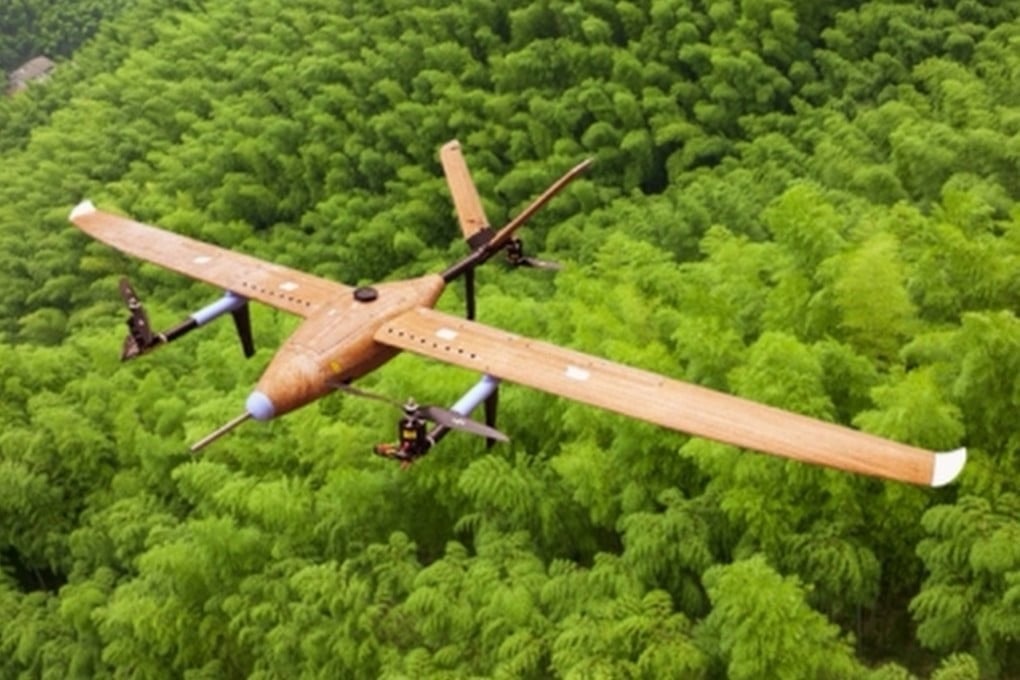
Researchers at Northwestern Polytechnical University’s (NPU) School of Civil Aviation in Xi’an, China have published what they describe as the world’s first open-source flight control system built specifically for bamboo-frame unmanned aerial vehicles (UAVs), releasing the software and hardware configuration files free to any developer worldwide. The paper appeared on February 28 in the journal Heilongjiang Science, and South China Morning Post reported the development on April 4, 2026. The system addresses a concrete engineering problem that has stalled bamboo-frame drone development for years: the material’s low-frequency vibrations overwhelm standard flight controllers.
Bamboo airframes vibrate at 8–20 hertz under flight loads. That range sits well below the frequencies conventional controllers filter for, which causes instability that makes bamboo structurally attractive but aeronautically difficult. Existing options, according to the team, are either closed-source commercial systems with no flexibility for unconventional materials, or open-source platforms poorly adapted to local development needs, leaving bamboo drone builders without a workable foundation.
How the NPU Team Solved the Vibration Problem
The NPU researchers built a custom flight control board around an industrial-grade chip and paired it with a dual inertial measurement unit (IMU) system — two sensors cross-checking each other to filter out noise the bamboo frame introduces. The control algorithms were rewritten from scratch to match bamboo’s physical properties rather than the carbon fiber and composite materials that conventional systems assume.
The core improvement came from tuning an extended Kalman filter to exploit bamboo’s natural vibration-damping properties. The result: control latency dropped from 15–20 milliseconds to 8–10 milliseconds, cutting response time roughly in half while maintaining stable flight. Senior engineer Tian Wei noted that by releasing both the flight control software and the structural parameter configuration files as open source, developers can adapt the system to different bamboo airframe geometries without rewriting core control algorithms.
The software architecture uses a modular publish-subscribe framework that allows parallel data processing and straightforward system expansion. It is fully compatible with MAVLink, the standard communication protocol used across most open-source drone platforms, meaning bamboo-frame UAVs built on this system can integrate with existing ground control stations, mission planners, and peripheral hardware without custom bridging work.
Bamboo as a Drone Material: The Case and the Catch
Bamboo is abundant, fast-growing, biodegradable, and lighter than most metals, with tensile strength per unit weight competitive with fiberglass. For applications in agricultural monitoring, forestry inspection, and science education in regions where composite materials are expensive, a low-cost bamboo airframe with reliable autonomous control makes economic sense. The catch has always been control. A bamboo frame flexes differently than carbon fiber, responds differently to wind gusts, and introduces vibrational modes that swamp sensor readings. The NPU system addresses this directly rather than working around it.
Drone swarms operating in complex natural environments, including dense forests, have been an active research area in China. In 2022, DroneXL covered Zhejiang University’s ten-drone swarm that navigated autonomously through a bamboo forest, using palm-sized quadrotors equipped with Intel RealSense cameras and PX4-based flight controllers. That swarm was designed for autonomy in GPS-denied environments. The NPU system targets a different layer of the problem: making bamboo the airframe itself, not just the operating environment.
DroneXL’s Take
The open-source release is the part worth paying attention to. Publishing both the software and the hardware configuration files removes the main barrier to bamboo UAV development: every team that wanted to build one previously had to solve the vibration-filtering problem from scratch. Now they don’t. That accelerates adoption in precisely the markets where bamboo drones make the most practical sense: agricultural extension programs, university research labs, and low-resource settings.
There is a context worth noting, though. Northwestern Polytechnical University is one of China’s “Seven Sons” — seven institutions identified by the Australian Strategic Policy Institute as having deep structural ties to the People’s Liberation Army, with roughly half of their research budget going to defense work. NPU’s own website describes the university as having “dedicated itself to national defense.” The same institution developed the “Little Falcon” biomimetic ornithopter drone and the Xiaosun flapping-wing drone, both covered on DroneXL. That does not mean sustainable agriculture research is a cover program. It does mean that open-source flight control software originating from NPU will receive scrutiny from security researchers and government procurement offices in ways that a release from a European agricultural university would not. The MAVLink compatibility and modular architecture that make this system developer-friendly also make it easy to integrate into platforms well beyond bamboo forestry drones.
I’ve been covering Chinese drone research since DroneXL launched in 2020, and the pattern is consistent: China’s university-to-defense pipeline produces dual-use innovations that are genuinely impressive on their own technical merits while carrying institutional baggage that Western buyers can’t ignore. This bamboo flight control system is a real engineering achievement. The team solved a problem that needed solving. By end of 2027, expect at least one commercial bamboo-frame UAV to ship using this stack — most likely from an agricultural drone manufacturer in Southeast Asia where bamboo supply chains and cost pressure align.
DroneXL uses automated tools to support research and source retrieval. All reporting and editorial perspectives are by Haye Kesteloo.
Discover more from DroneXL.co
Subscribe to get the latest posts sent to your email.
Check out our Classic Line of T-Shirts, Polos, Hoodies and more in our new store today!

MAKE YOUR VOICE HEARD
Proposed legislation threatens your ability to use drones for fun, work, and safety. The Drone Advocacy Alliance is fighting to ensure your voice is heard in these critical policy discussions.Join us and tell your elected officials to protect your right to fly.

Get your Part 107 Certificate
Pass the Part 107 test and take to the skies with the Pilot Institute. We have helped thousands of people become airplane and commercial drone pilots. Our courses are designed by industry experts to help you pass FAA tests and achieve your dreams.

Copyright © DroneXL.co 2026. All rights reserved. The content, images, and intellectual property on this website are protected by copyright law. Reproduction or distribution of any material without prior written permission from DroneXL.co is strictly prohibited. For permissions and inquiries, please contact us first. DroneXL.co is a proud partner of the Drone Advocacy Alliance. Be sure to check out DroneXL's sister site, EVXL.co, for all the latest news on electric vehicles.
FTC: DroneXL.co is an Amazon Associate and uses affiliate links that can generate income from qualifying purchases. We do not sell, share, rent out, or spam your email.