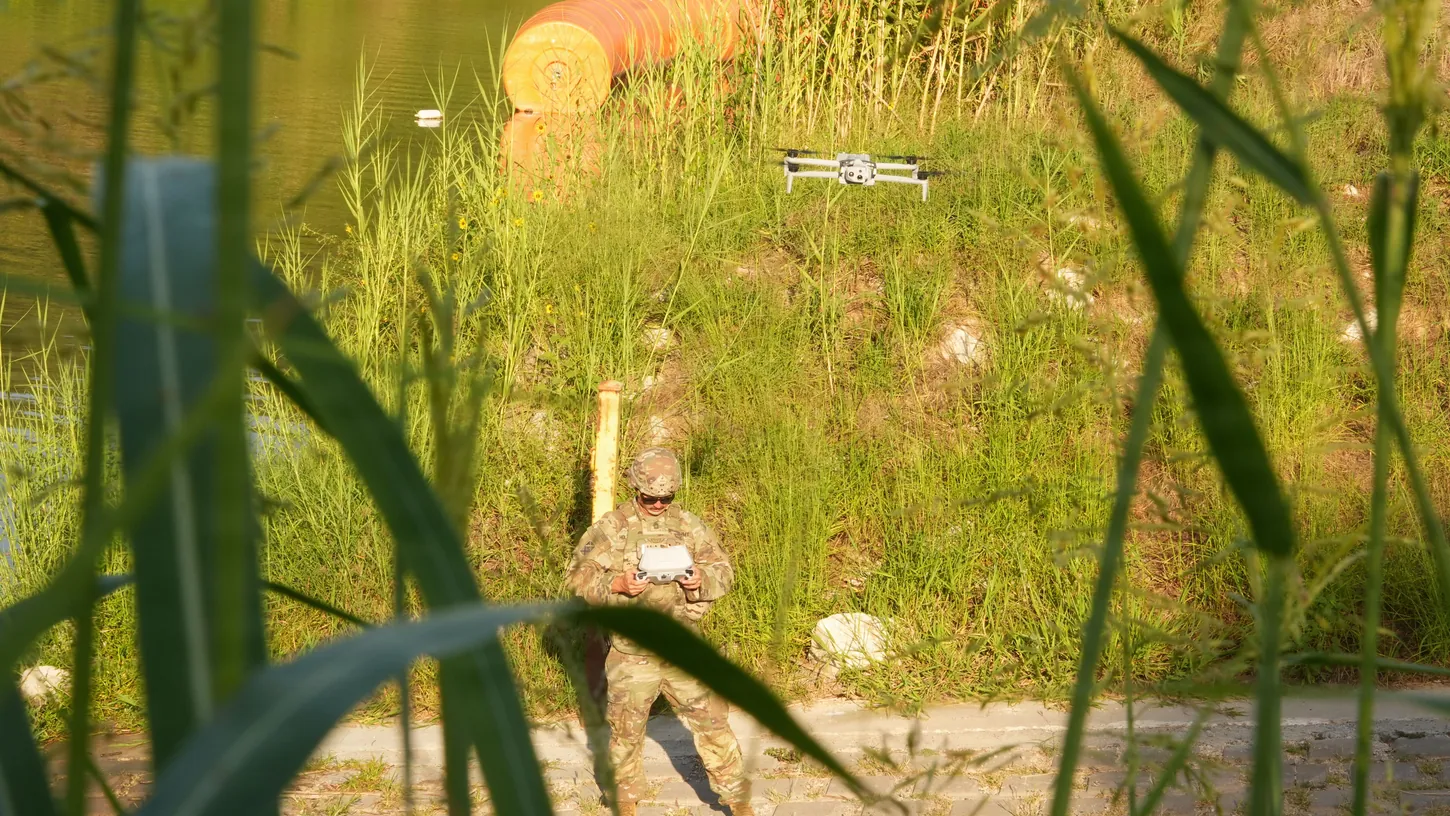
A two-minute drone flight to film a church has turned into a federal case. John Alexander Meza, a 26-year-old from La Porte, Texas, faces up to a year in prison for flying a DJI Mavic 3 in restricted airspace in East Downtown Houston on June 11. Houston’s first World Cup match did not kick off until June 14. DroneXL has tracked the World Cup drone crackdown since the first seizures in June, and Meza’s case shows exactly who the dragnet is catching.
A Two-Minute Flight Becomes A Federal Case
The criminal complaint reported by Houston Public Media describes a flight that lasted two minutes and topped out just over 200 feet (61 m). Meza told investigators he was capturing video for Houston’s First Baptist Church, where his LinkedIn profile lists him as a cinematographer.
The complaint stacks three violations onto those two minutes. Meza held no remote pilot certificate, never checked for active flight restrictions, and flew an aircraft that was not registered with the FAA.
He was flying near the 600 block of Live Oak Street, a few blocks from the FIFA Fan Festival site in East Downtown. That put him inside the restricted ring around a fan event, even though NRG Stadium sat empty that day.
He is not alone. Charging documents reported alongside his case describe Patrick Phillip Heer, a 34-year-old from Katy who flew real estate footage near the same fan zone on June 13, one day before Houston hosted a single match. Heer told FBI agents he knew restrictions existed and did not verify whether one was active.
The Fan Fest Ring Never Turned Off
The World Cup airspace structure explains how a man filming a church on a matchless Wednesday ended up in a federal complaint. Stadium restrictions covered a 3 nautical mile radius up to 3,000 feet (914 m) on match days only, but fan event restrictions ran a 1 nautical mile radius up to 1,000 feet (305 m) whenever the events operated.
Houston’s Fan Festival operated almost continuously. The site ran 34 of the tournament’s 39 days, from June 11 through the final on July 19. For five weeks, a chunk of East Downtown was a no-fly zone whether or not a ball was in play anywhere in Texas.
The pattern was national. DroneXL reported in June that World Cup flight restrictions reached Boise, Louisville and Utah, hundreds of miles from any match, because team base camps carried their own rings.
Texas enforcement moved early too. Texas DPS had seized eight drones at the Houston TFR before the city hosted its first game.
The Enforcement Numbers Kept Climbing
Meza’s case is one data point in the largest drone enforcement operation the United States has run. The FBI counted more than 600 drones seized at World Cup venues across all 11 host cities, a tally DroneXL reported in early July after months of No Drone Zone warnings.
The per-city numbers DroneXL broke down in June showed Miami leading with 99 seizures, Atlanta at 77 and Dallas at 63. The striking detail in that data: plenty of the violators held Part 107 certificates. Meza held nothing at all.
The detection side explains why a two-minute flight leaves a paper trail. Remote ID requires most drones to broadcast their identification, position and the pilot’s location in real time, so a sensor near a fan fest does not just log the aircraft. It points agents at the person holding the controller.
The penalties are heavier than most hobbyists realize. Operators caught inside an active World Cup restriction face civil fines up to $75,000, criminal fines up to $100,000, forfeiture of the aircraft, and up to a year in prison. The FAA also updated its enforcement policy this year to push airspace violations toward legal action rather than warning letters, according to the reporting on Meza’s complaint.
The charges scale with the circumstances. A Honduran national who flew a DJI Mini 3 Pro near the Arlington stadium on June 14, while the Dallas area hosted its first match, faces up to three years in federal prison, according to the same reporting. Flying during a live match day, near an active stadium, sits in a different category than an empty Wednesday.
DroneXL’s Take
I’ll be direct, the detail that stops me in this case is the calendar. Meza flew on June 11. Houston’s first match was June 14. The stadium was empty, the city had no game, and the flight lasted about as long as a red light. On paper, that is a federal defendant. On the street, that is a church volunteer with a camera.
And still, I cannot call him innocent. No certificate, no registration, no airspace check, in a host city, after months of published No Drone Zone warnings. The excuse does not erase the violation. It explains it. Those are two different things, and the difference is exactly what prosecutors and judges are supposed to weigh.
That is my real position on this crackdown, and I have held it since the seizure numbers started climbing in June: every one of these cases deserves tweezers. A system that files the same charge against a church videographer, a real estate photographer, and an actual bad actor is not measuring risk. It is measuring paperwork. Intent has to count for something, and so far the complaints read like it counts for nothing.
Watch how the Southern District of Texas resolves this first wave of filed cases. Those outcomes, not the seizure tally, will tell every casual pilot in America what a two-minute mistake actually costs.