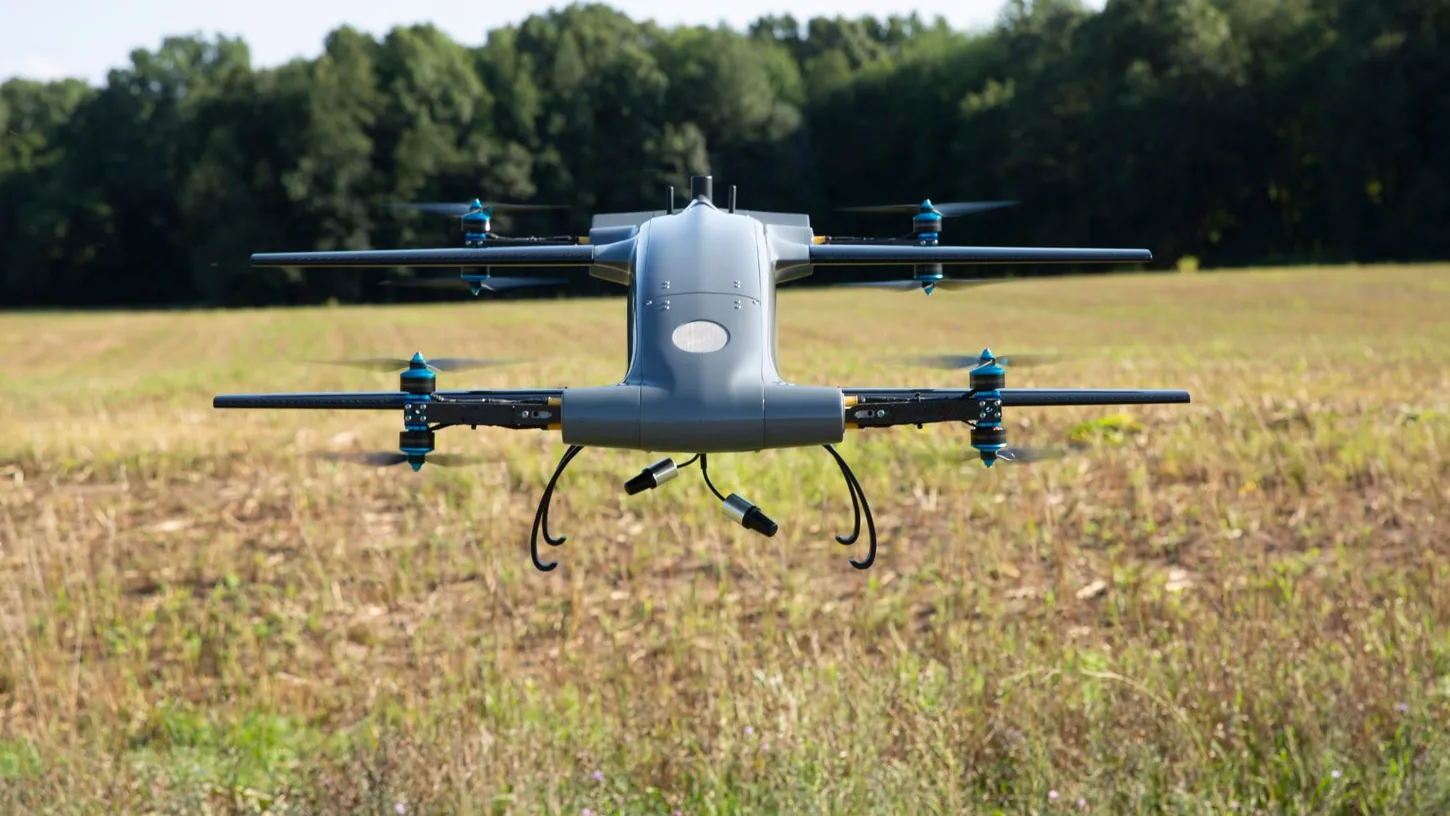
Jack Demmer Ford flew a box of oil filters across Newburgh Road by drone on Tuesday, August 25, opening a state-funded auto parts delivery network in metro Detroit. The Wayne, Michigan dealership is running it with Brighton-based drone manufacturer blueflite and Detroit-based airspace software company Airspace Link, paid for by a $740,000 grant from Michigan’s Advanced Air Mobility Activation Fund.
The flight lasted under two minutes. What is worth more attention is the aircraft that made it. Blueflite’s Cobalt 461 holds a Department of War Conditional Approval exempting it from the FCC Covered List, the same list that swept up every foreign-produced drone in December 2025, and it sits on the FAA’s Section 44807 approved list. Very few delivery drones hold both.
DroneXL flagged this $740,000 grant back in May, in coverage of blueflite’s medical delivery work for Munson Healthcare in northern Michigan. Tuesday moved it off the grant paperwork and into live operations, with a 12-mile (19-kilometer) service radius around Jack Demmer Ford dealerships.
Jack Demmer Ford Sent Oil Filters Over Newburgh Road
The demonstration flight on Tuesday, August 25 carried automotive parts from Jack Demmer Ford in Wayne to a parking lot behind the dealership group’s Quick Lane Tire and Auto Center. The trip took under two minutes and crossed Newburgh Road near Ford’s Michigan Assembly Plant.
The payload was oil filters, built to a 7.6-pound (3.4-kilogram) limit, according to the Detroit Free Press, which had a reporter at the demonstration. Two round trips ran that day, flown autonomously, though the aircraft can also be hand-flown by a pilot.
Today that same errand is a technician jogging across live traffic or a truck making the loop. That is the whole problem the program exists to solve, and it is a smaller problem than the phrase “advanced air mobility” suggests.
Tyler Bruder, blueflite’s business development lead, told the Free Press that company staff will be on site during flights for now because of licensing requirements, with the goal of running them remotely from headquarters later. He also said the tiltrotor design keeps the cargo bay steady in flight, and that the aircraft carries a parachute for emergency landings. Neither figure has been independently tested.
Mark Hatfield, who manages the parts department, said the dealership wants to prove the route can support multiple flights per day. How often it will actually fly at the start has not been set.
Michigan’s AAM Activation Fund Put $740,000 Behind The Network
Michigan’s Advanced Air Mobility Activation Fund is putting $740,000 into the program. Four state bodies administer it: MDOT, the Michigan Aeronautics Commission, the Office of Future Mobility and Electrification, and the Michigan Economic Development Corporation. The money covers deliveries within a 12-mile (19-kilometer) radius of Jack Demmer Ford dealerships.
The state calls the Ann Arbor to Detroit drone corridor the operating environment for the program, per the announcement Airspace Link issued through PR Newswire on August 25. The grant itself is not new. Michigan awarded it in July 2025, alongside Executive Directive 2025-4, which Governor Gretchen Whitmer signed on July 17 of that year to stand up the Michigan Advanced Air Mobility Initiative. Whitmer’s stated aim in signing it was to “reduce our dependence on foreign manufacturing.”
Thirteen months separate that signature from Tuesday’s oil filters.
Justine Johnson, Michigan’s chief mobility officer, was one of the speakers at the dealership on Tuesday. “not just testing in a sandbox, we’re testing in the real world,” she said of the project.
The partners describe the program as one of the first commercial drone delivery operations in the U.S. automotive industry, which is probably fair and also currently amounts to crossing a road. Metro Detroit residents have been watching Amazon Prime Air fly in Hazel Park since late last year, so the sight itself is no longer novel there.
Blueflite has more going on in the state than parts runs. The company has been flying medical samples for Munson Healthcare under a separate Michigan grant program, and Bruder told the Free Press about a Louisiana project involving blood deliveries for crash victims. Jack Demmer wants to extend the network to its Lincoln dealership in Dearborn and to a 27-bay commercial vehicle center opening next year.
Blueflite’s Cobalt 461 Cleared The FCC Covered List In May
The Department of War granted blueflite a Conditional Approval for the Cobalt 461 on May 26, 2026, exempting the aircraft and its data transmission devices, communications systems and flight controllers from the FCC Covered List. The FAA added the same platform to its Section 44807 approved list on June 1.
That sequence is the part of this story the press release does not mention, and it is the part that determines whether the program has a future.
On December 22, 2025, the FCC’s Public Safety and Homeland Security Bureau added all uncrewed aircraft systems and critical components produced in a foreign country to the Covered List. Two exits from that list matter here. Hardware that qualifies as a domestic end product under the Buy American Standard is carved out by category. Everything else needs an individual Conditional Approval from the Department of War or the Department of Homeland Security. DroneXL covered the first four drones to clear that process in March and VEX AIR’s exemption in June.
Blueflite markets the Cobalt 461 as designed and manufactured entirely in the United States. It nonetheless went through the individual Conditional Approval pathway, which the FCC established for entities producing systems or components in foreign countries. Public Notice DA 26-761, released July 21, spells out what that approval now rests on: DoW removed the December 31, 2026 expiry date and made the exemptions open-ended, “so long as the applicant for Conditional Approval abides by the onshoring plan” in its application. An approval terminates if a company fails to follow that plan or made a false statement in its filing.
Which components put the Cobalt 461 on that track is not on the public record. The FCC’s notices list aircraft, not bills of materials, and blueflite’s own announcements of the approval do not address it. The gap matters because the aircraft’s clearance is now permanently tied to a plan nobody outside the review can read.
The airframe carries one more detail worth noting. Blueflite says the Cobalt 461 is listed with a maximum takeoff weight of 54.98 pounds, two hundredths of a pound under the 55-pound ceiling that separates Part 107 small drone operations from a much heavier certification burden. The Free Press independently reported the same 55-pound all-up figure at the demonstration. That is not a coincidence of engineering. It is a regulatory target the airframe was built to hit.
For now the flights stay inside visual line of sight with crew on the ground, because the FAA’s BVLOS rulemaking under Part 108 is still unfinished.
DroneXL’s Take
A U.S.-built aircraft, flying U.S. auto parts, for a Michigan dealership, on Michigan taxpayer money, needed a Department of War clearance to stay off a communications security blacklist. Read that again, because it is the actual story here, and the ribbon-cutting buried it.
I want to be fair about what Michigan bought. This is not vaporware. Blueflite has real mission counts behind it, 67 flights at a 91 percent success rate in the Munson Healthcare pilot, and that is more operational evidence than most advanced air mobility grants ever produce. The state’s money is going somewhere that flies. Thirteen months and $740,000 to cross Newburgh Road is still a long runway, and everyone involved knows the road is not the point.
The regime it flies under is what bothers me. Appendix B of DA 26-761 lists fifteen UAS entries that have cleared the Conditional Approval door since the December listing. Fifteen, in seven months, for an entire national market. That is not a functioning exemption process, it is a boutique one, and boutique processes reward whoever can afford the lawyers and the federal relationships. Blueflite earned its clearance. Most small American manufacturers will never file for one, and no drone service provider in Michigan gets to fly anything faster because this particular airframe got through.
What I keep circling back to is the onshoring plan. Blueflite’s clearance no longer has an end date, which reads like a win, but the tradeoff is that it now lives or dies on a document the public cannot see, enforced by an agency that has published no criteria for what compliance looks like. A permanent approval conditioned on secret terms is not the same thing as being cleared.
DA 26-761 does give one date to mark. The Buy American domestic end product carve-out now runs to January 1, 2028. Whether the Conditional Approval list is still a fifteen-name club by then, or has become a routine filing that any competent American manufacturer can complete, will tell you far more about the health of this industry than any number of oil filters crossing Newburgh Road.
Sources: PR Newswire (Airspace Link), Detroit Free Press (Eric D. Lawrence), Michigan Executive Directive 2025-4, FCC Public Notice DA 26-524, FCC Public Notice DA 26-761, blueflite
DroneXL uses automated tools to support research and source retrieval. All reporting and editorial perspectives are by Haye Kesteloo.