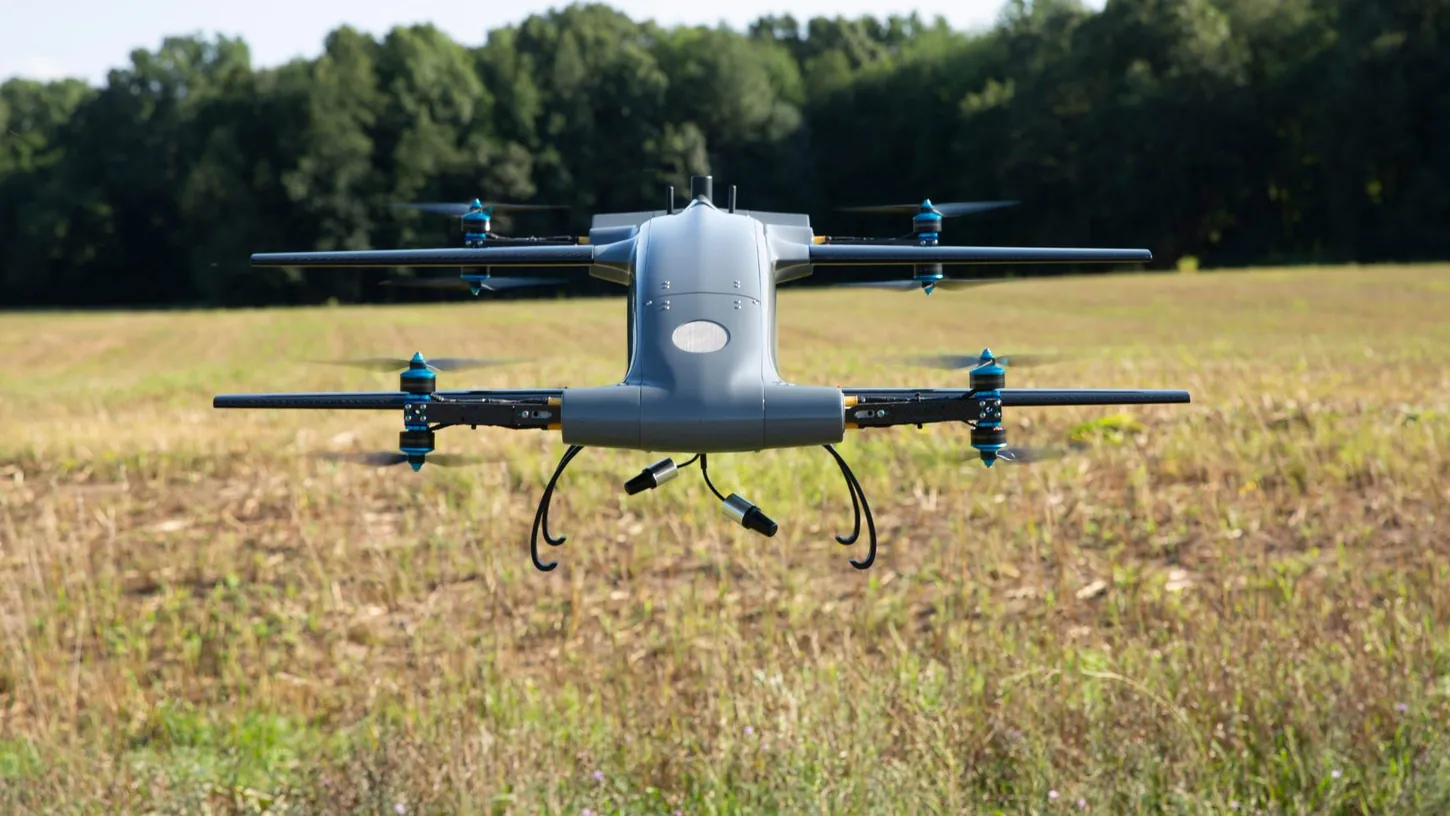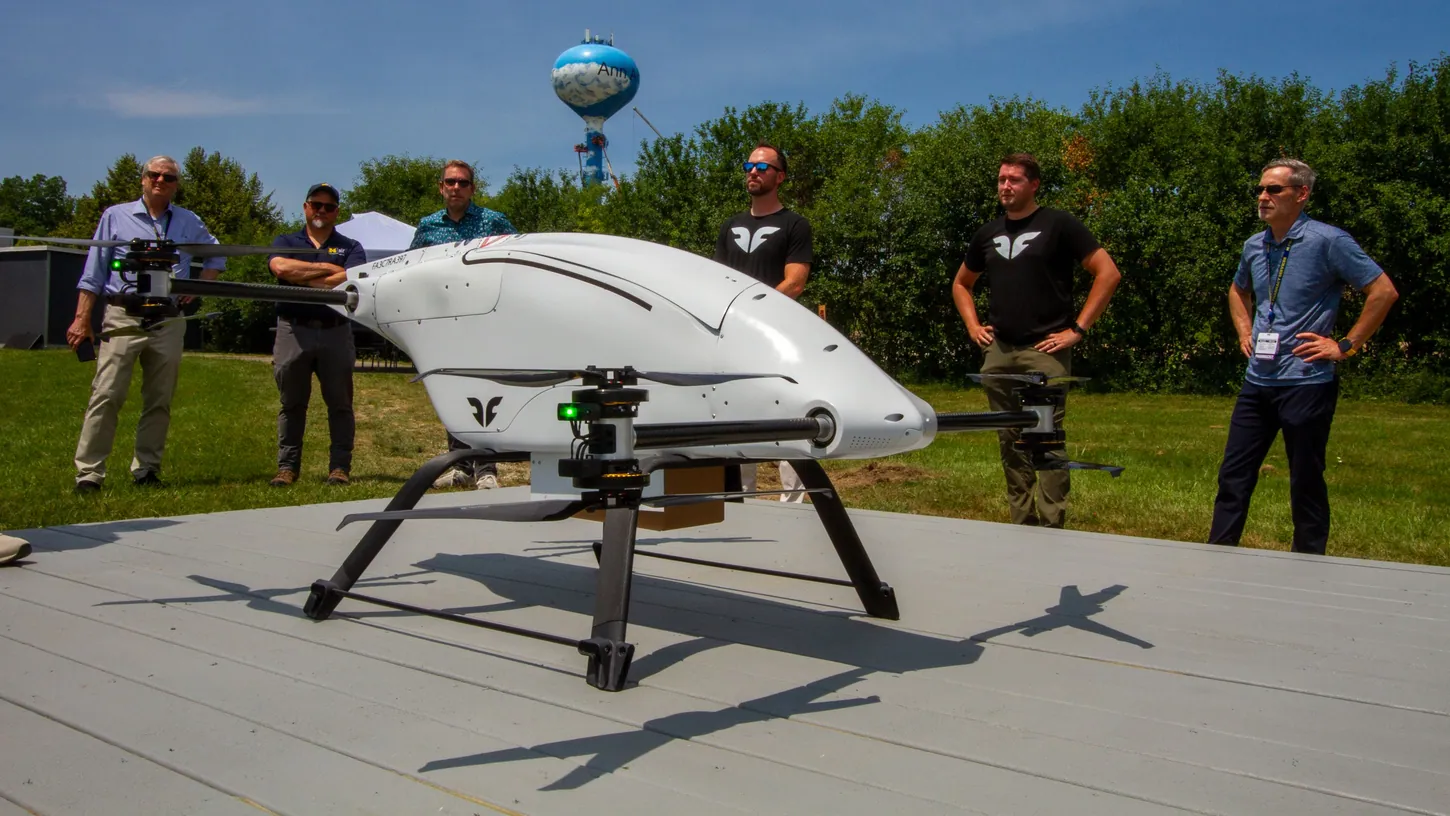
Brighton drone maker blueflite will test flying donor organs to Michigan Medicine, the University of Michigan’s academic medical center, in a state-funded pilot announced Wednesday, October 21. Michigan’s Office of Future Mobility and Electrification (OFME) gave blueflite $245,000 for the Ann Arbor project, the largest of 12 drone and advanced air mobility grants that add up to $1,705,000.
The other 11 grants run from $70,000 to $230,000. They pay for a drone-as-first-responder program for the Battle Creek Police Department and thermal drone scans of downtown Detroit buildings, among other work. Eight of the 12 projects are in Detroit, and all of them came through the Michigan Mobility Funding Platform, which NextEnergy runs for the state.
The state’s announcement sets no performance goal for any of the 12 projects. The organ team published its own the same day.
Blueflite Targets 30% Faster Organ Transport Over 20 Test Flights
Where the state’s release names no goals, the organ project’s partners published three: at least 20 end-to-end demonstration missions, at least a 30% cut in last-mile organ transport time against historical ground benchmarks, and mission reliability of 95% or better. Testing starts at the Mcity Test Facility in Ann Arbor.
The targets come from Mcity’s announcement of the grant. Blueflite joined M-air, U-M’s advanced air mobility initiative inside Mcity, as a founding member with the grant. Michigan Medicine is the clinical partner and the transplant recipient site, and M-air handles airspace integration and the beyond-visual-line-of-sight (BVLOS) operations. The project will record payload temperature, vibration and shock exposure, plus a time-stamped chain of custody.
Dr. Florian Schmitzberger, a clinical assistant professor of emergency medicine at the U-M Medical School, said in the Mcity release that “Minutes lost to traffic or logistical bottlenecks directly impact organ viability and patient outcomes.”
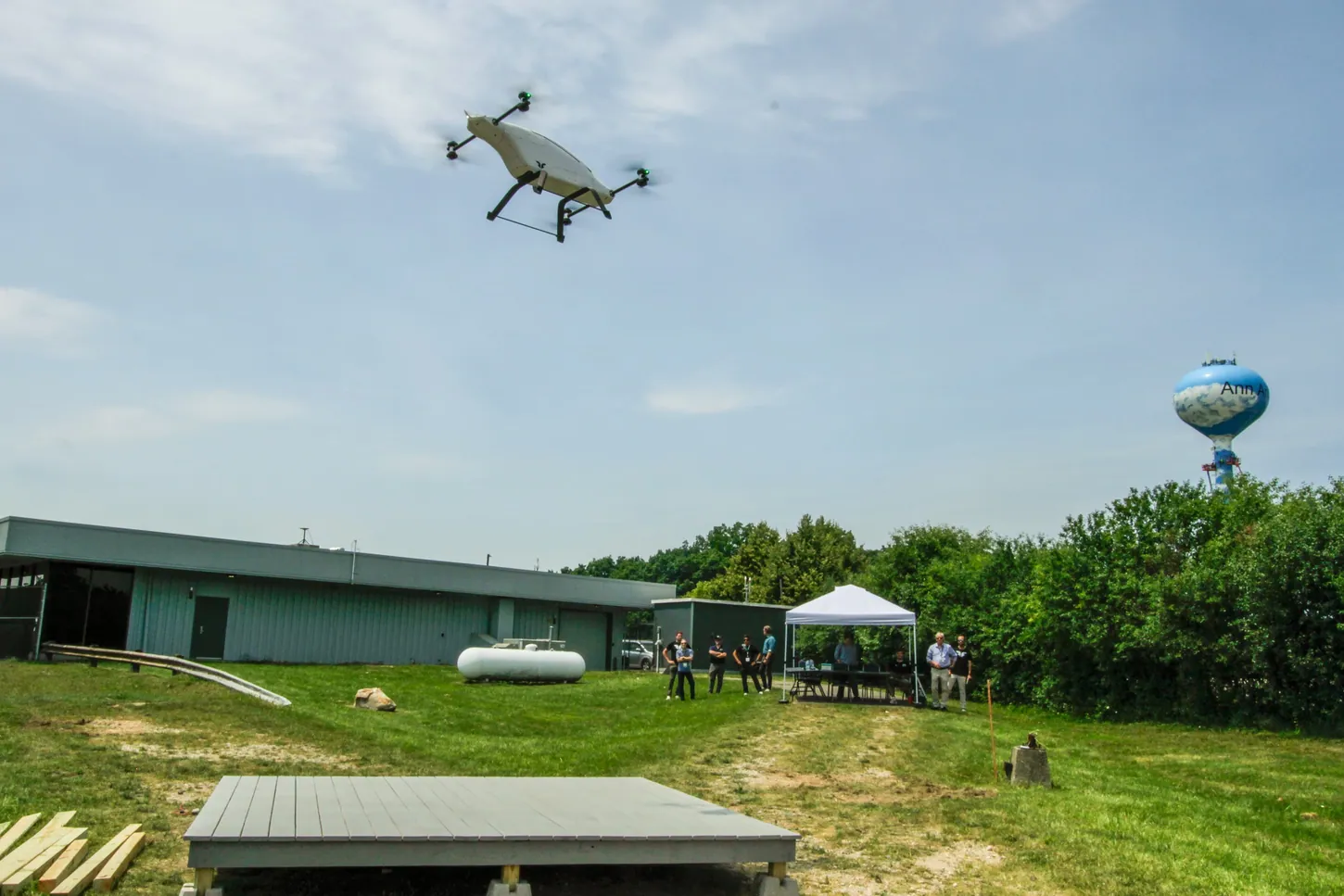
The organ grant adds to a busy fall for blueflite. The same company flies the Jack Demmer Ford auto parts network that opened in Wayne on August 25 on a $740,000 state grant, and it is flying Munson Healthcare’s second medical delivery trial in Traverse City through October 30. Its Cobalt 461 holds a Department of War conditional approval that exempts it from the FCC Covered List. Blueflite also took this round’s smallest grant, $70,000, to test Tubular Network’s automated vertical tubes at the Detroit Smart Parking Lab. The tubes carry a package from a rooftop drone drop-off point to the floor it is addressed to.
Detroit Takes Eight of the 12 Projects and $990,000
Detroit hosts eight of the 12 projects and $990,000 of the $1.705 million, more than half the money, and three of them run inside the city’s Transportation Innovation Zone, including General Orbit’s $150,000 test of magnetic navigation for drones flying in GPS-degraded and GPS-denied environments.
The other two in the zone are delivery and route-planning tools. ESSPI, the Detroit battery-safety company whose Med Hawk division supplies medical payload bags for blueflite’s Munson flights, gets $110,000 for a real-time oversight system for medical drone deliveries. Wolverine Radar gets $136,000 to test a satellite-derived hazard warning system for drone route planning.
The largest Detroit grant, $230,000, sends Lamarr AI’s thermal drones over 2 million gross square feet of privately owned downtown buildings to check façade safety and energy performance. Birdstop, which DroneXL covered in May when its drones began counting open spaces at two Detroit truck lots, gets $110,000 for 24/7 truck parking monitoring from self-charging drone perches. Airspace Link, the Detroit airspace software company on the Jack Demmer Ford project, gets $80,000 to run a UAS traffic management service over the city. Future Flight Global gets $104,000 to work with TruWeather Solutions and Bedrock Detroit on feeding localized urban wind data into Detroit’s digital twin for drone mission planning.
Konner Petz, head of special projects at the City of Detroit Office of Mobility Innovation, said in the state’s release that Detroit’s lead in mobility testing “now extends into our airspace.”
Two grants went further north. CENSYS Technologies gets $170,000 to demonstrate drone power line inspections in Traverse City. The company was already flying its Sentaero fixed-wing VTOL with the Ohio Department of Transportation when sales director Kyle Miller talked BVLOS on DroneXL’s PIXL Drone Show in June 2024. Westwood AI gets $100,000 in Calumet, in the Upper Peninsula, to test AI-assisted drone data capture for land and infrastructure inspections. It is Westwood AI’s second state award in ten weeks. On August 12 it was one of five companies that split $2 million in a separate OFME challenge, paired with the Michigan Department of Transportation.
Battle Creek Police Get a Drone First Responder Program From ResilienX
ResilienX won $200,000 to deploy its ORION-X drone services platform in Battle Creek. The first job is a drone-as-first-responder program for the Battle Creek Police Department. The state’s release says the platform should later serve other municipal and commercial customers as well.
ORION-X is an on-demand aerial data service. A customer requests images, video or a lidar scan, and ResilienX handles the flight.
The Syracuse, New York company is already building Battle Creek’s airspace infrastructure. Battle Creek Unlimited picked ResilienX in January to install a ground-based detect-and-avoid system at Battle Creek Executive Airport for the city’s MICH AIR hub, combining radar, ADS-B and Remote ID into one picture of the local airspace.
DroneXL’s Take
Michigan is right to spread $1.7 million across a dozen small bets, and it should make every one of them publish its results. The organ team set its targets before a single organ flight, so anyone can check later whether blueflite hit them.
Munson’s first medical drone trial published its numbers afterward, in a December 2025 report that listed all 67 flights and the six it lost, and I trust that program’s second phase more because of it. A $110,000 demo that ends in a press release teaches the next city nothing. OFME should require each of these 12 grantees to publish a results report, failures included, the way Munson did.
Source: Michigan Department of Labor and Economic Opportunity, October 21, 2026, Mcity, October 21, 2026, ResilienX.
DroneXL uses automated tools to support research and source retrieval. All reporting and editorial perspectives are by Haye Kesteloo. Read our editorial standards.