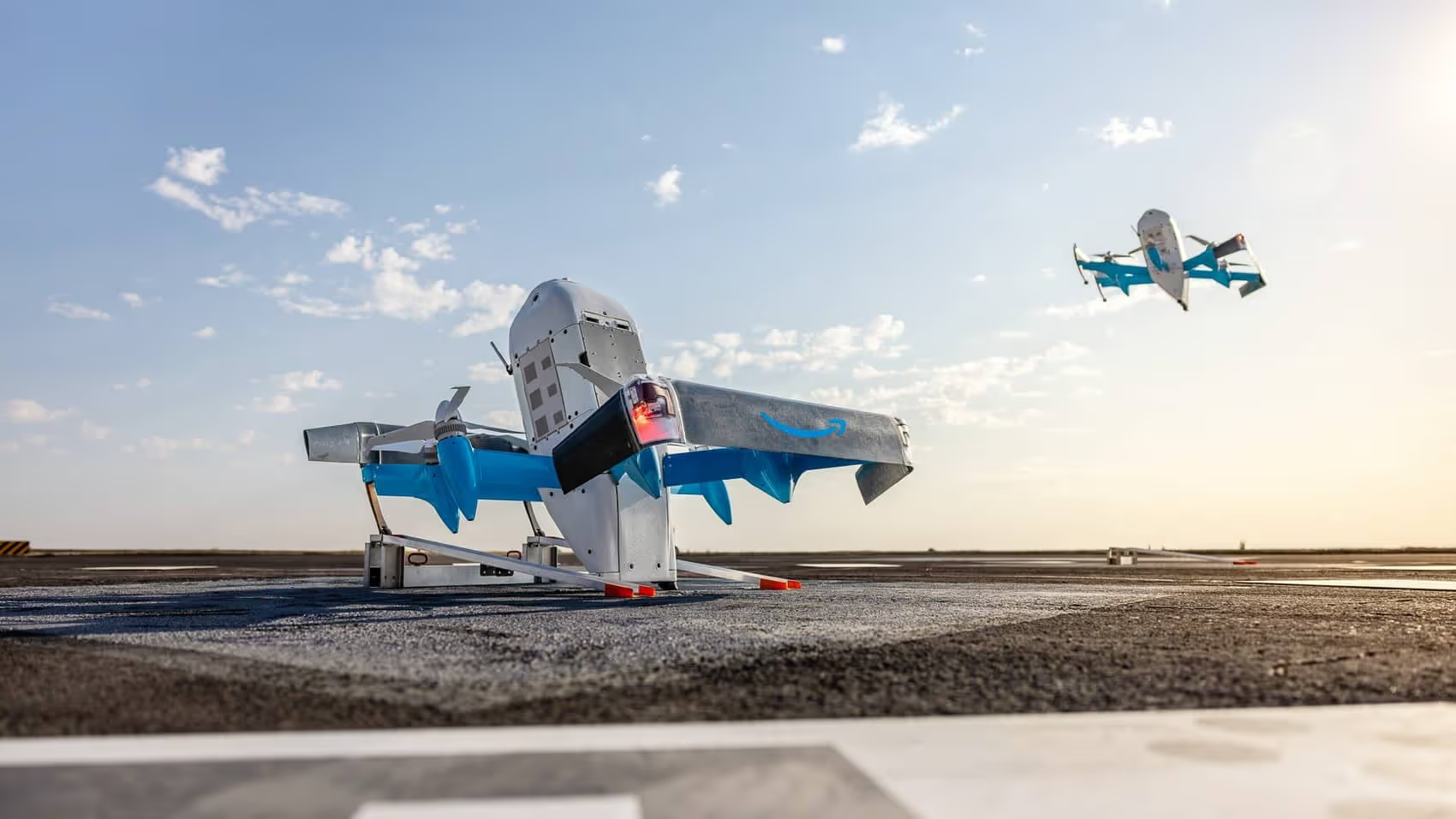
Amazon Prime Air did not answer eight written questions about its MK30 delivery drone by the deadline DroneXL set for Saturday at 5 p.m. Eastern. The questions went to three Amazon addresses on Thursday afternoon, the day after the company declined to put an engineer on the record at Commercial UAV Expo in Las Vegas. Among other things, they asked why a drone carrying a 5-pound box weighs 78 pounds, and why it has no parachute.
Amazon’s communications team replied twice on Friday. Neither reply addressed the questions.
The deadline has passed, and the offer has not. Amazon can still answer, and DroneXL will publish its responses in full. The questions are printed below so that Amazon, and the nearly 500 cities and towns it plans to fly over by the end of the year, can see exactly what was asked.

Amazon Has Not Answered These Eight Questions
DroneXL asked Amazon Prime Air to attribute its answers to a named spokesperson or engineer, and offered a 15-minute recorded video call with an engineer as an alternative. The questions cover the aircraft’s mass, its missing recovery system, its collision record and the fleet Amazon plans to fly.
- FAA filings list the MK30 at 77.9 pounds empty and 83.2 pounds at maximum takeoff weight, carrying a 5-pound payload. Zipline’s P2 carries 8 pounds at 55 pounds empty; Wing’s production aircraft carries 2.6 pounds at about 12 pounds. What drives the MK30’s mass, and did Amazon evaluate a lighter airframe for the same 5-pound, 7.5-mile mission?
- Does the MK30 carry a parachute or any ballistic recovery system? If not, was one evaluated, and why was it excluded?
- After a mid-air collision with a fixed object, such as the crane in Tolleson, the cable in Waco or the building in Richardson, what is the MK30’s designed descent behavior, and which systems remain functional?
- What is the status of the FAA and NTSB investigation into the October 1, 2025 Tolleson crane strikes, and what changes did Amazon make to Detect-and-Avoid or operating procedures after Tolleson, Waco and Richardson?
- Amazon’s propeller redesign cut perceived noise by roughly half. Did Amazon test whether a smaller, lighter airframe with the same propeller design would be quieter still? What were the results?
- Packages are released from about 13 feet. What does Amazon do to verify the drop zone is clear of water, people and pets, and what changed after the August 17 pool delivery in Richmond, Texas?
- How many MK30 aircraft are in service today, and how many does Amazon expect to operate to serve nearly 500 cities and towns by the end of 2026?
- Who is the on-the-record contact for DroneXL’s future Prime Air coverage?
Amazon Answered The Email About The Email
Amazon’s two Friday replies concerned whether DroneXL had told the company in writing that Wednesday was its last day at the Expo. The first asked DroneXL to resend that message. The second acknowledged it: “I’m not sure why we did not receive.” Neither mentioned the eight questions.
DroneXL had supplied the original message with its full headers on Friday afternoon. The exchange followed the publication of DroneXL’s opinion piece on the MK30 on Thursday, which described Amazon’s decision not to make an engineer available while I was at the show. Amazon disputed that description by phone, off the record. DroneXL corrected one point, on which Amazon was right, and expanded the account of Amazon’s interview offers. The corrected article carries a dated note. Amazon’s communications lead acknowledged those updates in writing on Friday evening, and still did not answer a question about the drone.
The Aircraft Is Why The Questions Matter
An MK30 weighs 78 pounds (35.5 kilograms) empty and carries a 5-pound (2.3-kilogram) box, per FAA filings. It has six motors, redundant flight controllers and no parachute. Amazon says no single failure can cause loss of control. That is a claim about motors, not crane booms.
The record is the reason the questions are not academic. Two MK30s struck the same crane in Tolleson within minutes of each other last October. One clipped an internet cable in Waco 13 days after service launched there. One hit an apartment building in Richardson in February and landed on the sidewalk with its propellers turning. No one was seriously hurt in any of them. Each one ended with the airframe on the ground, because an aircraft that has struck a fixed object does not fly home on five motors.

Amazon’s competitors made different choices with the same problem in front of them. Zipline’s P2 carries a heavier box, 8 pounds, in a lighter aircraft, 55 pounds, and carries a parachute; when one came down in a Greenville, Texas street in July, it arrived under canopy. Wing’s production aircraft weighs about 12 pounds. Whether Zipline’s approach is safer in every case is a fair debate. That Amazon will not join the debate is the finding here.
Five Hundred Cities Multiply Every Open Question
Amazon said on August 19 that Prime Air flies thousands of deliveries a day from 11 sites and will reach nearly 500 cities and towns by year-end, a sixfold footprint. Every flight is an MK30 over someone’s street. Amazon has not said how many aircraft that takes.
That number was question seven. Amazon has delivered hundreds of thousands of packages by drone this year, by its own count. It matters because incidents are a rate, and the rate gets multiplied by the fleet. Amazon called the second pool delivery in a year uncommon, which is a claim about frequency that nobody outside Amazon can check without knowing how many flights there are. As DroneXL noted when the expansion was announced, the 500 figure counts every municipality inside each hub’s 7.5-mile radius, so the fleet is smaller than the headline. How much smaller is the answer Amazon has.
Every one of those towns has a council, and every council can ask the eight questions above. DroneXL will publish a guide for them, operator-neutral, with the same questions put to Zipline, Wing and Wingcopter.
DroneXL’s Take
DroneXL is not against drone delivery. I went to Düsseldorf and Las Vegas to look at this aircraft because I want it to work. Prescriptions flown to people who cannot drive are the drones-for-good story this publication exists to tell, and Zipline is doing it with a parachute on board.
Amazon deserves two things said in its favor. Its redundancy is real engineering, and in every MK30 incident on record, no one on the ground was seriously hurt. Those facts are in the article because they are true, and they are not answers to the questions.
What I cannot explain is the silence. A company confident in its design answers the parachute question in one paragraph, because the engineers who made that decision have the paragraph ready. Amazon has had the question since Thursday, had an engineer available for a Thursday it knew I would miss, and spent Friday on the delivery status of an email. The explanation that fits that record is a company that would rather not have this conversation in public, and I would like to be wrong about that.

The fix is not complicated. If the MK30 hits a power line or a crane over a neighborhood in Boise or suburban Cook County, an 83-pound aircraft is coming down. Obstacle avoidance and six motors are the layers meant to keep that from happening. A parachute is the layer for when they don’t, Zipline flies with one, and Wing’s aircraft weighs a fraction as much. Amazon should build the safest drone it can, which likely means a recovery system, and it should be able to say so on the record.
The offer stands. Eight questions, answers published in full, whenever Amazon is ready. Between now and December, the councils of nearly 500 towns will have the chance to ask them too.
Sources: Amazon, FAA, DroneXL correspondence with Amazon Prime Air
DroneXL uses automated tools to support research and source retrieval. All reporting and editorial perspectives are by Haye Kesteloo.