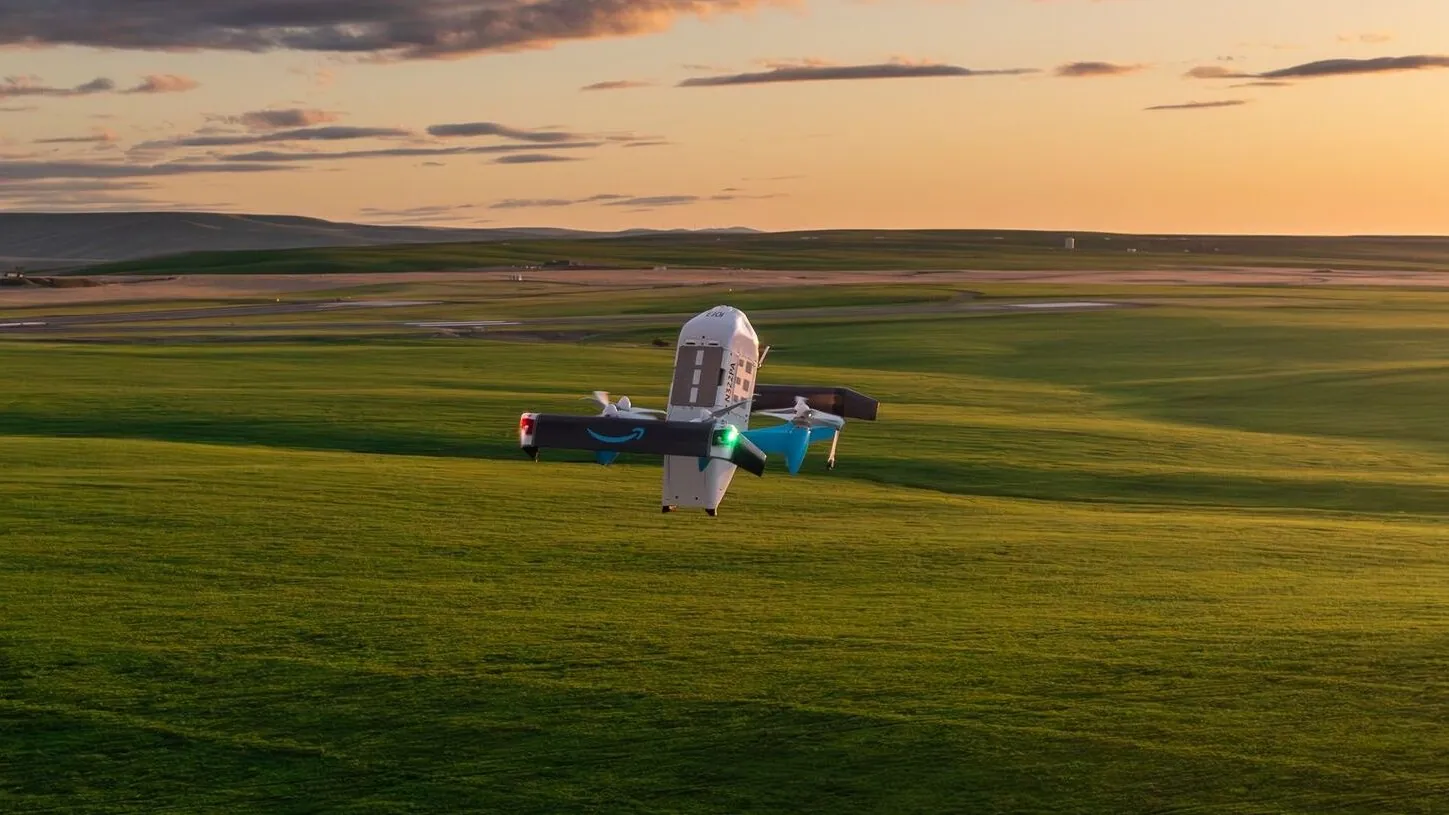
A reporter sat outside Amazon’s Papillion fulfillment center for an hour on a Friday and counted the traffic. Between 11:45 a.m. and 12:45 p.m., about 25 Prime Air drones left and about 25 came back. Fifty operations in an hour, over a Nebraska suburb whose city council never voted on any of it.
Reed Davis liked them at first. The Papillion resident works from home, called his first sighting super cool, and now plays music to get through the workday. Three drones passed overhead during a 15-minute television interview. He has started picking driver delivery even when the drone option is offered.
Amazon has changed a flight path over Sarpy County once since service began on July 30. It did it for bald eagles.
Sarpy County Residents Say the Drones Run All Day
Davis told 3 News Now he hears the aircraft even when they are not delivering to his street, and that the altitude Amazon quotes, 100 to 400 feet (30 to 122 meters), is nowhere near enough separation. He wants the routes pushed onto busy roads and off residential blocks. “I can hear them all day” was how he put it.
He is not the only one talking. Hundreds of comments landed on Facebook after the drones launched, which is what sent the station out to the warehouse with a clicker in the first place.
The reaction in the 7.5-mile (12 km) delivery circle splits. The Flatwater Free Press found a birdwatcher who counted five drones over a park that bans them, a Teamsters official who reads the whole program as job destruction, and a retired Air Force pilot in Papillion who enjoys watching the drops and says “the drones are quieter than lawnmowers, motorcycles and even the traffic on busy streets”.
Amazon’s Omaha Noise Filing Puts a Delivery Near 92 Decibels
The FAA’s noise report for the Omaha hub puts the MK30 at 92.1 decibels SEL measured 25 feet from a delivery, 90.5 on takeoff and 91.8 on landing at 20 feet, and 63.7 decibels cruising 200 feet overhead. The measurements were taken at Pendleton, Oregon, in October 2024.
Those numbers sit in Appendix E of the Omaha environmental assessment, public since the file went up. DroneXL pulled the identical figures out of the Baton Rouge filing last week, because it is the same aircraft and the same methodology behind every Prime Air market.
The gap between the two ends of that range is the delivery itself. The drone descends to 13 feet (4 meters) over the drop point and holds there while the doors open, which is why the loudest reading in the document is taken 25 feet away. Amazon’s quoted 100-foot floor and the filing’s 180-to-377-foot cruise band do not contradict each other either: the profile passes through 115 feet on the climb out and 140 feet on the way down to a backyard.
The Papillion Hub Flies Far Below What Amazon Asked For
Twelve drones flew about 6,000 trips out of Papillion in July and August, the Flatwater Free Press reported, roughly 180 a day. Amazon’s filing asks the FAA for up to 1,000 flights a day from this hub, seven days a week. That works out to about 365,000 a year.
Even the midday hour the station counted, 25 deliveries in 60 minutes, comes to about 400 a day if it held across the approved 6 a.m. to 10:30 p.m. window. Papillion is hearing something closer to a fifth of what the paperwork contemplates, and it is calling the newsroom about it.
A June 15 FAA memo written specifically for the Omaha review spells out the modeling assumption: 10 percent of deliveries falling outside 7 a.m. to 10 p.m., a nighttime penalty applied, and 1,900 equivalent daily deliveries run through the math. Amazon expects no single delivery location to average more than four drops a day.
Nothing in the Filing Reaches the FAA’s Significance Threshold
The FAA treats DNL 65 decibels as the point where aircraft noise becomes incompatible with housing. At the full volume Amazon asked for, its own consultants put a home directly under a route at 48.9 DNL, and the 65-decibel contour stays within 150 feet of the launch pad.
A house 16.4 feet from where the package lands, the closest a person is allowed to be, sits around 52 DNL at four or five deliveries a day. Every number in the analysis sits at least 12 decibels under the federal bar, which means a complaint about frequency has no metric to register on.
Local government has no lever either. The flights required no action from the Papillion City Council or the Sarpy County Board, because altitude and routing are federal and always have been.
Amazon Already Moved Omaha Flight Paths Once, for Bald Eagles
Amazon agreed with federal officials last month to keep its Omaha drones 1,000 feet (305 meters) from bald eagle nests at Chalco Hills Recreation Area, according to Amanda Grint of the Papio-Missouri River Natural Resources District, which manages the park about a mile from the warehouse.
The park’s rules prohibit drones. They prohibit launching one there, not flying one across it, which is how Prime Air aircraft keep crossing a lake ringed with no-drone signage. A loophole that distinguishes takeoff from overflight is the kind of line that only makes sense to whoever drew it.
That agreement came within weeks of the first flights. Texas got the same treatment in March, when Amazon raised outbound altitudes over Richardson to an average of 225 feet (69 meters) and pushed departures over commercial land after residents objected. Neither change needed a rulemaking. Both happened inside an envelope the FAA had already approved.
Omaha’s Own Review Has No Final Decision on the Record
The public comment window on Amazon’s Omaha environmental assessment closed July 22. The FAA signed a national finding covering drone delivery on July 28. Service began July 30. As of the agency’s September 11 update, no final Omaha assessment or decision appears on its site.
The Omaha draft still sits under documents open for public review, comment period closed, with nothing in the completed-reviews section to match it. Which document authorizes the flights over Papillion today, the site-specific review that was never finished or the national one signed two days before launch, has not been stated by either the FAA or Amazon. The agency did not answer the Flatwater Free Press when it asked about the Omaha application at all.
The distinction matters for every town after this one. Under the national finding, a new market gets checked against that document inside the agency and no comment period opens. Sarpy County at least got its 30 days, even if nobody has published what came of them.
DroneXL’s Take
The eagles got a 1,000-foot buffer within weeks. Reed Davis got the FAA’s address.
I stood next to an MK30 at XPONENTIAL Europe in Düsseldorf: 78 pounds (35 kg) of airframe, taller than a fifth grader, six propellers built for quiet. The engineering is real, and so is the thing it does. A kid’s allergy medicine arrives in 90 minutes without anyone starting a car.
Skip Bailey is right about the peak, too. A pass at 200 feet measures 63.7 decibels SEL, under the mower next door, and he flew airplanes for a living. The peak was never the complaint. Fifty operations an hour is the complaint, and DNL takes exactly that, the arrival rate, and averages it into a figure that cannot cross 65 at these volumes no matter how many drones pass over a given roof. The metric was built for runways, where a few very loud events decide the number. A suburb at midday is the opposite problem, and the FAA’s own guidance concedes the threshold fits poorly where background noise is low.
So the answer residents get is that the noise is federal, the level is below the federal bar, and the council cannot help. Then Amazon turns around and moves the routes when a bald eagle is involved, or when a Texas city council makes enough noise of its own. The company has the lever. It pulls it for the constituencies it decides are worth pulling it for, and a homeowner in Papillion has not made that list.
Today was the due date on the fifteen questions DroneXL put to Amazon about MK30 safety and operations, sound level among them, every one still logged unanswered. The aircraft in the meantime keeps generating its own record: one set itself down beside a Baton Rouge road on Saturday two months into that market.
September 26 is the date to watch. That is when the window closes to challenge the national finding in court, the finding that erased the comment period Sarpy County still got. Amazon says it wants nearly 500 cities by the end of the year, and Papillion went live on July 30 as market number 11. The next 489 towns will hear the drones before they ever see a document.
Sources: 3 News Now, FAA Public Involvement and Environmental Review for Drone Operations, Flatwater Free Press via The Reader.
DroneXL uses automated tools to support research and source retrieval. All reporting and editorial perspectives are by Haye Kesteloo. Read our editorial standards.