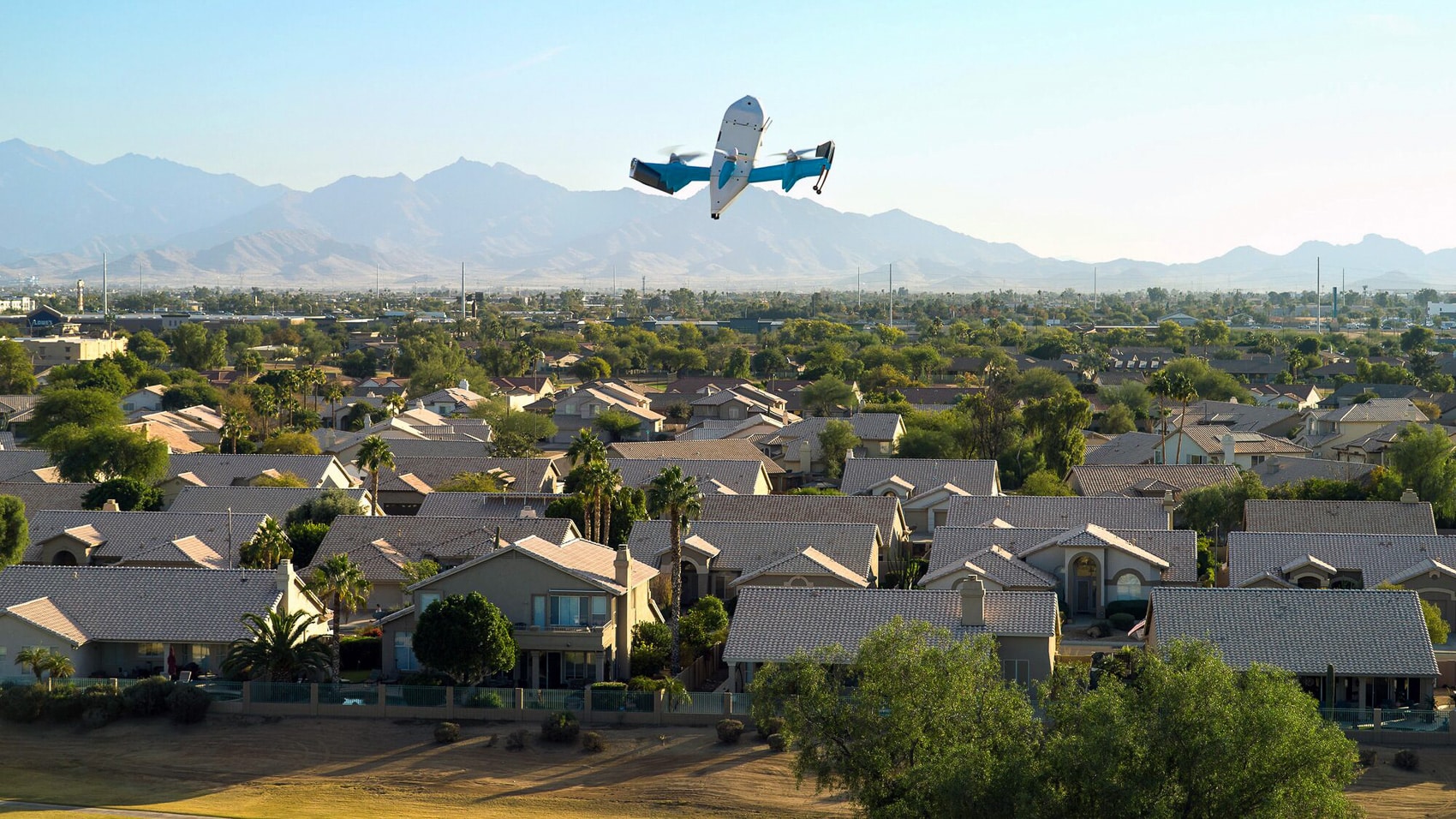
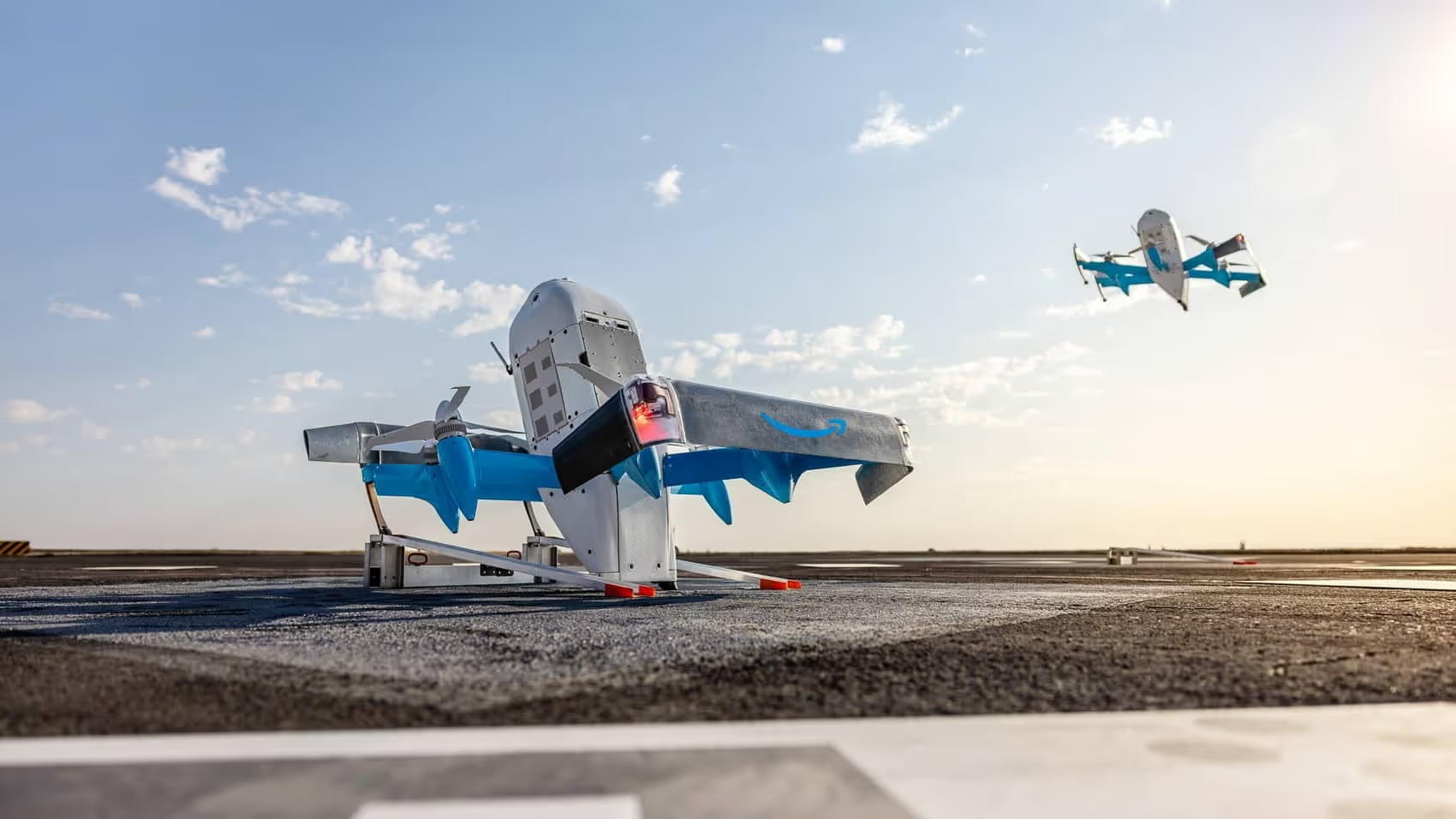
Amazon’s Prime Air operations manager in Baton Rouge told a Rotary Club audience Wednesday that the company’s delivery drones are quieter than an idling delivery truck. An Amazon spokesperson at the same event said flying them higher would require FAA approval. The FAA’s own noise filing for that hub puts the loudest moment of a Baton Rouge drone delivery at 92.1 decibels, and benchmarks a diesel truck at 50 feet at 80 to 90.
Tyra Jones, who runs Prime Air in Baton Rouge, spoke on September 9 at the Rotary Club of Baton Rouge, two months after the service began flying from a hub beside the Cortana Place fulfillment center. She said Amazon has another drone model in development and has started offering scheduled deliveries so customers can pick a window instead of taking the package whenever it lands. She declined to give a daily delivery count, saying the number moves with demand.
A Rotarian who lives in Broadmoor, near the hub, told the room they hear about 20 drones an hour. Asked whether Amazon had considered flying higher over Baton Rouge, an Amazon spokesperson at the event said altitude changes require Federal Aviation Administration approval. Six months ago Amazon raised the altitude of the same aircraft over Richardson, Texas, after residents there made the same complaint.
Amazon raised its drone altitude in Texas after the same complaint
Richardson residents raised noise and overflight complaints in January 2026. By March, Amazon had increased the minimum altitude for outbound flights to an average of 225 feet (69 meters) and rerouted some departures eastward over commercial land before they cross a residential neighborhood. The city published the changes itself.
Sam Bailey, a senior manager of economic development policy at Amazon, laid those adjustments out at the Richardson City Council’s March 9 meeting, along with the reasoning behind them. Making the aircraft itself quieter would take a hardware change that is not in near-term development, so altitude is the lever Amazon has. None of it required a new rule. It required a company deciding to fly a different profile inside an envelope the FAA had already approved.
Richardson also tested what a city can actually do. In April the council declined to pursue a rezoning of Amazon’s drone facility on legal advice, and the city manager pointed residents toward the FAA and their congressional delegation instead. Richardson’s own drone page now states plainly that cities cannot set altitude or create airspace limits. Baton Rouge sits in that same position, and so did College Station in 2024.
Amazon’s own FAA filing already puts a number on the noise
The noise estimates for the Baton Rouge hub are public, in the FAA’s environmental filing for the site. That document puts the maximum sound exposure level at 92.1 decibels during a delivery, measured 25 feet from the aircraft, and 63.7 decibels for a drone cruising at 200 feet (61 meters).
Both numbers come with the FAA’s own reference points, and they cut in opposite directions. The agency likens the 63.7-decibel cruise to an air conditioning unit heard from 100 feet. For the 92.1-decibel figure it offers a diesel truck at 50 feet, or a noisy urban street in daytime, at roughly 80 to 90 decibels. Jones’s comparison holds while the MK30 is passing overhead. It inverts at the doorstep.
The doorstep is where the filing gets specific. On a delivery the drone descends to about 13 feet (4 meters) above the drop point and hovers there while it releases the package, which is why the loudest reading in the document is taken 25 feet away. Takeoff and landing measure 90.5 and 91.8 decibels SEL at 20 feet. The FAA compares both to a household vacuum cleaner at 10 feet.

Broadmoor sits near the Cortana hub rather than under the far end of a delivery route, so the passes a resident counts there are takeoffs and landings, the two loudest phases in the profile. Measured 75 feet from the pad, the filing puts those at about 70 decibels Lmax.
The Baton Rouge hub flies well below what its own filing contemplates
The same filing sets the ceiling. Prime Air asked to run up to 1,000 MK30 flights a day out of Baton Rouge, seven days a week, roughly 365,000 deliveries a year, between 6 a.m. and 10:30 p.m. Amazon expects to reach that level gradually.
Spread across that 16-and-a-half-hour window, 1,000 flights works out to roughly 60 departures an hour, and every one of them is a round trip. What a Broadmoor resident hears today is nearer the floor than the ceiling. Texas showed the same gap: Bailey told the Richardson council its hub was filling about 150 orders a day while the FAA’s August 2025 approval assessment permitted up to 1,000, the Dallas Observer reported.
Baton Rouge is one of 11 sites Amazon flies today, and the company announced on August 19 that it intends to reach nearly 500 US cities and towns by year’s end. When DroneXL covered the Baton Rouge hub in May, Amazon put 12 to 20 MK30 drones at the site. Jones said the hub holds 20 and can fly 10 at once.
The FAA closed the comment window towns used to get
An operator opening a new metro used to trigger its own environmental assessment, with a published draft and about 30 days for anyone to file an objection under their own name. The FAA did that more than 20 times between 2021 and 2025, and on July 28 it stopped.
That day the agency signed a national Programmatic Environmental Assessment covering Part 135 delivery across the country. A new market now gets checked against that document inside the agency, and if it fits, no fresh review is written and no comment period opens, as DroneXL documented on Monday. Fitting inside it is largely a noise calculation: a ceiling of 1,150 deliveries a day from one hub, and a hub running that volume kept at least 600 feet (183 meters) from homes. The window to challenge the finding in court closes September 26.
Baton Rouge got in under the old system, and its paperwork trail has a loose end. The FAA’s public NEPA page, last updated August 20, still lists the Baton Rouge draft assessment under documents open for review, comment period closed July 22, and no final assessment or Finding of No Significant Impact for the site appears in the completed-reviews section. Amazon began commercial service on July 7, fifteen days before that comment period closed. Neither agency nor company has published anything reconciling the two dates, and the identically dated Omaha filing sits in the same unfinished state.
DroneXL’s Take
Start with the part Amazon has right. Altitude is federal. A city cannot set a floor or route a flight path. Richardson’s council spent months learning that and dropped its zoning threat on legal advice, and a Baton Rouge resident calling City Hall is calling the wrong building.
Which is exactly why pointing at the FAA is not an answer. Amazon changed the altitude in Richardson without a rulemaking and without anyone’s permission but its own, because a council and a few hundred residents made enough noise back. That was a company decision inside an approved envelope. Amazon knows the lever is there. It pulled it six months ago, in a market it is still flying today.
The part that bothers me is the framing, not the aircraft. The numbers were never hidden, and they are more honest than the pitch: quieter than an air conditioner when the drone is passing over, louder than the truck when it is over your yard. A room full of Rotarians got the half that flatters the product. Anyone who wanted the other half had to know a document called Appendix B existed.
The benchmark has a second problem, and this one Amazon built itself. The FAA’s reference point is a diesel truck at 50 feet, and Jones reached for an idling one. Amazon is retiring both. It has more than 40,000 Rivian-built electric vans on US roads against a standing order for 100,000 by 2030, and an electric van has no idle at all, because nothing is running while it waits at the curb. Every year that fleet grows, the yardstick gets shorter. The 92.1 does not move.
None of which is an argument against electrifying the vans. That is the best thing Amazon has done for the streets it delivers on, and it is nowhere near finished: tires still make noise on asphalt, and most of the US fleet still burns fuel today. The point is narrower. Amazon is measuring its aircraft against the vehicle it is spending billions to take off the road. Run that forward to 2030 and what pulls up outside a house in Broadmoor arrives almost silently, while the thing overhead still drops to 13 feet above the lawn at 92 decibels.
I want this to work. Drone delivery done right takes vans off residential streets and gets a sick kid’s medicine to the house without a car trip, and DroneXL has covered that case since the MK27 days. It does not survive a decade of communities discovering that the real number was public the whole time and nobody led with it. “seeing a Prime Air drone in the sky will be like seeing a delivery van” is the future Jones described. Delivery vans do not hover 13 feet over the lawn.
Two dates decide how this reads next month. September 15 is when Amazon’s answers to DroneXL’s fifteen questions come due, sound level among them, and every one so far is logged as unanswered on its page in the Drone Delivery Tracker. September 26 closes the only remaining legal challenge to the national finding that made the comment period disappear. Baton Rouge still got its thirty days. The towns Amazon adds next will not.
Sources: The Advocate, FAA NEPA and Drones, City of Richardson, Community Impact, Dallas Observer, Amazon.
Correction, October 6, 2026: An earlier version of this article’s opening paragraph attributed the statement that flying higher is up to the FAA to Amazon’s Baton Rouge operations manager. An Amazon spokesperson at the event made that statement, as the article’s body and The Advocate report. The paragraph now says so.
DroneXL uses automated tools to support research and source retrieval. All reporting and editorial perspectives are by Haye Kesteloo.