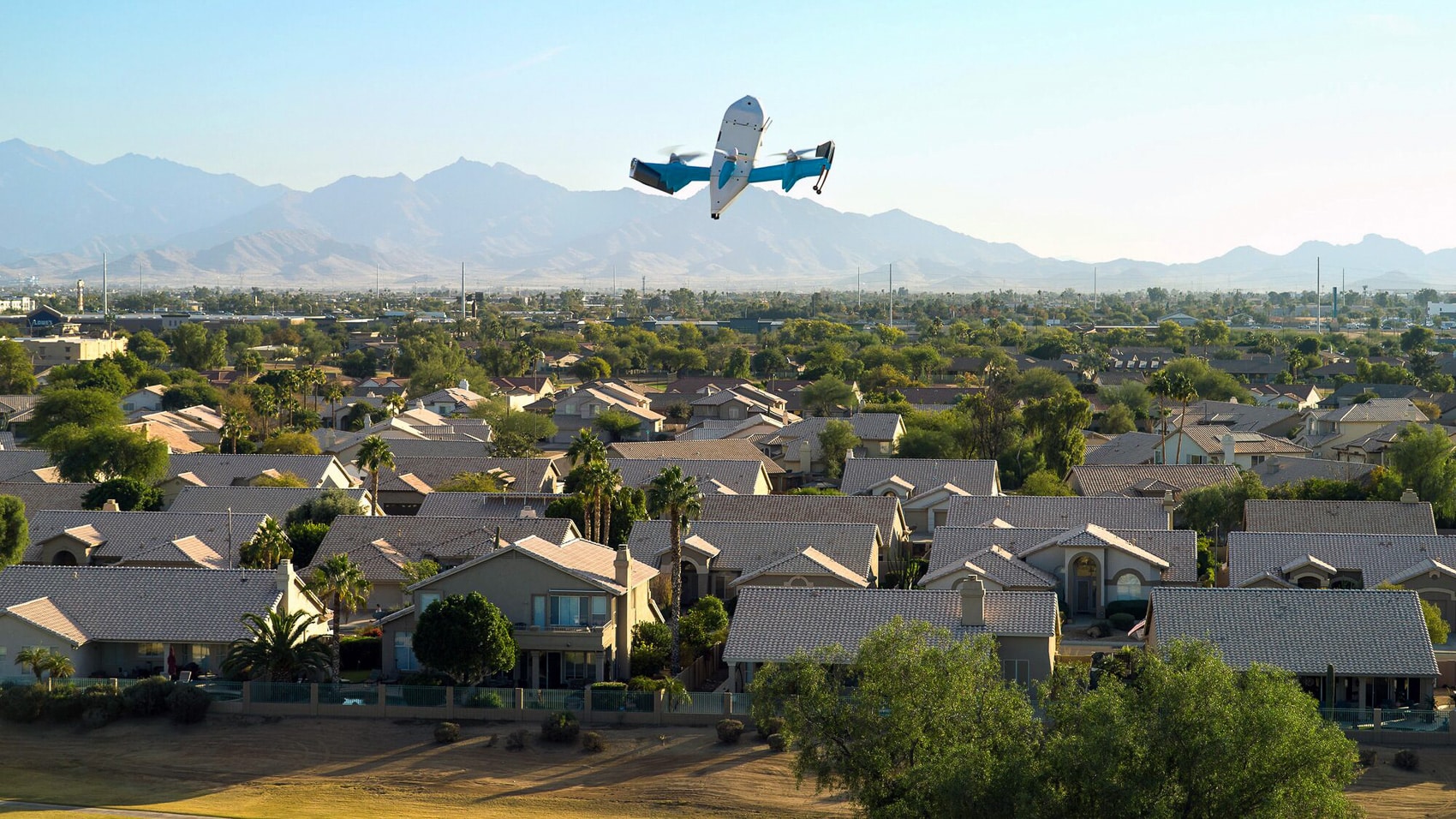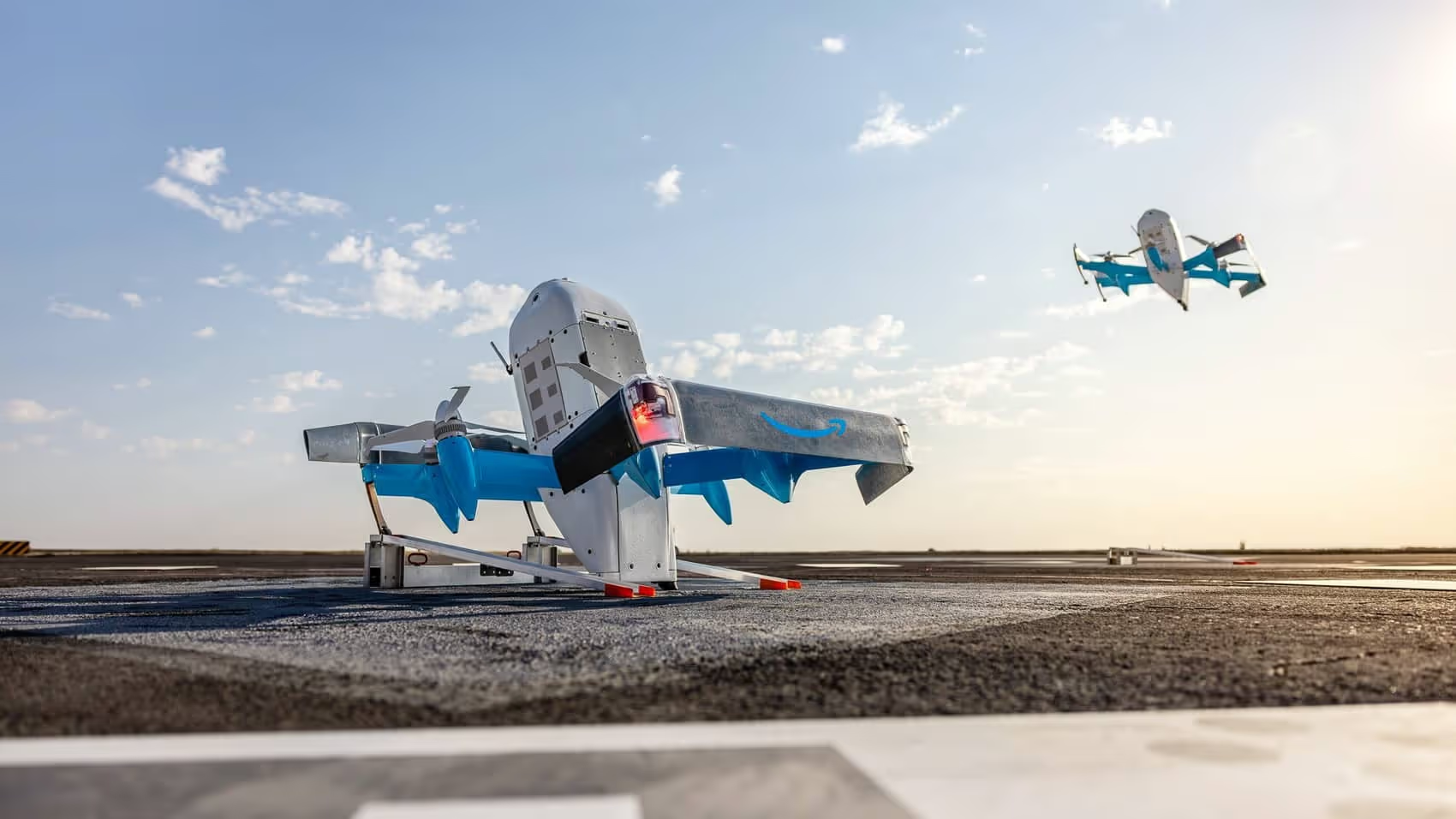
Amazon wants to fly delivery drones out of North Portland. A pre-application conference request filed with the city’s permitting department shows the company proposing a Prime Air Drone Delivery Center at its sub-same-day fulfillment center at 1001 N. Schmeer Road, with service planned for early 2027. This is Portland, Oregon, not Maine: the address is the former Portland Meadows racetrack beside Interstate 5, in the Delta Park industrial strip a few minutes north of downtown.
It would be the first Prime Air hub serving customers in Oregon, or anywhere in the Pacific Northwest. Amazon has flown in the state for years, at the Pendleton UAS Range in Eastern Oregon, where its test program has an FAA environmental assessment of its own. Portland appears in none of Amazon’s published expansion plans, and, as of the Drone Delivery Tracker’s September 16 sweep, in none of the 40 Amazon delivery hubs DroneXL has pulled from FAA filings. A city permit surfaced it, the same way a Tacoma Walmart permit surfaced Wing’s first Washington hub four days ago.
Oregon’s attorney general is one of 17 who told the FAA in January that its national drone delivery review was “a paper exercise.” The FAA signed it anyway in July. If the FAA decides the Portland site fits inside that national review, no Portland-specific federal environmental document and no federal comment period follows. Portland’s own land-use process is separate, and it is the only public step the city controls.
Amazon’s Portland Request Covers a Building, Not the Flights
A pre-application conference is a meeting with city planners that Portland requires before certain land-use applications. It approves nothing. Amazon’s request describes a Prime Air Drone Delivery Center added to the existing warehouse at 1001 N. Schmeer Road, with drone delivery from the site planned for early 2027.
The Portland Business Journal reported the filing first, and Amazon confirmed the plan without adding to it. “We are currently working with local officials and exploring opportunities,” spokesperson Farah Jad told the paper, describing Portland as one of several locations the company is looking at.
What a city gets to review in this process is the ground. In Richardson, Texas, the equivalent step covered a fenced launch pad and two modular buildings for battery charging, maintenance and storage, and the city first updated its zoning so applicants could seek a special permit for drone operations. Portland’s conference will sort out the same kind of questions: structures, parking, stormwater, whether the industrial zoning already allows what Amazon wants to build.
The air is federal. Prime Air flies under a Part 135 air carrier certificate, and a new operating area needs FAA approval, typically an amendment to Amazon’s operations specifications plus whatever environmental determination the agency attaches to it. Portland can shape the pad. It cannot decide whether 83-pound (38-kilogram) aircraft cross Kenton and Bridgeton on the way to a customer’s yard.
The same public records show Amazon leased two more Portland warehouses in August, at 4444 S.E. 27th Avenue and 2405 N. Albina Avenue, for Amazon Now, its 30-minute delivery service that runs from small urban sites without drones. The drone center is one piece of a wider Portland build-out.
Portland Appears in None of Amazon’s Public Plans or FAA Filings
Amazon’s August 19 expansion announcement listed 11 operating sites in seven states and named Chicago, Syracuse, Cleveland, Atlanta and Boise as next. Oregon was absent. DroneXL’s Drone Delivery Tracker holds 40 Amazon hubs drawn from FAA filings, and at its September 16 sweep Portland was not among them.
DroneXL found no Portland document of any kind on the FAA’s drone environmental review page on September 19; the page was last updated September 11. The company says it will reach nearly 500 cities and towns by the end of 2026, a sixfold jump from the current footprint, with each site covering about 175 square miles (453 square kilometers). An early-2027 Portland launch falls just outside that window, which is consistent with a hub that has not yet reached the FAA paperwork stage.
The permit-before-announcement pattern is becoming the way new hubs get found. Wing’s first Washington hub showed up in a Tacoma Walmart permit on September 15, in a state that had appeared on none of Wing’s announced market lists. Tracy, California got a car show booth and a launch date before any federal document appeared for the site. Portland now has a land-use filing and a launch quarter, and nothing else on the public record.
Oregon is not new ground for Amazon, only Portland is. Prime Air has flown at the Pendleton UAS Range at Eastern Oregon Regional Airport since 2019, and the FAA signed an environmental assessment for those test operations in November 2022, then re-evaluated it in August 2025 to let the MK30 fly there for testing and training. Pendleton is also where the aircraft’s development record was written. OPB and the Northwest News Network counted 10 crashes serious enough to be reported to federal authorities at the range by mid-2022, nearly all of them Amazon’s delivery drone, and Bloomberg reported that spring on current and former employees who said the program had prioritized speed over safety. Amazon said at the time that the move to customer deliveries showed the technology was safe and no longer experimental.
Pendleton is a test range, not a delivery hub, which is why it does not appear in the tracker’s hub count. Portland will be added as an announced hub with no FAA decision found, and the entry gets checked at Monday’s weekly sweep. (The tracker updates the day a story publishes; the sweep catches what the stories miss.)
Oregon Signed the Letter Calling the FAA’s Drone Review a Paper Exercise
On January 23, attorneys general from 17 states, Oregon included, told the FAA its draft national assessment for Part 135 drone delivery could not support a no-impact finding and asked for a full impact statement. The FAA signed the finding on July 28. New hubs are measured against it.
DroneXL covered the nationwide finding when it landed. It holds only if operators implement the noise mitigation written into the assessment, and the core of that is physical: at the analyzed ceiling of 1,150 average daily deliveries, a hub is sited with a 600-foot (183-meter) setback from noise-sensitive uses, and a proposal outside the national envelope tiers off into a narrower supplemental review. Oregon’s signature on the January letter does not change any of that for Portland. The state asked for a bigger process and did not get one.
Whether Portland gets a site document of its own is now an FAA choice made without a public step. Chicago’s draft assessment ran a comment period. Baton Rouge’s did too, and Amazon started commercial service there 15 days before it closed. Tracy has nothing. Under the statute governing review of FAA orders, 49 U.S.C. 46110, a challenge to the July 28 decision has to be filed within 60 days, which runs out on September 26, one week from today. After that the default for the next several hundred towns is settled in the agency’s favor.
Washington’s attorney general fought the same finding, and Wing’s Tacoma hub is arriving under it regardless. Oregon and Washington are the two Pacific Northwest signatories, and both now have a drone delivery hub coming that neither state’s legal position slowed by a day.
The Schmeer Road Site Sits Inside Portland International’s Airspace
The warehouse sits about 4 miles (6.8 kilometers) west of Portland International Airport and 2 miles (3.1 kilometers) south of Pearson Field in Vancouver, Washington, across the Columbia River. PDX’s Class C airspace runs from the surface to 4,000 feet within 5 nautical miles, and Schmeer Road is inside it.
The Class C description in 14 CFR Part 71 carves out only two areas near the site: a low-altitude box over Pearson Field on the north shore of the Columbia, and everything west of the Willamette’s east bank. Delta Park is east of the Willamette and south of the Columbia, so neither exclusion applies. The FAA describes Pearson’s runway 8 threshold as sitting directly under the instrument approach to PDX runway 10L, which is why it wrote Pearson its own special flight rules area. What Class C means for a Part 135 drone operation from this address is set by Amazon’s FAA authorization, and nothing about that authorization is public yet.
Amazon’s MK30 cruises between 180 and 377 feet (55 to 115 meters) above ground in its FAA filings and carries up to 5 pounds (2.3 kilograms), with existing hubs serving a radius of about 7.5 miles (12 kilometers). A circle that size drawn around Schmeer Road would reach most of North and Northeast Portland, part of Vancouver, Washington, and the approach paths into PDX. Whether Portland’s service area looks anything like that circle depends on the routes and boundaries the FAA approves, and none of them are public. The Portland filing describes a building.
The safety record Portland is being asked to host is on the tracker. Seven Amazon incidents in DroneXL’s files, among them the October 2025 crane strikes in Tolleson, a cable strike in Waco, an apartment crash in Richardson, a package dropped into a Richmond, Texas pool in August, and an MK30 that set itself down beside a Baton Rouge road on September 11, two months into service there. The MK30 carries no parachute or ballistic recovery system in any of Amazon’s FAA filings, and it releases packages from about 13 feet (4 meters).
DroneXL sent Amazon 25 written safety questions about the MK30 between September 3 and September 10, including its fleet flight hours and what changed after Tolleson. The final deadline was September 15. Zipline answered its set in part. Amazon has answered none.
DroneXL’s Take
I want Prime Air in Portland. A drone hub that gets a package across North Portland in 30 minutes without a van on I-5 is the kind of drone use DroneXL exists to cover, and Amazon’s 11 sites move thousands of packages a day, most of them without incident. Thirteen years of engineering went into that aircraft, by its own account, and the record of it flying is mostly a record of it working.
The record also has seven entries in it, and Amazon has now let two DroneXL deadlines pass without answering a single written question about any of them. That is the company Portland is dealing with. Not the community team with the static display and the free tacos, who are excellent, but the one that decides which questions get answered on the record, which so far is none.
Portland holds less than it thinks and more than Amazon would like. The city cannot touch the airspace. What it does hold, my read of the process rather than a legal opinion, is the timetable for the ground: the pad, the buildings, the permits Amazon needs before anything flies. A pre-application conference is the one moment when Amazon has to sit across a table from a public body and explain the building, and the planners in that room can ask for the operating documents that go with it: the noise modeling, the delivery area map, the FAA correspondence, and whether the site will get its own environmental assessment or ride the national one. Baton Rouge’s FAA filing had a wildlife appendix a resident could open. Portland should ask for the same before it agrees to anything about a parking lot.
The January letter Oregon signed was right about the review and lost anyway, and the loss is now Portland’s problem to manage locally. I don’t know what weight, if any, the finding carried in Amazon’s site selection, and Amazon has not said. What I can see is the sequence: a signatory state, a finding signed in July, a land-use filing in September, and a launch quarter that lands before any court has ruled on whether the states had a point. Watch September 26. If no challenge is filed by then, the only public process Portland gets is the one its own permitting office runs, and the tracker will show whether Amazon files anything with the FAA before the first MK30 leaves Schmeer Road.
Sources: Portland Business Journal via KGW, Amazon, Community Impact, Federal Register, FAA NEPA and Drones, OPB.
DroneXL uses automated tools to support research and source retrieval. All reporting and editorial perspectives are by Haye Kesteloo. Read our editorial standards.