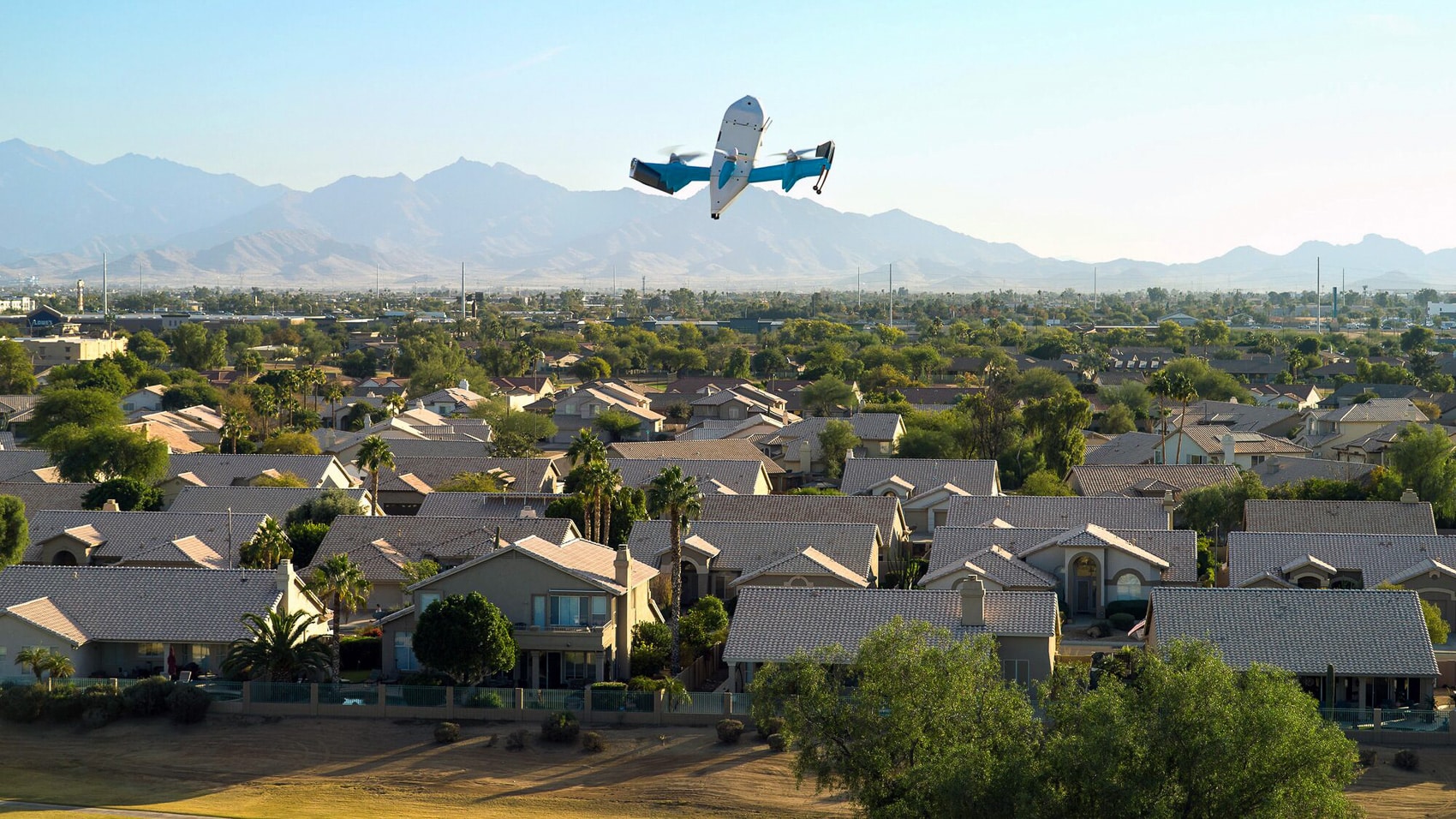
Amazon wants to fly up to 1,000 MK30 delivery flights a day out of its North Haven, Connecticut warehouse, roughly 365,000 a year, to addresses within 7.5 miles (12 kilometers) of the building, and Connecticut residents have until October 1 to say what they think of it. The state’s Department of Energy and Environmental Protection published a notice on September 16 that the Federal Aviation Administration wants its concurrence on the plan, and opened a 15-day comment window on the same day. The New Haven Register reported the notice on Thursday and the Hartford Courant followed with the FAA document on Saturday.
A 7.5-mile circle around the warehouse covers about 174 square miles (451 square kilometers) and takes in Hamden and Wallingford and reaches into New Haven. It is the first federal paperwork DroneXL has seen for any Prime Air hub in the Northeast, and the first comment window DroneXL has seen open on one.
The 1,000 reads like a Connecticut forecast, and it is nothing of the kind. One thousand flights a day, 365,000 a year, 174 square miles: Amazon writes the same ceiling into every MK30 filing it makes, from Chicago to Baton Rouge to Florida. What Connecticut has is the standard envelope, 11 days to comment on it, and a question the FAA has not answered: whether North Haven gets a site review of its own or rides the national finding the agency signed in July.
Amazon’s Connecticut Numbers Are the Same Numbers It Files Everywhere
Every MK30 environmental filing on the FAA’s public review page carries the same proposal: up to 1,000 delivery flights a day, seven days a week, about 365,000 a year, from a 7.5-mile radius covering 174 square miles. Chicago, Baton Rouge, Omaha, Detroit, Kansas City, Florida and Texas all say it.
The one exception is the oldest MK30 hub. Amazon asked the FAA for 469 flights a day at Tolleson, Arizona, in 2024, about 171,000 a year. Every filing since has asked for the round number, and the FAA’s public review page repeats it seven times over. Connecticut’s document carries the operating window the 2026 filings share: 6 a.m. to 10:30 p.m., with up to 100 of the 1,000 daily flights falling in the first hour and the last half hour.
What the hubs actually fly sits well under that. Sam Bailey, Amazon’s economic development manager, told the Richardson, Texas city council in March that its hub was filling about 150 orders a day against a permitted 1,000. A Baton Rouge resident told a Rotary Club audience this month that the neighborhood hears about 20 drones an hour, the same story where Amazon’s manager called the aircraft quieter than an idling truck. Amazon says it reaches those levels gradually, as demand builds.
The ceiling still matters, because the ceiling is what gets analyzed. The noise model and the FAA’s finding on a site both run at the proposed maximum, and the national environmental document the agency signed on July 28 works the same way: it covers a hub up to 1,150 deliveries a day, provided a hub running that volume sits at least 600 feet (183 meters) from homes. A 1,000-flight North Haven proposal fits inside that number by design.
Connecticut Opened a 15-Day Comment Window the FAA Never Advertised
The FAA asked Connecticut’s Department of Energy and Environmental Protection on August 17 to concur that approving Prime Air’s beyond-visual-line-of-sight deliveries around New Haven is consistent with the state’s Coastal Management Act. DEEP published the notice on September 16, takes comment through October 1, and must decide by October 16.
DEEP spokesperson Bill Flood laid out the timetable for the New Haven Register: 15 days of comment from publication and a 60-day clock from receipt for the department’s decision. The federal Coastal Zone Management Act gives a coastal state that review over federal actions that could affect its coast, and the FAA’s own document says this one will not: the site is inland, outside the coastal boundary, with no construction in the coastal zone, and the drone overflights inside the 7.5-mile radius are transitory. Texas ran the same review for Amazon’s Pasadena hub last fall and gave the public 30 days. Connecticut is giving 15. The Register’s report does not say how comments are to be filed. DEEP’s coastal consistency page says its Land and Water Resources Division runs these reviews and ends each one with a concurrence or an objection, and neither that page nor the department’s public-notices listing showed the Prime Air notice when DroneXL checked both on September 20.
That state notice is the only public trace of the federal side of the project. The FAA’s drone environmental review page listed no Connecticut document of any kind when DroneXL checked it on September 20; the page was last updated September 11. Coastal consistency has appeared on that page before, as an appendix to a site-specific assessment: the Texas, Florida and Chicago filings each carry one. It has never, on that page, appeared on its own.
Which route North Haven takes is the open question. Chicago, Baton Rouge and Omaha each got a draft assessment with a 30-day federal comment period. Tracy, California got a launch date and no document. Since July 28 the FAA has had the option of checking a new hub against the national finding inside the agency, with no draft published and no comment window, as DroneXL laid out when Washington cleared the runway for 500 cities. If that is the path New Haven is on, the 15 days DEEP is offering are the only days Connecticut will get, and they are running on a review the FAA itself says has nothing to find.
Connecticut’s attorney general, William Tong, is one of 17 who told the FAA in January that its national review was a paper exercise and asked for a full impact statement. The FAA signed the finding anyway. The 60-day window to challenge it in court under 49 U.S.C. 46110 closes September 26. Oregon signed the same letter, and Amazon’s Portland hub surfaced this weekend under the same finding. Connecticut joins Oregon and New York among signatory states with a Prime Air hub in the pipeline and no federal document posted for it.
Amazon confirmed the plan without adding to it. Amazon is “always exploring new ways to get customers a wider selection at faster speeds,” spokesperson Mike Murphy told the Courant, and is working with local officials on Connecticut. The company’s website now lists 13 operating locations in nine states and four more coming soon, according to the Register, up from the 11 sites Amazon counted on August 19. Its stated goal is nearly 500 cities and towns by the end of 2026, and its August list of next markets named Syracuse, the other Northeast site, and not New Haven.
North Haven Approved the Ground in May, With a Noise Pitch Attached
North Haven’s commissioners approved a Prime Air Drone Delivery Center at Amazon’s 409 Washington Avenue warehouse, a 142-acre site cleared for warehouse use in 2019, plus a perimeter fence. Sam Bailey previewed the plan in early May, and the minutes describe preprogrammed flights to fixed points within seven miles.
The commission noted what every planning board eventually notes: the FAA has sole jurisdiction over altitude and flight patterns. The town approved a building. Bailey used the meeting to describe the flights anyway, and the Register Citizen’s account of it, carried by GovTech, has him putting takeoff and landing noise at a little over 60 decibels, a little louder than a dishwasher. He promised a public information session and said Amazon was reaching out to neighboring towns.
Amazon’s own FAA filings put different numbers on the same aircraft. The Baton Rouge noise appendix records takeoff and landing at 90.5 and 91.8 decibels SEL measured 20 feet from the aircraft, about 70 decibels Lmax at 75 feet, and 63.7 decibels SEL for a drone cruising overhead at 200 feet (61 meters). The FAA compares the takeoff figure to a household vacuum cleaner at 10 feet. Bailey’s 60 came with no distance and no metric, and which of the filing’s readings it corresponds to is not something the Register Citizen’s account resolves. The loudest moment in the filing, 92.1 decibels, is the delivery itself: a hover at about 13 feet (4 meters) while the payload doors open and the package falls to the lawn.
Connecticut is one of 21 states with no statute on dropping objects from aircraft beyond the federal hazard standard, as DroneXL’s 35-state review found on Sunday, so the drop raises no state-law issue here of the kind it raises in Arizona or Michigan. What it raises is the same one it raises everywhere: the MK30 releases a 5-pound (2.3-kilogram) package in free fall, carries no parachute in any FAA filing DroneXL has read, and Amazon has answered none of DroneXL’s 25 written safety questions about it since the first set went out on September 3.
The FAA’s document describes the aircraft North Haven will host in plain terms: 78 pounds (35 kilograms) empty, 83.2 pounds (38 kilograms) at takeoff, a 5-pound payload, cruise between 205 and 370 feet (62 to 113 meters), 73 mph (117 km/h) at the top end, and a vertical descent to the drop. The document does not mention Tweed New Haven Airport, which lies south of the site, and whether Amazon’s approved area reaches its airspace depends on boundaries the FAA has not published. Deliveries would cost $5 for Prime members and $10 for everyone else, the pricing Bailey gave the commission in May.
DroneXL’s Take
North Haven is about 55 miles (90 kilometers) from my house, the first Prime Air hub I could drive to in an afternoon. A drone that gets children’s Motrin to a house in Hamden in 30 minutes without a van on the Wilbur Cross is the industry DroneXL exists to cover, and Amazon’s 13 hubs deliver that daily.
The 1,000 is a ceiling and Amazon will fly under it for years, the way Richardson flies at 150 and Baton Rouge at a rate its own manager won’t put a number on. Anyone reading 365,000 as next year’s traffic over Wallingford is reading it wrong. It is also the only number the FAA will ever analyze for this site, and the number the noise model and the finding will be built on. A resident who wants a say gets it on the ceiling or not at all.
The number is Amazon’s boilerplate. The process is the story, and I suspect the reason two Connecticut newspapers found this in a state environmental office and not on an FAA page is that there is nothing on an FAA page to find: the New Haven application is being checked against the July 28 national finding, in which case DEEP’s coastal review is the only public document Connecticut ever gets. I can’t confirm that, and the FAA hasn’t said. The pattern holds, though. Tracy got nothing. Portland got a city permit and nothing. North Haven got a coastal consistency letter for a site the letter itself says is nowhere near the coast, and 15 days to answer it.
Connecticut’s attorney general put his name on the January letter that said this is exactly what would happen. The letter lost. The 60-day clock runs out September 26, and if nobody files, the towns Amazon adds after New Haven inherit whatever process New Haven gets. That makes the next 11 days the ones that count, and Connecticut has more in hand than it thinks. A coastal consistency comment does not have to be about the coast. DEEP is being asked to concur with a federal action, and anything a resident, a first selectman or the attorney general puts in that file before October 1 is on the record when the FAA decides whether New Haven needs a review of its own. The 92.1-decibel delivery hover from Amazon’s Baton Rouge noise appendix belongs in it. So does the question of which environmental path the application is on, and the public session Bailey promised North Haven in May. The town cannot touch the airspace. Connecticut can decide what gets said on the record before the first MK30 leaves Washington Avenue, and right now the record says 60 decibels and 1,000 flights, both Amazon’s numbers, while the one the FAA wrote down, 92.1, sits in an appendix filed in Louisiana.
Sources: New Haven Register, Hartford Courant, The Register Citizen via GovTech, FAA NEPA and Drones, Comments of 17 Attorneys General, January 23, 2026, Texas General Land Office, Amazon.
DroneXL uses automated tools to support research and source retrieval. All reporting and editorial perspectives are by Haye Kesteloo. Read our editorial standards.