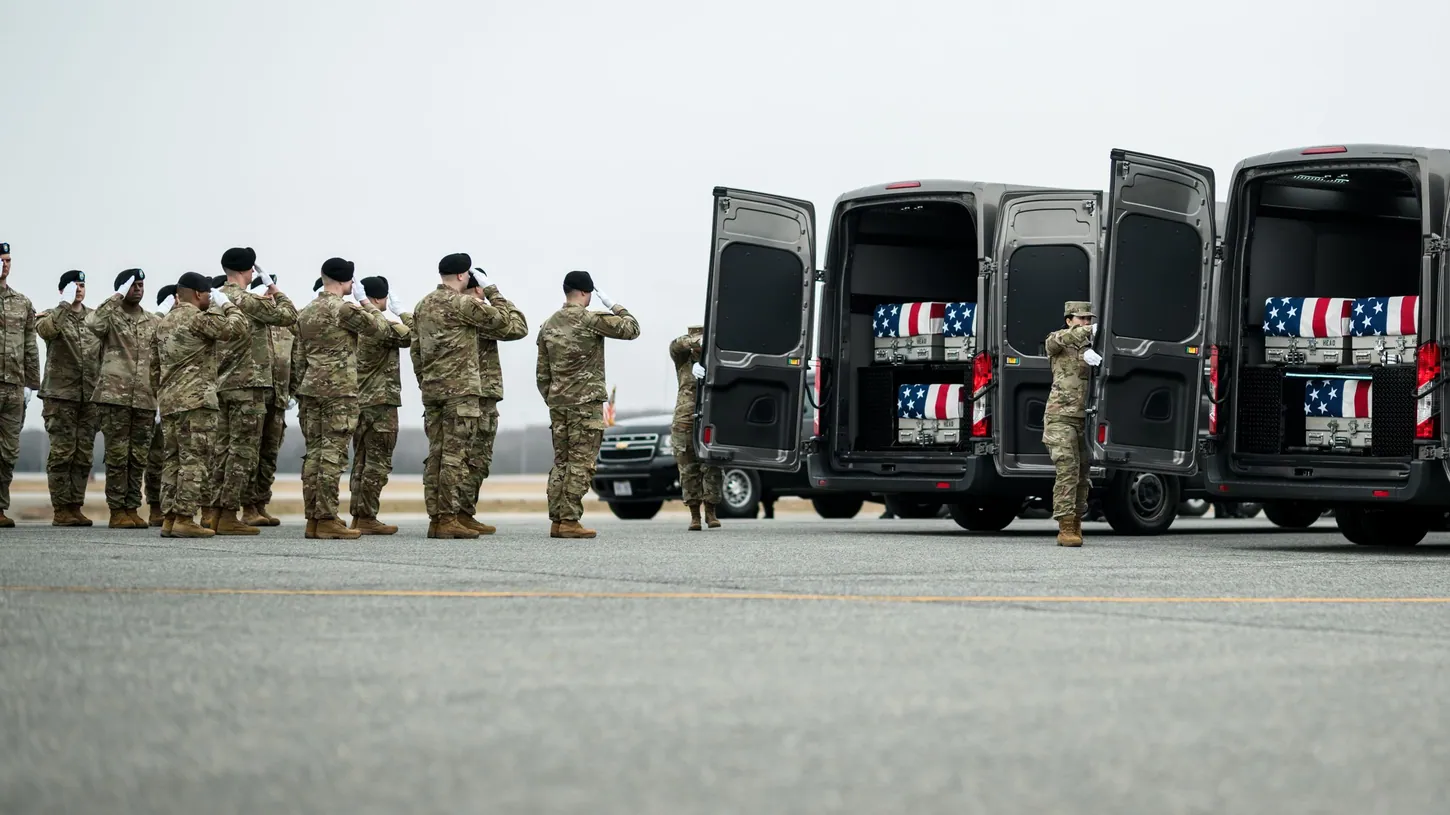
Nine U.S. soldiers wounded when an Iranian one-way attack drone hit Port Shuaiba, Kuwait, on March 1 told The Associated Press on the record that the military’s medical system left them, in many ways, fighting for treatment on their own. The strike, on the second day of the war with Iran, killed six soldiers and wounded dozens more at a logistics site that, as DroneXL noted in March, an official had told CBS had “basically no drone defeat capability.”
Army Lt. Col. Arturo Lincón was about 7 feet (2.1 meters) from the blast. Shrapnel lodged in his jaw, cut through a salivary gland, severed an artery in his neck and embedded in a vertebra, and a damaged left vertebral artery put him at risk of a stroke. When he reached Landstuhl Regional Medical Center in Germany, the Army did not admit him. He was sent to the barracks and told to book outpatient appointments.
The Pentagon says the medical care was appropriate. The Army declined to comment on the AP’s reporting, saying it had not yet briefed the families of the dead on the outcome of its investigation into the attack.
Wounded Soldiers Used Google to Find the Nearest Hospital
Soldiers at Port Shuaiba treated each other with tourniquets after the strike, then searched on Google for the nearest hospital and drove the wounded to Kuwait City, about 20 minutes away, the AP reported. Some of the most seriously wounded flew out within two days. Others waited some 10 days.
Lincón spent a week in a Kuwaiti hospital, where surgeons removed shrapnel from his jaw and staff told him the blast had given him a traumatic brain injury, ruptured his eardrum and briefly blinded him. Chief Warrant Officer 4 Rodney Bearman, with shrapnel from his face to his legs, was seen briefly at a Kuwaiti facility and then sent to the home of a U.S. government employee, as Iranian missile and drone fire made evacuation flights risky, the AP reported. The soldiers who finally boarded the cargo plane sat on its floor in straps. Bearman could barely eat or lie down.
The six who died at Port Shuaiba were among the 18 Americans killed in a war that, by the Pentagon inspector general’s count, had wounded 417 through June 30.
Landstuhl Turned the Wounded Away Over a Coding Error
When the plane landed in Germany, Bearman said, the soldiers learned they had not been documented as wounded in combat, which he attributed to a coding error. Landstuhl would not hospitalize them. Like Lincón, they were sent to the barracks for outpatient care. Lincón went days without pain medication.
Lincón carried a CD of his Kuwaiti medical records. The emergency room doctor at Landstuhl who read it expressed concern that nobody had yet put him in front of a trauma team.
“Some sacred trust that I thought would never be broken was broken,” said Bearman, who has served more than three decades, including in Afghanistan.
A Pentagon official told the AP that Landstuhl’s mission in battlefield casualty situations is to stabilize patients and transfer them to specialized care at a military hospital in the United States, not to admit them. In a statement, the Pentagon said every wounded service member who arrives at its facilities is evaluated and may be admitted based on severity, according to physicians following “healthcare-industry practices.” The large U.S. military hospitals that once sat closer to Kuwait are gone. The Air Force Theater Hospital at Joint Base Balad in Iraq was handed to the Iraqi government in 2011.
Brain Injury Diagnoses Waited Until Fort Hood, and Treatment Waited Longer
Medical records shared with the AP by Maj. Stephen Ramsbottom and another officer show neither was diagnosed with a traumatic brain injury until they reached Fort Hood, Texas, a week after Germany. Ramsbottom, who had shrapnel removed from his head, said he waited over four months for his MRI results.
The wounded went to Fort Hood for the Army’s demobilization process, the routine step for returning deployed troops, not for treatment.
The second officer, who was blown off his chair by the blast, said he got no care for weeks after that diagnosis and had to find his own specialists, including a neuro-ophthalmologist for the blurred vision his injury left behind. Maj. Billy Key said he did not reach a soldier recovery unit for his head injury, hearing loss and smoke-damaged lungs until mid-April.
“I’ve had to build my own case for everything,” Ramsbottom told the AP.
Dr. James Kelly, chief medical scientist at the Invisible Wounds Foundation and an emeritus professor of neurology at the University of Colorado School of Medicine, said it is still not uncommon in war for a TBI diagnosis to take longer than it should, which can cost a soldier the early treatment that produces the best outcome. The AP noted that soldiers may not register the Army’s battlefield concussion evaluation as an evaluation, and Kelly said records too often log a concussion without flagging it as the mild TBI it is. The initial check, he said, should be done by someone with medical training, not another soldier.
Lincón received the Purple Heart and is back on active duty as an instructor at Fort Leavenworth. Shrapnel remains in his back, too close to his spinal cord to remove, and dizziness disrupts his days, he said. The 1995 West Point graduate, born in Texas to Mexican parents, was issued only a one-year passport to replace the one destroyed in the blast and was asked for more proof of his U.S. citizenship. After the AP contacted the State Department, he got a call saying the request was a mistake and a 10-year passport was coming. His claim for Traumatic Injury benefits under the Servicemembers’ Group Life Insurance program was denied for not meeting the hearing-loss threshold, without addressing his other injuries, he said. The Army’s Human Resources Command did not immediately respond to the AP’s emailed request for an explanation.
“I’m American enough to have fought in three different wars,” Lincón said.
Warren’s July Letter Put the Same Failures to Hegseth
Senator Elizabeth Warren, four other Senate Democrats and eight House Democrats sent Defense Secretary Pete Hegseth a letter on July 29 with 23 questions on medical care, casualty reporting, force protection and investigations after Port Shuaiba, due August 12. A Pentagon official declined to comment to Military Times.
The letter asks why Landstuhl’s medical teams did not know wounded soldiers were on the flight, why the wounded were not logged as medical evacuees or as seriously injured in the casualty database, and when the soldiers sent to Fort Hood finally saw a doctor who could diagnose a TBI. It also asks how the Army classified as “not seriously injured” a soldier described in CBS News reporting as riddled with shrapnel with a concussion, hearing and vision loss and lung damage, and it cites CBS reporting that the 103rd Sustainment Command’s requests for more medical personnel and supplies before the attack were ignored. Warren, Kirsten Gillibrand, Richard Blumenthal and Mark Kelly had written to Hegseth about force protection at Port Shuaiba on April 26.
The Army completed its investigation of the attack in June, the AP reported separately on Monday, citing an official familiar with it, and has not released the report because, the official said, sensitive material still has to be redacted.
DroneXL’s Take
The Pentagon spent the first week of this war learning what Ukraine already knew about one-way attack drones: a $20,000 to $50,000 airframe gets through a post that, by one official’s account to CBS, had “basically no drone defeat capability.” DroneXL covered the first Shahed wave on March 1 and the scramble for Ukrainian interceptors a week later. This AP report is the other half of the same lesson, and I see nothing in the Pentagon’s statement that suggests the Army has absorbed it.
From four years of covering Shahed strikes on Ukraine, my understanding is that a Shahed hit produces a different casualty profile from a mortar: blast-wave concussions and shrapnel across everyone in a trailer, a whole staff section with mild TBIs that look fine on the ramp and get worse in the barracks. By Bearman’s account, the system logged the soldiers on his flight as not wounded in combat, and that entry, not a trauma assessment, decided whether they got a hospital bed. Lincón, who arrived earlier, was judged by the Army not serious enough to admit despite a severed neck artery.
I’d argue the drawdown logic that left Port Shuaiba with almost no drone defense is the same logic that stripped the region of the hospitals that would have caught these injuries early. Balad closed in 2011. I expect the next Shahed that reaches a U.S. post to send its wounded down the same Landstuhl-to-Fort-Hood pipeline, and nothing in the Pentagon’s statement says the coding will be right next time.
Sources: The Associated Press via The Seattle Times, Senator Elizabeth Warren’s July 29 letter to Secretary Hegseth, Military Times
DroneXL uses automated tools to support research and source retrieval. All reporting and editorial perspectives are by Haye Kesteloo. Read our editorial standards.