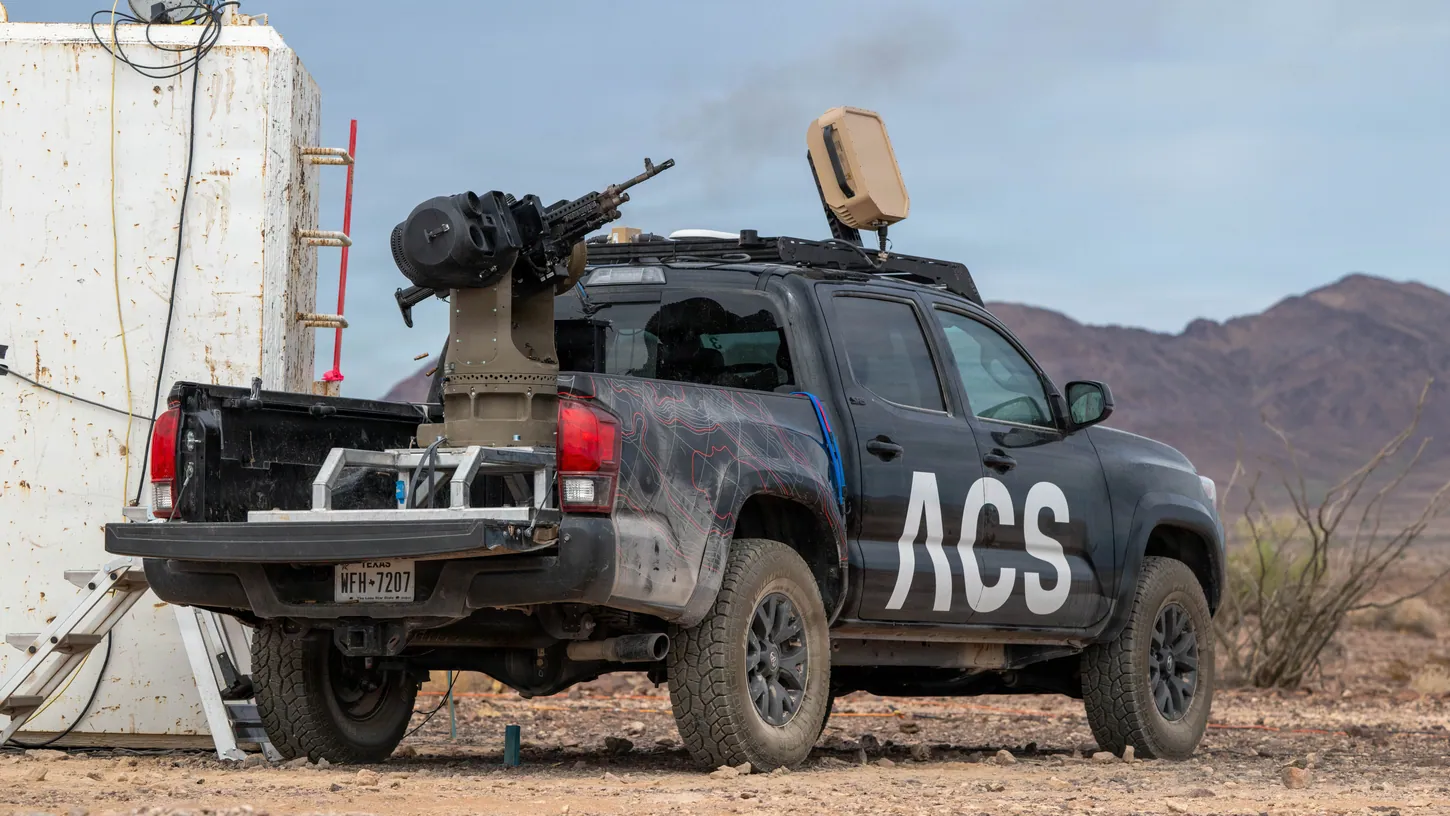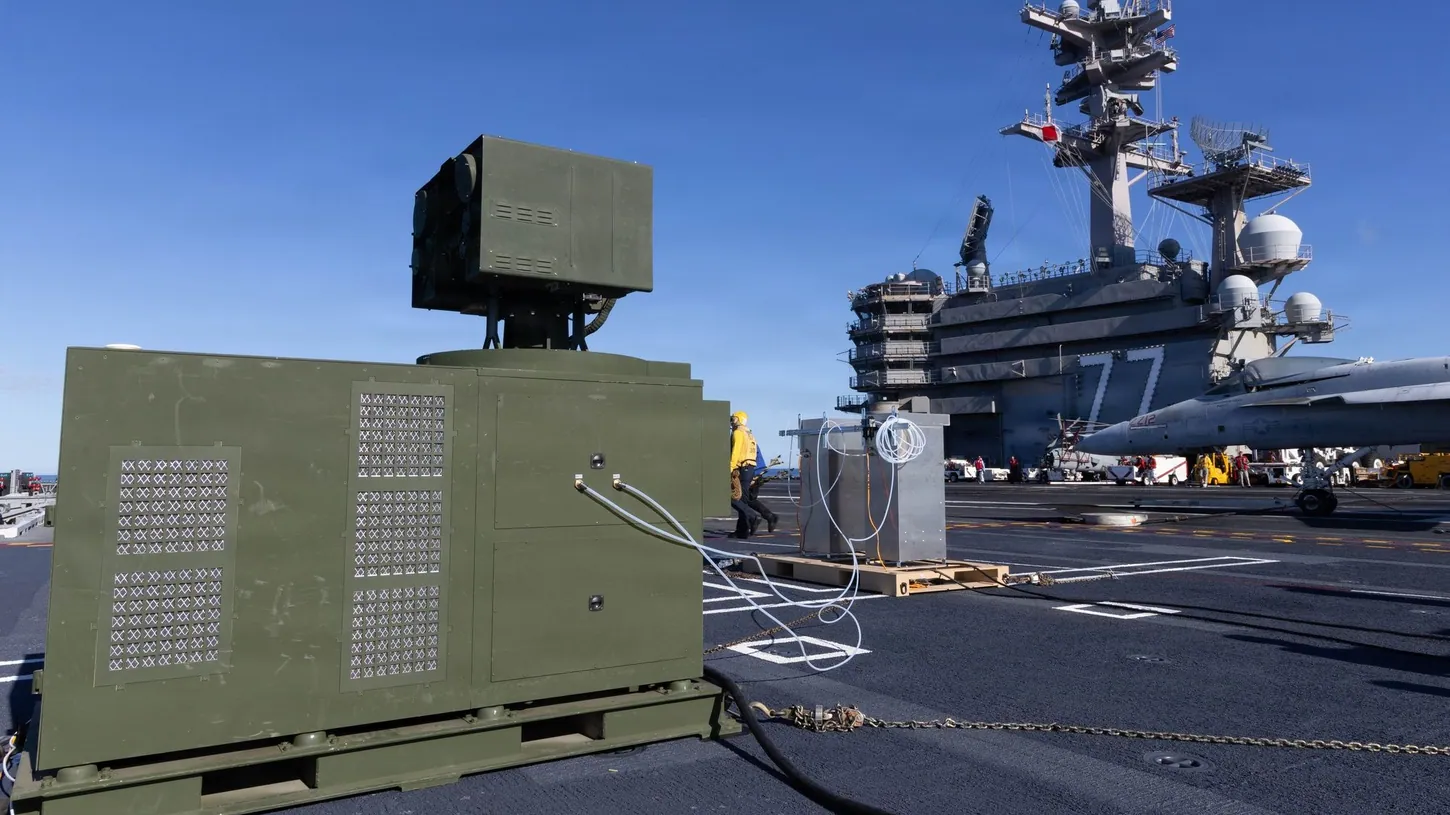
The Pentagon has picked the four directed-energy weapons that will defend US military bases against drones for the next year: high-energy lasers from AeroVironment, Kord and Boeing, plus Epirus’ Leonidas, a high-power microwave that knocks drones out of the sky by the swarm. The Department of War announced the selections on October 5 for the pilot run by Joint Interagency Task Force 401 (JIATF 401), the Army-led counter-drone task force.
Congress ordered the pilot in the Fiscal Year 2026 National Defense Authorization Act. The task force named five host installations in May: Fort Huachuca in Arizona, Fort Bliss in Texas, Naval Base Kitsap in Washington, Grand Forks Air Force Base in North Dakota and Whiteman Air Force Base in Missouri. DroneXL reported in September that the weapons will run there for 365 days.
The announcement leans on an FAA safety assessment at White Sands Missile Range to call the program safe. The laser the FAA assessed there came from AeroVironment’s LOCUST family, the company says.
Three Lasers And One Microwave Made The Pentagon’s First Cut
AeroVironment’s Palletized High-Energy Laser, Kord’s Firefly and Boeing’s Compact Laser Weapon System are the three lasers in the pilot. Epirus’ Leonidas is the lone microwave, and the only pick designed to disable an entire drone swarm with a single pulse of energy.
AeroVironment’s entry is the roll-on, roll-off version of LOCUST, the configuration that downed drones from the flight deck of USS George H.W. Bush in October 2025. The Army committed to the company in September with a $464.8 million production contract for the 30-kilowatt LOCUST X3, the deal DroneXL covered alongside the Army’s claim that its border laser cut cartel drone flights 75%.
Kord, a KBR subsidiary, builds Firefly as a palletized, mobile laser. Boeing said in October 2024 that its 5-kilowatt system had downed nearly 500 drones in demonstrations, swarms among them, including Group 3 aircraft weighing up to 1,320 pounds (600 kilograms) at the Red Sands exercise in Saudi Arabia.
Leonidas has the most dramatic record. At Camp Atterbury, Indiana, in August 2025, Epirus says it disabled all 61 drones it faced, finishing with a 49-drone swarm knocked out in one pulse. The Army has bought the system twice, with a $66.1 million contract in 2022 and $43.5 million in 2025.
Ross Doubts The Per-Shot Price That Sells These Weapons
The pilot exists to measure what directed energy costs a base to own and run: the October 5 release lists requirements, costs and best practices as the data it will collect. JIATF 401 director Army Brig. Gen. Matt Ross has already questioned the number the industry sells these weapons on.
That number is the price of one shot, which AeroVironment puts at $3 for LOCUST. Ross told reporters in August that the math leaves out the hardware, Defense News reports. Describing a hypothetical $6 million system that fires once a year, he said “you can’t tell me that that shot only costs 8 cents.”
More weapons are coming. In December the Pentagon will host a directed-energy shoot-off at Dugway Proving Ground in Utah to test additional lasers and microwaves, and Ross has said systems that perform there can go straight to a purchase order.
The FAA’s Safety Finding Covers AeroVironment’s Laser, Not Leonidas
The FAA announced on April 10 that a joint assessment found “a high-energy laser counter-drone system” posed no undue risk to passenger aircraft. AeroVironment later said that laser was its LOCUST. The October 5 release cites no FAA finding for Kord, Boeing or Epirus.
The Army fielded that LOCUST as AMP-HEL, and during the March 7 test at White Sands it shut itself off automatically when a commercial aircraft bound for Albuquerque drifted into its tracking angle. The FAA’s statement says the same methodology will be built in from the start for systems used in the homeland.
That assessment was a repair job. In February, a laser near Fort Bliss fired at what turned out to be party balloons and the FAA closed El Paso’s airspace. Two weeks later the same program shot down a Customs and Border Protection drone because CBP had not told the Pentagon it was flying.
A microwave raises a different safety question than a laser, because its pulse covers an area. Epirus calls that pulse low-collateral and says Leonidas picked one of two drones flying side by side at Camp Atterbury, then dropped another inside a software-defined safe zone. Nothing the FAA or JIATF 401 has published describes how far the pulse reaches or how those zones will be drawn on a US base.
DroneXL’s Take
Picking a microwave is the right call. A base cannot fight a swarm one beam at a time, and Leonidas is built for the problem Northcom’s deputy commander admitted in August: his command cannot stop a swarm launched inside US borders.
But the paperwork does not match the pitch. In May the Department of War wrote that White Sands validated that “the systems” pose no undue risk to passenger aircraft. The FAA’s own statement says it assessed one system, and AeroVironment says it was its own. El Paso is what happened the last time the Pentagon got ahead of its coordination with the FAA.
My read is that each of the other three weapons, the microwave first, needs its own FAA finding announced in public before it switches on at a base with civilian neighbors. The Camp Atterbury safe-zone demo is a claim from the company selling the weapon, and the FAA should test it the way it tested AeroVironment’s laser, on a range, before the pulse goes live over a US base.
Correction, October 7, 2026: An earlier version of this article reported, citing Defense News, that Brig. Gen. Matt Ross gave reporters a four-base list in August and that JIATF 401 had not told Defense News whether all five installations named in May remain in the pilot. Defense News has since removed both statements from its article, and they have been removed here, along with the section heading that referred to them.
Sources: U.S. Department of War, Federal Aviation Administration, Defense News, DefenseScoop, Epirus, Boeing, KBR
DroneXL uses automated tools to support research and source retrieval. All reporting and editorial perspectives are by Haye Kesteloo. Read our editorial standards.