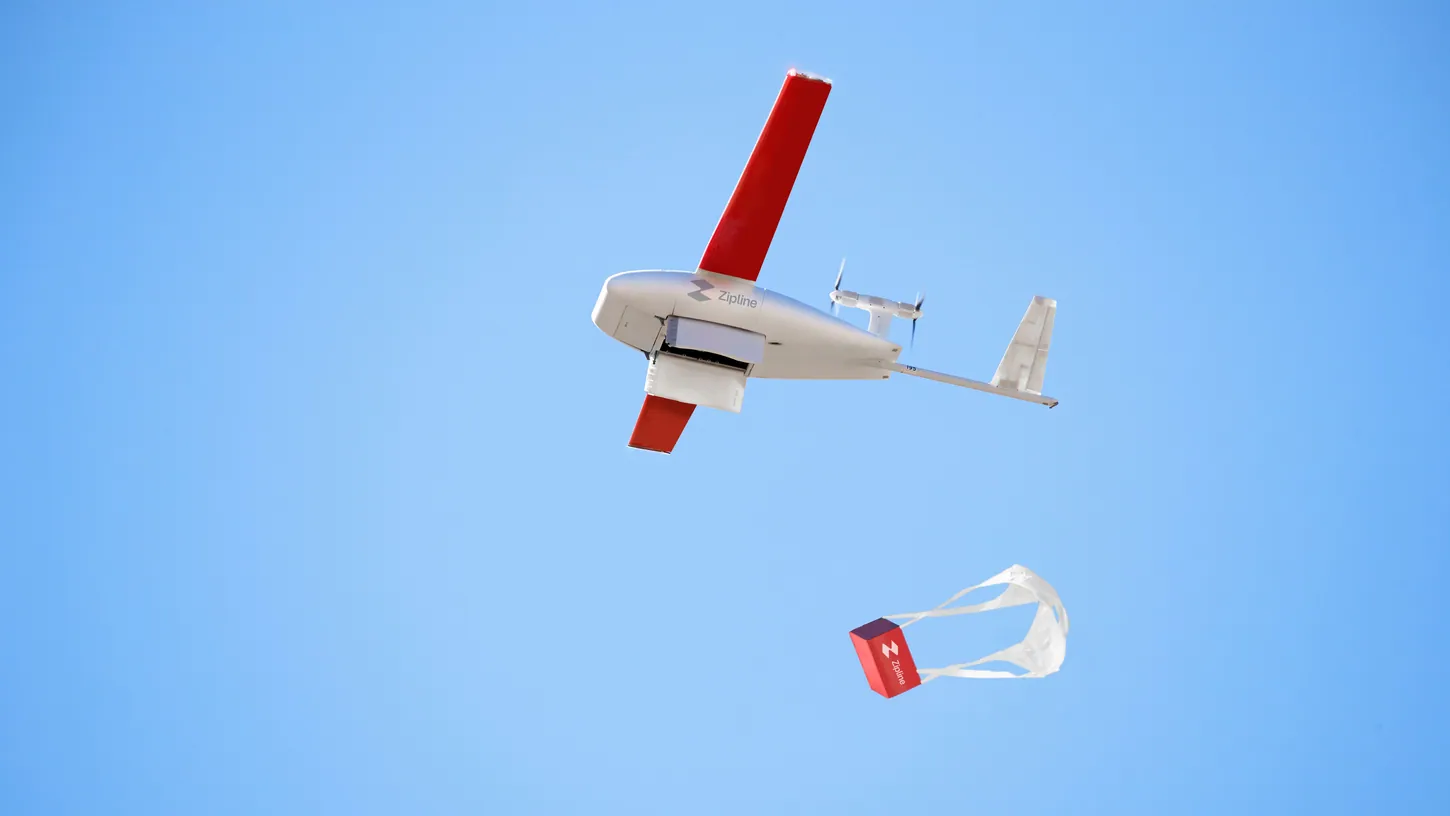
Zipline is marking 10 years of drone delivery in Rwanda today, October 16, the date it gives for its first flight there. The service began by dropping blood by parachute to rural hospitals. Zipline says it now counts more than 3 million deliveries and 140 million autonomous miles worldwide, and that Rwanda has the world’s first national drone delivery system.
To mark the date, Zipline released Origin Story, a four-minute film that opens its Stories from the Sky series. New episodes are dated through November 5. In the film, co-founder and CEO Keller Rinaudo Cliffton says that in the first year everything that could go wrong did go wrong.
Zipline’s anniversary page credits the Rwanda partnership with a 51% reduction in maternal mortality in Rwanda. The peer-reviewed study behind that number measured something narrower.
Zipline Launched Rwanda With 15 Zips And Launchers That Kept Breaking
President Paul Kagame opened the service in Muhanga District on October 14, 2016, according to Gavi’s launch release. Gavi and the UPS Foundation backed it. Zipline based 15 fixed-wing Zips there to air-drop blood to 21 transfusing clinics in western Rwanda, with up to 150 emergency flights a day.
Zipline’s anniversary material dates the first flight two days after that ceremony. Either way, the hardware was barely ready. “We had a bouncy castle. That’s how we were recovering the aircraft,” Rinaudo Cliffton says in the film. He told a longer version on First Round’s podcast. The team used deep-sea fishing poles bought at Walmart and paid a bouncy castle company to make inflatable pads, and the launcher destroyed itself about every third launch.
Caitlin Burton, Zipline’s Africa CEO, says in the film that Rwanda’s government never cared about autonomous drones. It wanted blood to reach women bleeding after childbirth. Emmanuel Nsengimana, a Zipline shift team lead, says getting blood used to take more than two hours, and Zipline now brings it within 40 minutes.
The 51% Figure Counts Hospital Deaths From Postpartum Hemorrhage
Behind Zipline’s 51% is a drop in in-hospital deaths among mothers with postpartum hemorrhage at hospitals the drones served, according to Wharton’s May 19 summary of the study. Wharton School researchers and Rwandan co-authors published it in Manufacturing & Service Operations Management.
The authors are Harriet Jeon, Hummy Song, Claudio Lucarelli, Jean Baptiste Mazarati and Donatien Ngabo. The same paper found a 30% drop in in-hospital deaths among trauma patients. Drone-served hospitals also cut the red blood cells they keep in stock by 63%, because a resupply is a flight away.
DroneXL’s February report on Rwanda’s nationwide deal put the reduction at 88%, crediting University of Pennsylvania researchers. The published paper says 51%. Zipline’s own companion page is also more careful than its anniversary page, limiting the 51% to “Zipline-serviced hospitals in Rwanda.”
Zipline’s Early film shows the patient that statistic is about. Theonile Mukankwiye, seven months pregnant and in labor, walked herself to the nearest hospital and delivered two months early. With her daughter in the NICU, she began losing blood from postpartum hemorrhage. Zipline says drone deliveries that arrived just in time helped save her life.
The anniversary page also credits Zipline with a 22% reduction in childhood deaths from severe acute malnutrition in Rwanda, and its companion page claims a 60% cut in medicine and vaccine stockouts where Zipline delivers. Neither anniversary page cites a study for those figures.
Côte d’Ivoire Is The Model Zipline Is Selling For Its Next Decade
Zipline says three years of flying from Daloa in Côte d’Ivoire have helped save more than 2,000 lives. The Ivorian health ministry has signed an eight-year public-private partnership with the company. Zipline’s Community film frames the deal as a move from traditional aid to long-term logistics contracts.
DroneXL covered that deal last month: 10 hubs serving 12 million people, with construction funded from the US State Department’s award of up to $150 million across five African countries and the operating bill paid by the Ivorian state.
In the film, Rinaudo Cliffton says Zipline serves fewer than 1% of the people on Earth. Burton says the next 10 years are about collapsing the timeline to reach a billion people and more. Investors are pricing that ambition: Zipline is seeking a $20 billion valuation.
DroneXL’s Take
Zipline has earned this anniversary. Rwanda bet on an untested startup in 2016 because it needed blood at rural hospitals, and a decade later a peer-reviewed paper shows fewer mothers dying of hemorrhage where the drones fly. I can’t think of a stronger case for drones being used for good.
That’s why the anniversary page bothers me. A 51% drop in hospital deaths from postpartum hemorrhage is an extraordinary result, and it doesn’t need to be stretched into “maternal mortality in Rwanda” as a whole. We printed an 88% figure in February, and the published paper came in at 51%, so I know how easily these numbers drift. Zipline now wants eight-year contracts from health ministries and trust from American neighbors who watch its aircraft overhead. The company should quote its best evidence exactly as the researchers wrote it.
Sources: Zipline, Stories from the Sky, Zipline, Origin Story video, Knowledge at Wharton, Gavi, First Round Review.
DroneXL uses automated tools to support research and source retrieval. All reporting and editorial perspectives are by Haye Kesteloo. Read our editorial standards.