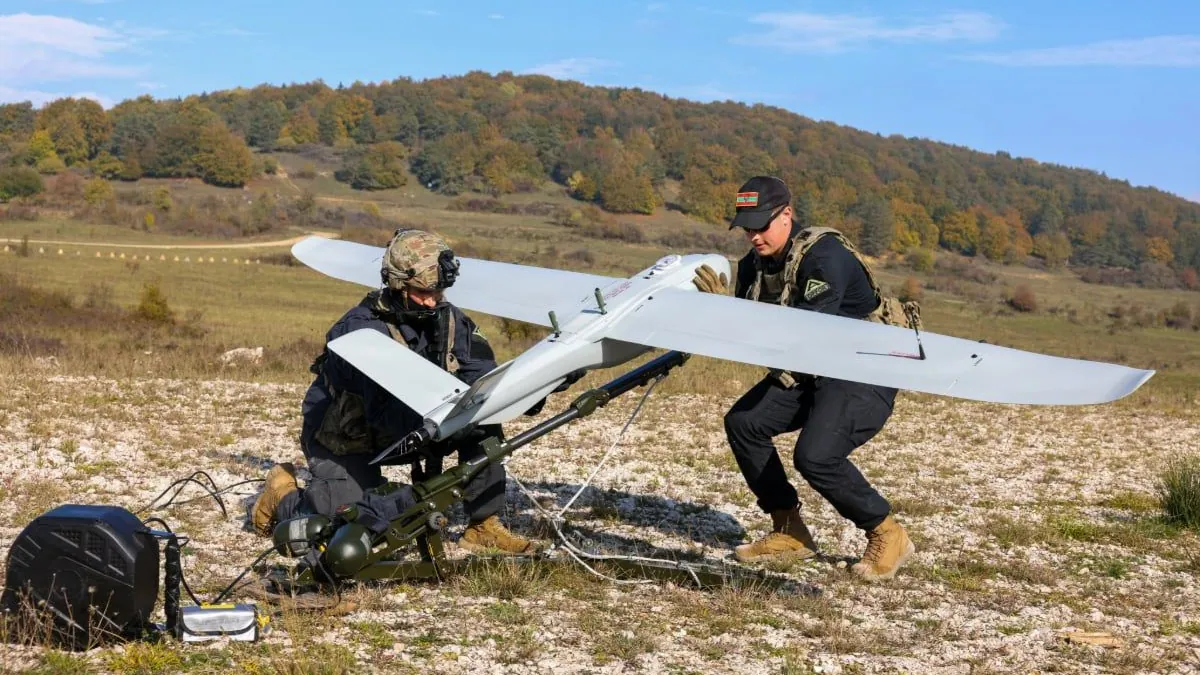
The US Army’s only drone assault battalion is losing its drone mission. After reporting its findings from the Saber Junction 26 exercise in Germany, which ran through September 13, the roughly 600 paratroopers go back to regular airborne infantry work on orders from acting Army Chief of Staff Gen. Christopher LaNeve.
DroneXL reported the phase-out on August 20. What has changed since is who is objecting. Michael C. Horowitz, a former deputy assistant secretary of defense who ran the Pentagon’s Emerging Capabilities Policy Office, published an analysis at the Council on Foreign Relations on September 14 asking whether the Army is backing off drones altogether.
His evidence is a summer of bad signs: Ukrainian drone units beating American troops in a spring exercise, the battalion’s cancellation, and the resignation of Army Secretary Dan Driscoll, the service’s loudest drone advocate.
Ukrainian Drone Operators Outfought US Troops at Hohenfels
In April and May, about 3,500 US soldiers, mostly from the 3rd Armored Brigade Combat Team, 1st Cavalry Division, faced a Ukrainian-reinforced opposing force during Combined Resolve at Hohenfels, Germany. According to The Wall Street Journal, the Ukrainian drone operators won.
Horowitz calls that result unsurprising. Ukrainian units have spent four and a half years refining drone reconnaissance and strike under fire, and US soldiers have never faced an enemy dropping munitions from the air as persistently as they did at Hohenfels.
It wasn’t the first time. At Hedgehog 2025 in Estonia, roughly 10 Ukrainian operators playing the adversary mock-destroyed 17 armored vehicles and effectively eliminated two NATO battalions in about half a day.
Horowitz’s broader argument is that wars are won by whoever adopts a technology fastest, and he points to the six-week software update cycles and repair networks Ukraine has built around cheap uncrewed systems. The clearest example is the software. Ukraine’s Delta system has cut the time from spotting a Russian position to hitting it from at least 20 minutes to three to five, and Driscoll told the Senate in May that American systems can’t do the same.
The Army’s Drone Battalion Returns to Airborne Infantry
The drone unit, roughly 600 paratroopers of the Italy-based 173rd Airborne Brigade stood up less than a year ago to absorb Ukraine’s drone lessons, is being returned to its airborne infantry mission after reporting its findings from the Saber Junction 26 exercise, on orders from Gen. Christopher LaNeve.
The timing is awkward. At that same exercise, the resident opposing force turned 1,900 autonomous systems on the 173rd, including Skydio X10 and Neros Archer drones.
LaNeve’s planning document, The Army Azimuth, does mention unmanned systems and artificial intelligence. It also calls for a return to the “fundamentals of Soldiering.” The battalion decision prompted a bipartisan group of lawmakers to write to LaNeve and Driscoll on September 1, noting that LaNeve’s back-to-basics message also told soldiers to learn and adapt faster. Eliminating the battalion, they wrote, “hurts our ability to acquire the critical knowledge and skills” available from working alongside Ukrainian soldiers.
Horowitz offers a less alarming read, too. The battalion was a flagship project of Gen. Randy George, the Army chief Defense Secretary Pete Hegseth ousted in April, and LaNeve has been unwinding a string of his predecessor’s decisions. The cancellation may say more about a new chief putting his stamp on the service, and about the Army pulling back from Europe, than about how the service values drones.
Driscoll’s Exit Removes the Army’s Loudest Drone Advocate
Army Secretary Dan Driscoll resigned at the end of August after 18 months in the job. He came from venture capital and pushed the Army to buy drones fast. The White House accepted his resignation on August 31, according to NBC News.
Driscoll is the official who announced last November that the Army would buy at least 1 million drones over two to three years. In his resignation, he raised concerns about Army transformation and about Hegseth firing the generals responsible for it, a source familiar with the matter told CNN.
The list of departures is long. George was fired in April. Gen. Christopher Donahue, who led US Army Europe and Africa, stepped down in June. Horowitz writes that the Army Transformation Initiative, launched under Driscoll, is now in doubt.
The Pentagon’s $55 Billion DAWG Request Points the Other Way
Army drone capability does not rest on one battalion. The Pentagon’s fiscal 2027 request asks for about $54.6 billion for the Defense Autonomous Warfare Group, up from roughly $225 million in fiscal 2026, and the Drone Dominance Program is a Hegseth priority, not an Army one.
DroneXL covered that request in April, when DAWG drew the largest year-over-year increase of any defense program. Horowitz says it should reshape Army capabilities regardless of who runs the service. His worry is about direction: leaders set the tone for what a service takes seriously, and to him the summer’s moves feel like a step back.
DroneXL’s Take
The Pentagon wants $55 billion for autonomous warfare while the Army strips the drone mission from its only drone assault battalion, and I think that gets the order backwards: Ukraine has shown since 2022 that adoption speed decides drone wars in the field.
I’ve followed Delta since March 2022, when it was a shared map Ukrainian units opened on laptops over Starlink. Four years later it routes thousands of drones to targets in minutes. Ukraine got there by making drones an institution, down to a separate Unmanned Systems Forces branch, and Russia answered with dedicated drone units of its own, such as Rubikon. China builds most of the world’s small drones and the parts inside them. Against that field, the US Army lost a drone fight to Ukrainians this spring and ended its drone learning unit in August.
The 173rd is Europe’s rapid-response airborne brigade, and a battalion busy experimenting with drones is a battalion it can’t send as infantry. It still doesn’t solve the bigger problem. Money buys drones. It doesn’t produce soldiers who know how to fight with and against them, and that knowledge was the job of the one unit tasked with learning it from Ukrainians.
Horowitz ends his piece hoping this isn’t a retreat. I’d go further: on the evidence so far, it is one. The battalion owes the Army its Saber Junction findings. Watch whether those findings end up changing how the rest of the 173rd trains, or end up in a binder.
Sources: Council on Foreign Relations, The Wall Street Journal, Stars and Stripes, NBC News, CNN, US Army.
DroneXL uses automated tools to support research and source retrieval. All reporting and editorial perspectives are by Haye Kesteloo. Read our editorial standards.