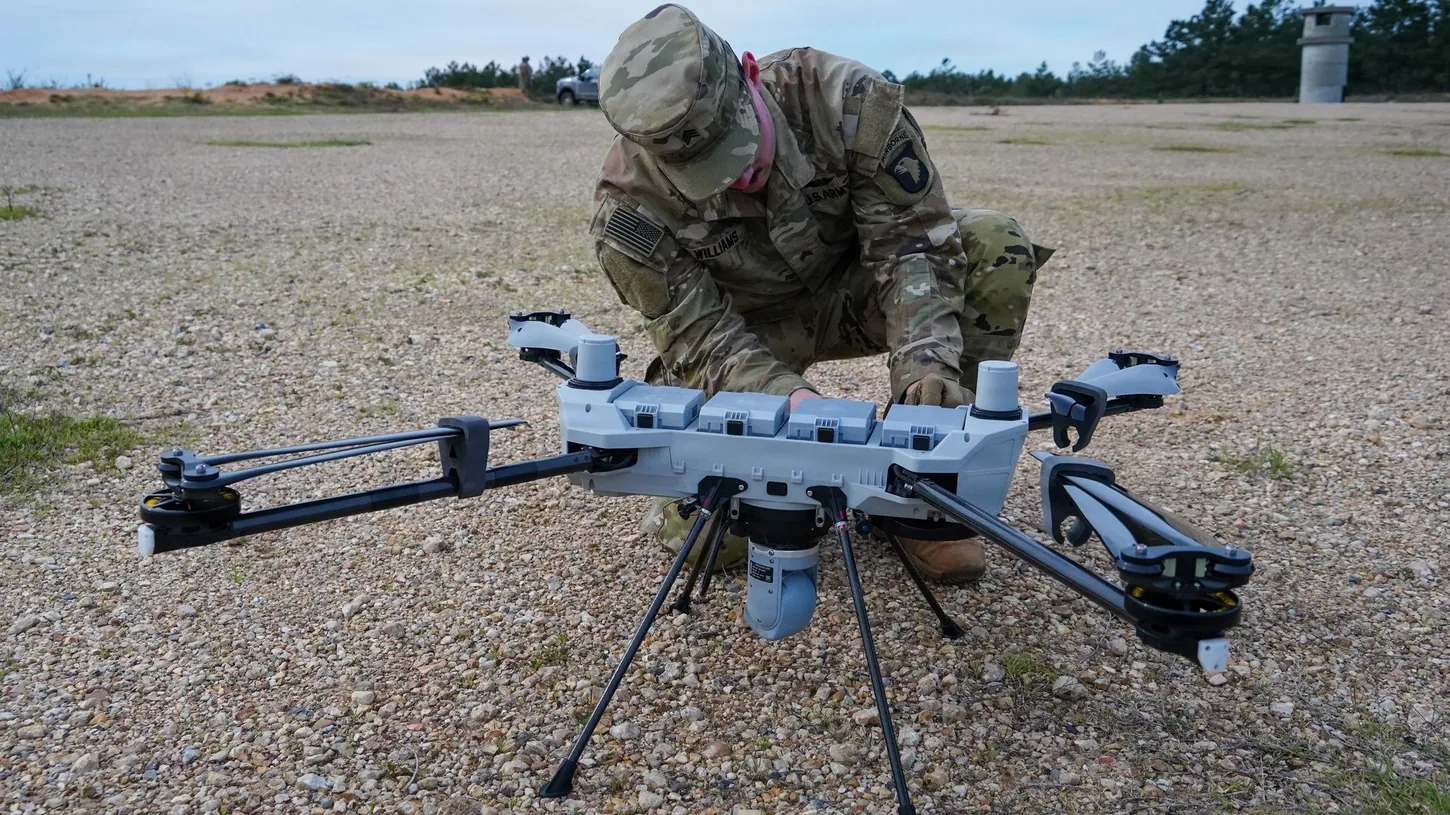
The Pentagon has committed to buying 60,000 attack drones, and the Wall Street Journal reports that the United States does not make enough explosives to arm them. All U.S. production of HMX and RDX, two powerful military explosives, comes from a single plant in Tennessee that was built during World War II.
A new joint venture called Odin Energetics wants to change that. Chemicals maker Solugen and warhead builder Kraken Kinetics announced it this month and committed $115 million. Odin says it can start supplying the military in small quantities next year.
The Army’s own fix is running late. Its $1 billion modernization of that Tennessee plant was due in 2025 and now targets 2029 or later.
Drone Dominance Needs a Warhead for Nearly Every Drone It Buys
Drone Dominance is the Pentagon’s $1.1 billion program to field low-cost drones by the end of 2027. A department official told the Wall Street Journal that virtually all of its 60,000 committed attack drones are designed to carry explosives. The payload order is nearly as large as the airframe order.
That 60,000 figure is the Phase 3 round the Pentagon opened on September 28 with $450 million and a 400-drone delivery gate. The competition is organized around drone makers, and payloads arrive through partners: Gauntlet II entrants were each paired with one or more lethality providers. Kraken Kinetics builds that kind of hardware, from warheads to fuzing and safe-and-arm devices. Neither the Journal nor the Gauntlet II results name it as a supplier to any entrant.
The shift traces back to Defense Secretary Hegseth’s July 2025 directive, which classified small drones as consumables. Expensive weapons fired rarely were the old model. Attack drones are meant to be used in large numbers, and every one of them uses up explosive.
Holston Makes 3% of What It Made in 1944
Holston Army Ammunition Plant in Kingsport, Tennessee, has been the only U.S. producer of HMX and RDX since widespread closures of government-owned plants in the 1990s. Tyler Hacker of the Center for Strategic and Budgetary Assessments estimates the 84-year-old plant now runs at about 3% of its 1944 peak.
Industry experts told the Journal the wait for Holston product runs one to two years, and the paper reports the plant has been beset by explosions and pollution violations. BAE Systems, which operates it, referred questions about the plant to the Army, which owns it. Army spokeswoman Ellen Lovett said the upgrade timeline shifted to ensure safety and technical standards were being met, and that the service is proceeding with safety and other improvements.
For now there are few other options. European explosives are going to Ukraine or staying home for rearmament, and many of the ingredients the U.S. once bought from Russia and China are now under export restrictions. The Army announced a $903 million research facility in Kentucky in March to raise HMX and RDX output before 2031, and the Pentagon set up a new office for energetics production.
It is the production gap Anduril’s Brian Schimpf spent nine years warning about, seen from the explosives end. Kraken Kinetics CEO Brian Davis, an Odin co-founder, put the timeline bluntly: “We have actually been in an energetics crisis for 20 years.”
Odin Says It Can Make About a Tenth of Holston’s Output
Odin says it can already produce close to a tenth of the roughly 11 million pounds of HMX and RDX that Holston makes each year, in modular factories that the Wall Street Journal reports can be built in about six months and set up at bases, test sites or battlefields.
Odin’s website calls its shipping-container factory Nitroforge. Solugen, whose largest investor is Peter Thiel’s Founders Fund, ships the starting chemicals by ordinary truck, and the explosive is only produced at Odin’s site. Executives pitch that as a safety answer to an industry where accidents have killed workers and shut plants for months, and as a way around local opposition to bomb factories.
At a test range just over an hour from Houston, Odin detonated a new formulation its makers say is 30% more powerful than what the military currently puts on drones. That figure is the company’s own.
The Army, which is looking at bringing energetics production onto its bases, is in discussions with Odin about supplying advanced explosives. The Pentagon’s Office of Strategic Capital, a lending office, has discussed possible funding with the company, executives said.
DroneXL’s Take
Drone Dominance put its public scoreboard on airframes. Gauntlet II did require lethality payloads and the Pentagon has an energetics office now, but my read is that the explosive inside the warhead got far less attention than the drone carrying it.
When we worked through the Phase 3 prices in September, the $450 million ran $150 million past what the listed drone prices add up to, and we wrote that payloads may explain part of the gap. If those warheads depend on HMX and RDX, a 60,000-drone order sits on one plant running at 3% of its wartime peak with a one-to-two-year queue, and no airframe competition shortens that queue.
I like where Odin is aiming. Factories that can be built in six months and dropped onto a base are the same bet Drone Dominance made on airframes, many cheap and fast producers instead of one old plant. But a venture announced this month that promises small quantities next year is still selling a plan. The number to watch is whether the Army or the Office of Strategic Capital turns those talks into a contract before Phase 3’s drones need their warheads.
Sources: The Wall Street Journal, Odin Energetics, Kraken Kinetics, Soldier Systems Daily
DroneXL uses automated tools to support research and source retrieval. All reporting and editorial perspectives are by Haye Kesteloo. Read our editorial standards.