
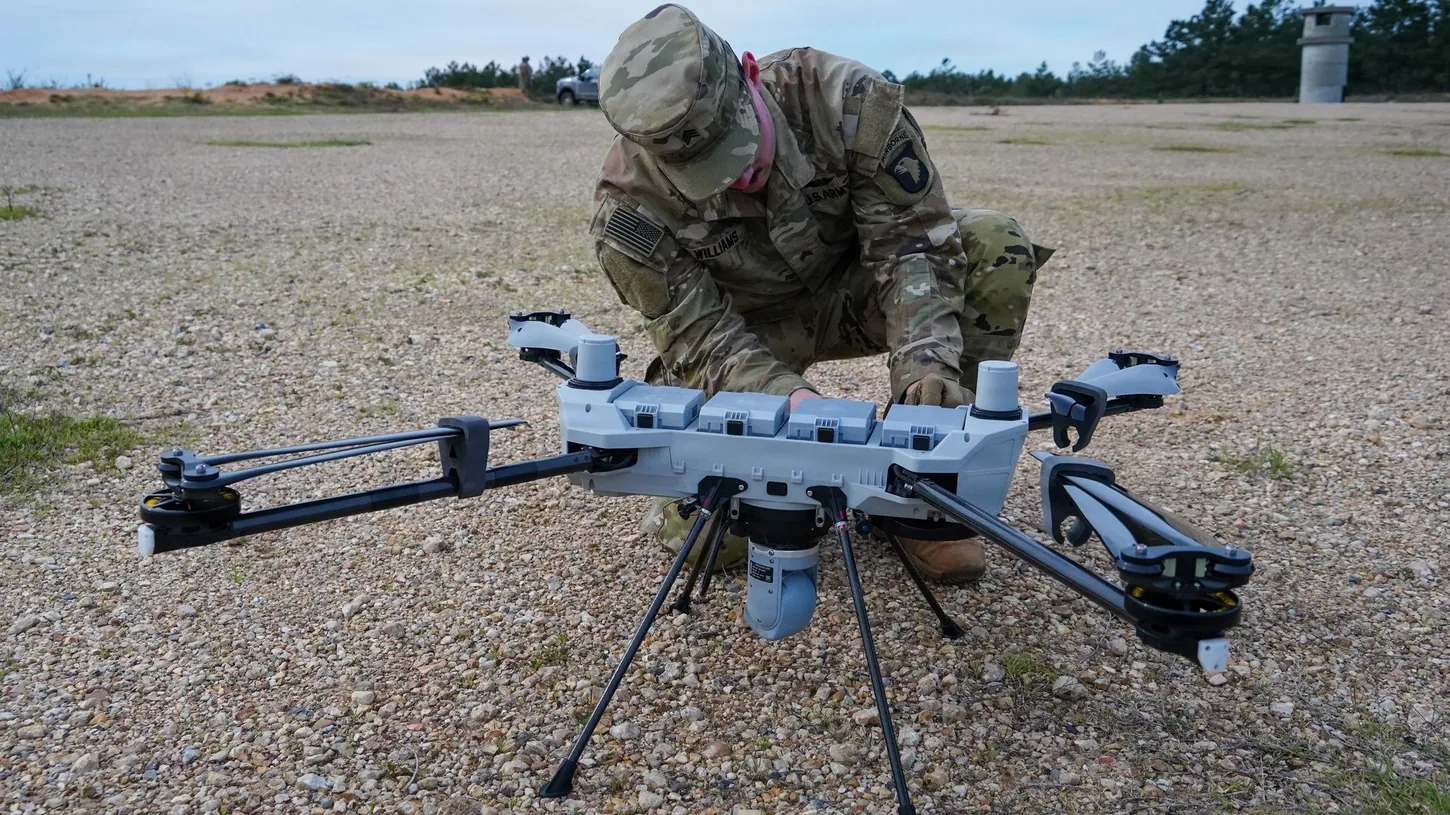
The Army’s small-drone manufacturing lead says the Pentagon is trying to “artificially induce” demand so that American companies will build a domestic drone supply chain. Jon Strzelec holds that job at Army Materiel Command, and the Army is the largest single buyer of small drones in the U.S. military.
The companies on the receiving end are split. Skydio says the signal is strong. Performance Drone Works CEO James Slider says he still needs to see sustained orders, and he put a number on it: one award, then 1,000 drones a month for a year.
That is 12,000 drones from one award. The largest base order in Gauntlet I of the Drone Dominance Program, the Pentagon’s flagship small-drone buy that DroneXL has tracked since its first results in March, was 2,560 drones, due within four and a half months.
Gauntlet Orders Are Sized In Months, Not The Year Slider Wants
Gauntlet I split 30,000 drones among 11 winners, from 1,520 for Farage Precision to 4,960 for Neros including bonus orders, the program’s leaderboard shows. No winner reached half of Slider’s 12,000. Six of the 11 got bonus orders on top of their base orders.
“We need to see sustained, normalized demand,” Slider told Breaking Defense. The program’s delivery terms run the other way. Gauntlet I winners had to ship half their base orders within two and a half months and the rest within four and a half. At that pace even the 2,560-drone order averaged under 600 drones a month, for less than half a year.
Gauntlet II in August was bigger: 30,000 drones in each of two missions, with orders of 8,000 down to 4,000 for the top five. Neros placed on both boards and announced a combined 14,000-drone order covering both missions, the only Gauntlet award that clears Slider’s 12,000, and only by adding two placements together. At the roughly 1,200 Archers a week Neros said it was building when it closed its Series C in August, that order is under three months of output. The leaderboard also says quantities are set at contract award and that awards are not guaranteed.
PDW is not on either leaderboard. It competed in Gauntlet I and is listed among the companies that did not rank, and it took part in the Phase 2 Qualifier at Camp Grayling, Michigan, but was not among the 19 companies advanced to Gauntlet II, according to the program’s participant page. PDW holds Army contracts for reconnaissance drones like the C100, and on July 31 it signed a conditional loan commitment of up to $820 million with the Office of Strategic Capital to build drone component capacity. That loan would fund capacity. Slider’s question is who orders the drones.
The Army Says It Is Inducing Demand Because Many Makers Won’t Invest Without It
Army officials describe the Gauntlets as a deliberate push, not a steady market. Strzelec said many companies tell the Army there isn’t enough demand to justify building a U.S. supply chain, so the department is trying to force one to stand up by creating that demand itself.
Andrew Evans, who directs the Strategy and Transformation Office in the Army’s G-2 intelligence directorate, said the department’s challenge is keeping production lines open even when demand falls between buys. “How do you incentivize industry to build if your ordering period is so episodic?” Evans said.
The program was built that way, as repeated smaller deals adding up to $1 billion over two years. Skycutter won Gauntlet I with 99.3 points and fell to fourth on Gauntlet II’s Deep Strike board. Neros’s Gauntlet I bonus orders included 800 drones it picked up from rivals that missed their deadline. The same structure that rewards delivery leaves a company with no guaranteed follow-on order between rounds.
Skydio Hears A Strong Signal, While AeroVironment Wants Steady Awards
Skydio sells across the federal government and reads the market differently. Chief Revenue Officer Callan Carpenter said on October 13 that demand is strong at the Department of War, Homeland Security and civilian agencies, and that Skydio sells into all of them.
“The demand signals are very strong, and it’s not just DOW either,” Carpenter said.
Skydio does not appear on the Drone Dominance Program’s participant or leaderboard pages, and its biggest Army order came outside the program. The Army placed a $52 million order for more than 2,500 X10D drones in March, which Skydio called the largest single-vendor small drone buy in Army history.
Chad Chasteen, who leads Army business development at AeroVironment, said during a panel at the AUSA conference the same day that the Army’s habit of switching solutions every year or two throws the supply chain into disorder. He wants continuous orders to follow continuous competitions, not rounds of white papers. “There is no supply without demand,” Chasteen said.
John Burer, CEO of the American Center for Manufacturing & Innovation, said he would not invest ahead of a large budget or a consistent signal if he made drones. Slider said he does not expect much more private equity to flow into the sector without stronger commitments.
The $54.6 Billion That Would Answer Slider Is Stuck In Reconciliation
The money Slider says would change his read, $54.6 billion for the Defense Autonomous Warfare Group, Replicator’s successor, in the Pentagon’s FY27 budget request, has not been appropriated, and most of it rides on a reconciliation package Congress has not passed.
Slider said seeing DAWG money flow down to companies would be very encouraging, even if it lands in the base budget at those levels. For now, he said, the answer on whether that money arrives changes with whoever he talks to.
Congress holds the other open piece too. The four-star Autonomous Warfare Command Defense Secretary Pete Hegseth ordered on September 30 needs legislation before it can stand up, and his memo set no budget line for it.
DroneXL’s Take
Strzelec is right to call the signal artificial, and I give the Army credit for saying so plainly. Moving undelivered drones to companies that did ship is merit-based competition, and it beats picking a winner once and living with it for a decade.
PDW didn’t rank in Gauntlet I or reach Gauntlet II, so Slider has a stake in how the Pentagon buys. His number still holds up. A thousand drones a month is roughly a fifth of what Neros says its line already builds, so Slider isn’t asking for Neros-scale volume, only for it to last. In two rounds and 90,000 drones, one company has cleared his 12,000, by combining two placements, and that order still covers less than three months of its own production. My read is that the Gauntlets can keep choosing the best drone every six months, but they can’t give anyone a year of production on their own. Appropriated DAWG money can. Until Congress passes it, I’d give Slider’s skepticism more weight than Skydio’s optimism, because Skydio’s biggest Army order didn’t come out of a Gauntlet.
Sources: Breaking Defense, Drone Dominance Program leaderboard and participant list.
DroneXL uses automated tools to support research and source retrieval. All reporting and editorial perspectives are by Haye Kesteloo. Read our editorial standards.


