
St. Louis police can start flying drones to 911 calls this week. On Wednesday the St. Louis Board of Police Commissioners voted 4-1 to approve the special orders that govern the department’s new Aerial Response Unit, and Mayor Cara Spencer cast the only no vote. Police said the first test flights and responses to select 911 calls could begin as early as Wednesday afternoon.
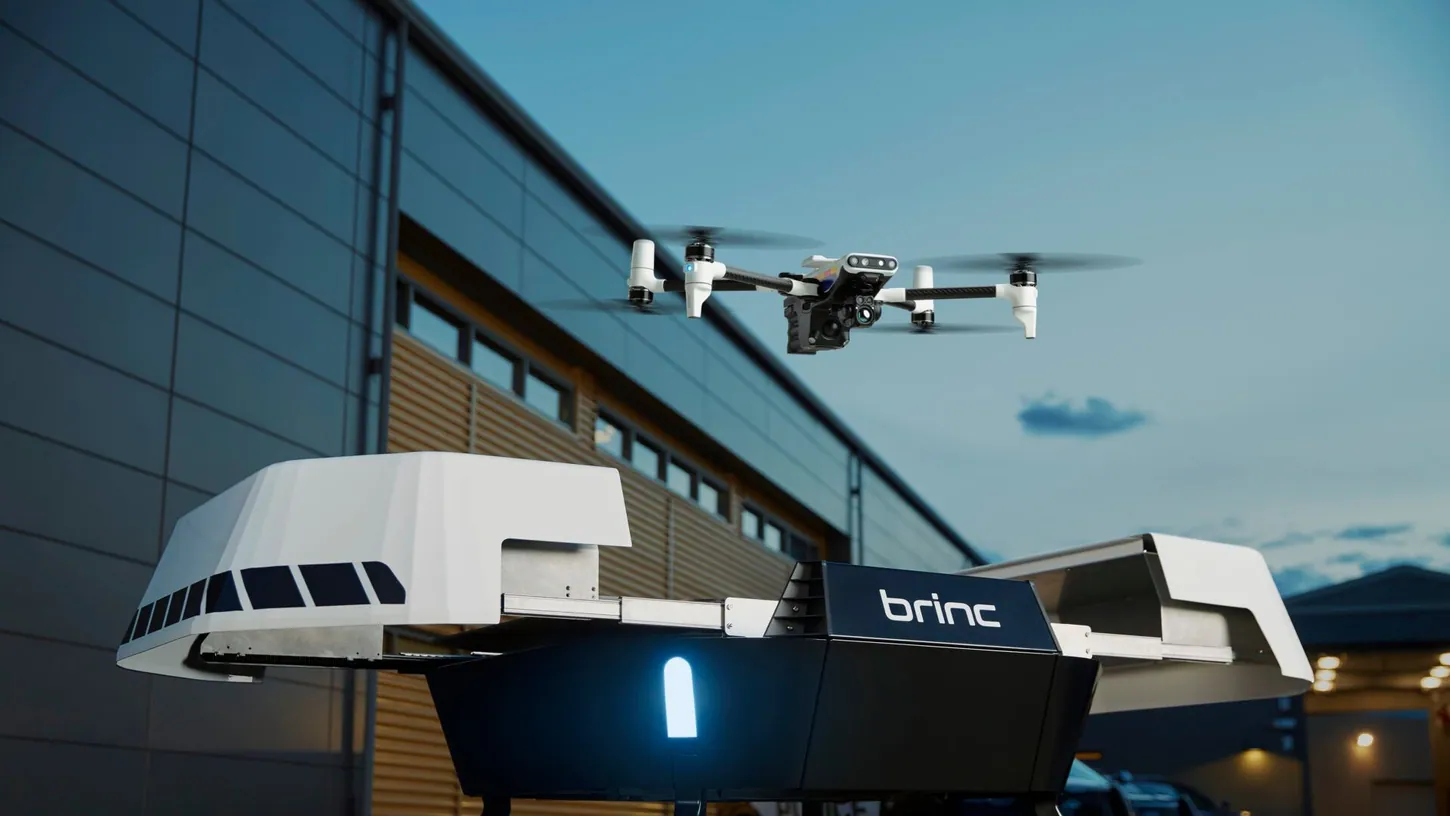
The drones are BRINC aircraft, launched from docking stations and flown remotely by pilots at the department’s Real-Time Crime Center. That is the program DroneXL covered when the same board approved buying six BRINC drones in May, on the condition that policies and a public engagement plan be approved before any drone flew.
The department’s drone FAQ tells residents the camera faces the horizon on the way to a call and tilts down only at the scene. The special order SLMPD posted Wednesday afternoon, after the vote, has no rule about camera angle.
SLMPD’s Horizon Camera Pledge Sits in an FAQ, Not the Special Order
Special Order 5-35, issued and effective Wednesday, says transit cameras “will be used primarily for safety of flight and navigation” and sets no camera angle. The department’s FAQ says the camera is “oriented forward, toward the horizon” until it arrives, then “only tilts down once it arrives on scene.”
The FAQ, on slmpd.org/drones, also says the drone is not recording “unless it has been dispatched to a particular incident,” and that recording stops when the call is resolved. At the May 27 board meeting, Maj. Joseph Morici went further: “They’re not recording, they’re not live streaming as they are traveling,” according to KSDK’s account of that meeting. KSDK reported Wednesday that the proposal keeps cameras pointed up until a scene.
The approved order does not bar recording en route. It tells pilots to avoid “unnecessary observation of persons, homes, yards, or activities unrelated to the incident,” and its privacy section says the aircraft “will always be directed toward the authorized incident, involved persons, hazards, routes, or other mission objectives.” St. Louis Public Radio published the October 29 draft on Monday, and the final order keeps its transit and privacy language.
The department posted the final order on its drone page Wednesday afternoon. When DroneXL checked at about 1 p.m. ET, the page still linked only the draft.
Mayor Spencer Was Outvoted by the Governor’s Appointees
Spencer told the board the plan was not “vote ready,” KSDK reported Wednesday. She said she had seen the final plan for 48 hours, that it had faced no public feedback, and that it should be checked against the St. Louis Fire Department’s approach to drones before a vote.
The other four votes came from the board’s governor-appointed members. Since Missouri’s 2025 state takeover of the department under House Bill 495, the board’s voting seats are the mayor and four commissioners appointed by Gov. Mike Kehoe. A fifth Kehoe appointee sits on the board without a vote.
Spencer said in a statement that she received the policies Monday, at the same time as the media. The department said it fielded drone questions at community meetings since May, and KSDK reported those questions were not specific to this proposal. Officials told St. Louis Public Radio they spent six months reviewing other cities’ policies and getting input from neighborhood groups. In May the board received the purchase contract one day before it voted, and that contract listed no dollar amounts.
The St. Louis Police Foundation is covering the nearly $583,000 first-year cost, which includes the drones and a Sparrowhawk radar system, with no cost to taxpayers in year one, the department said. Officials told St. Louis Public Radio they hope the foundation keeps paying after that.
The Order Bars Face Recognition Without a New Policy, Names No Retention Days
The approved order bans weapons, bans “generalized surveillance” and patrolling neighborhoods solely to look for crime, and bars facial recognition unless the department adopts a separate policy. It also bars intentionally viewing or recording private areas without a warrant or other lawful exception.
On retention, the order defers to existing department policy: recordings “will follow the Department video recording record retention policy.” It names no number of days. The FAQ says video is stored in BRINC’s LiveOps platform on encrypted U.S. servers, and that a retention policy “will be finalized before the DFR program launches.” The drone page did not show one when DroneXL checked Wednesday afternoon, after the launch was approved.
Jay Stanley, a privacy expert at the American Civil Liberties Union, told St. Louis Public Radio he was pleased the policy rules out routine surveillance, but that data retention and how recordings can be used are still open questions. He said police should not run collected video through face recognition or AI searches.
The order bans using drones to interfere with “lawful First Amendment activity,” but lets pilots observe a rally or demonstration when the use is “tied to a legitimate public-safety purpose.” It also says the department “may” publish flights on an online platform after 72 hours.
Four drones are docked and ready, two at Central Patrol in JeffVanderLou and two at North Patrol near Mark Twain, according to St. Louis Public Radio. The St. Louis Metropolitan Police Department said South Patrol should come online later this month. Every pilot must hold an FAA Part 107 certificate. The order allows dock and BVLOS flights only under the department’s FAA Certificate of Authorization, and the radar lets officials see other drones in the sky to avoid conflicts.
DroneXL’s Take
I’m for drones that reach a shooting or a missing child before the first patrol car does, and this order has real teeth on weapons and face recognition. My problem is that the two privacy promises residents were given, a horizon-facing camera in transit and a retention policy before launch, sit on an FAQ page. The special order officers have to follow sets no camera angle and no retention period. I think “primarily for safety of flight” is a standard almost no one could enforce against a pilot who records a backyard on the way to a call.
St. Louis knows how to write a hard drone rule. In 2024 the city passed a law on commercial surveillance drones that bars those companies from flying within 25 feet of a person without permission. If the horizon camera is how SLMPD flies, Special Order 5-35 should say so in words that plain, with a retention period in days.
Sources: KSDK, St. Louis Public Radio, St. Louis Metropolitan Police Department (Aerial Response Unit FAQ, Special Order 5-35 of November 4, 2026, and the October 29, 2026 draft), Office of the Governor of Missouri
DroneXL uses automated tools to support research and source retrieval. All reporting and editorial perspectives are by Haye Kesteloo. Read our editorial standards.


