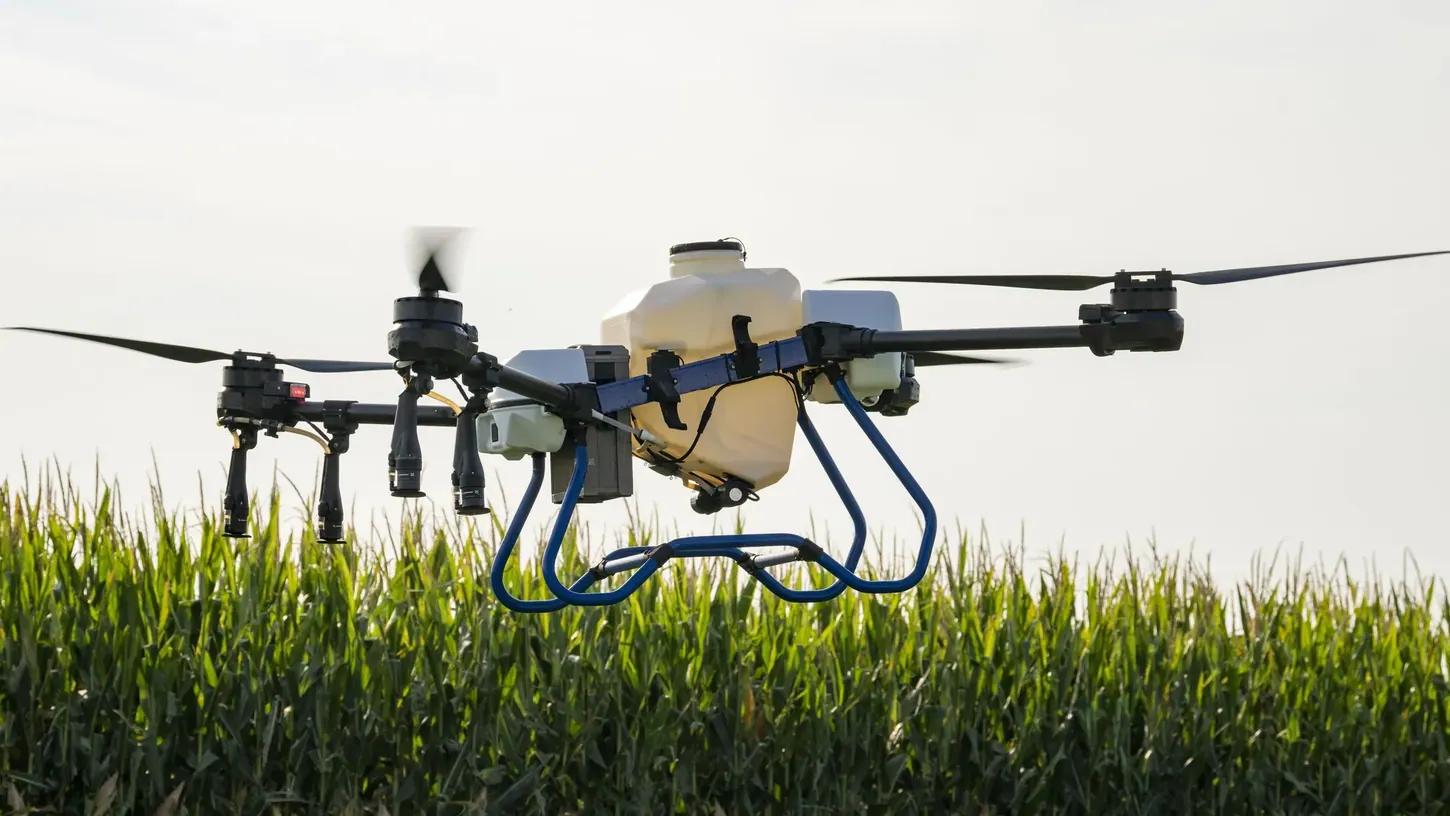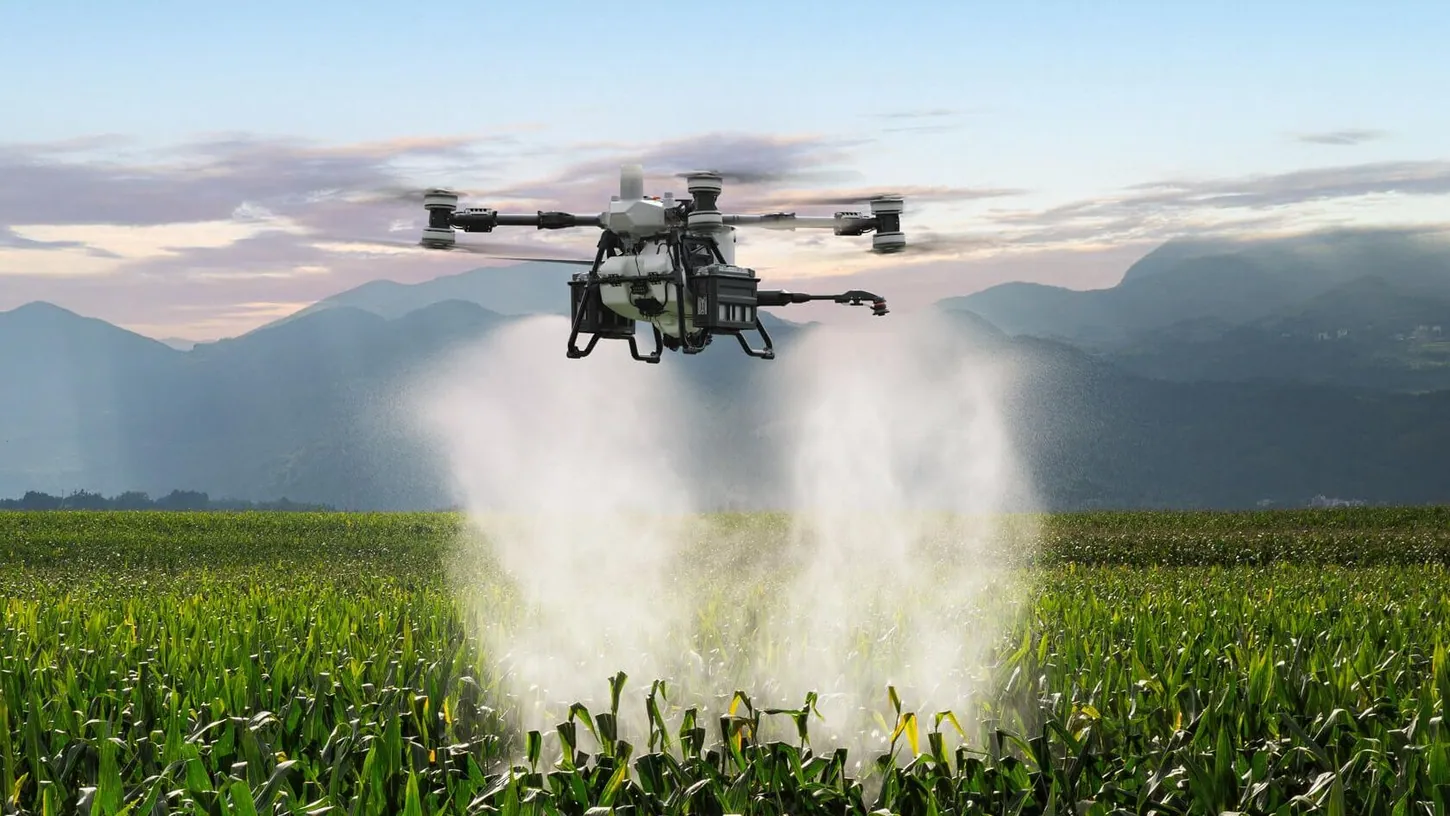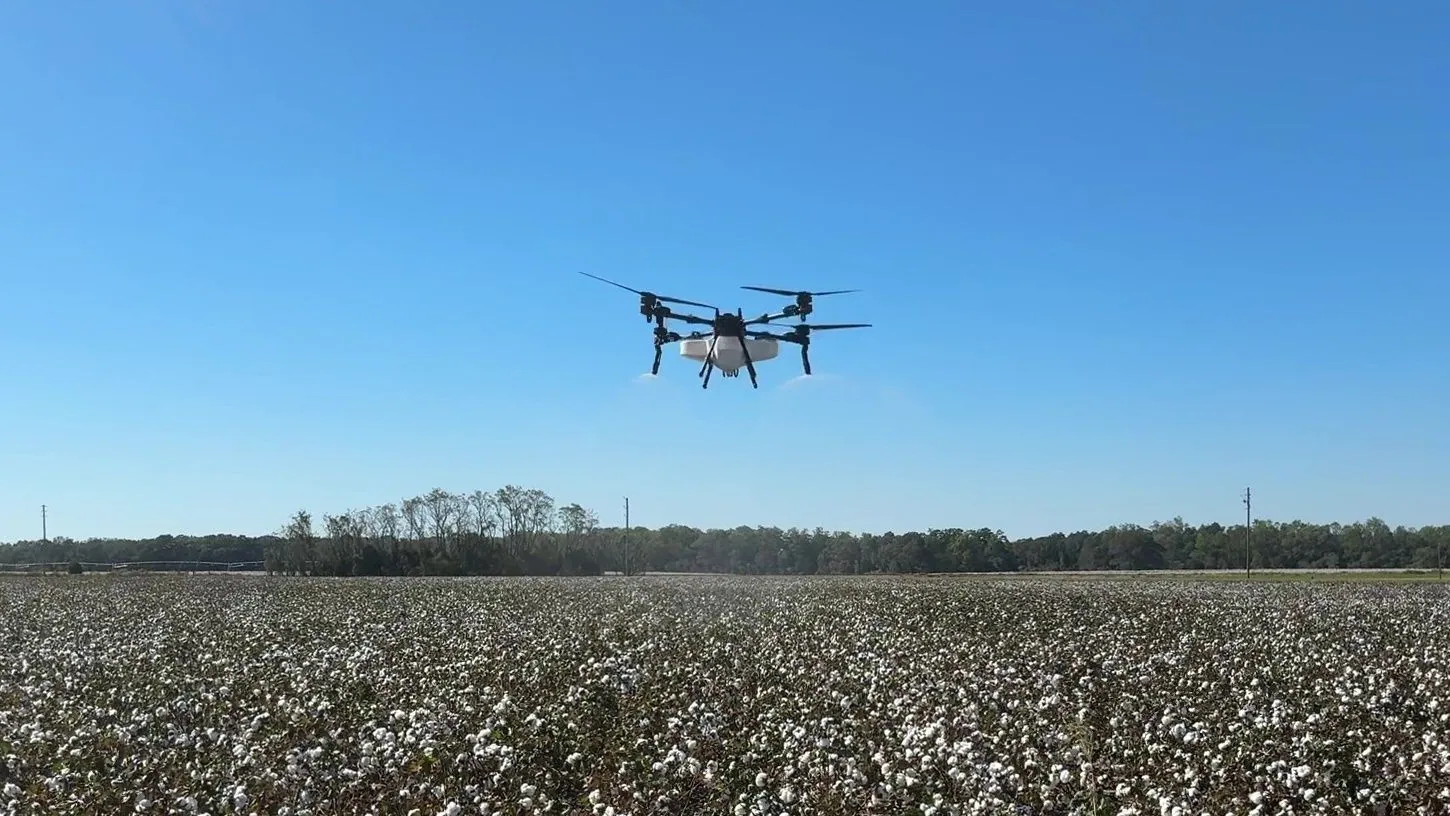
Spray drones defoliated cotton about as well as a ground sprayer in Auburn University field trials in Alabama, even though the drones left lower and less even spray coverage on the plants. Simer Virk, a precision ag specialist at Auburn, reported the results on November 16 in a column for Farm Press.
The spray drones flew a three-way defoliant mix at 3 and 5 gallons per acre (28 and 47 liters per hectare). The ground rig applied the same mix at 10 gallons per acre (94 liters per hectare). Defoliation, lint yield and fiber quality came out similar in every year of the study.
Alabama Extension’s cotton defoliation guide, posted in 2020, tells growers to apply harvest aids at no less than 15 gallons per acre by ground and 5 by air. Auburn’s drone gave similar results at 3.
Drone Coverage Trailed The Ground Rig At Every Canopy Level
Auburn measured spray coverage at the upper, middle and lower positions in the cotton canopy, and the drone trailed the ground sprayer at all three. Virk puts that down to the ground rig’s higher spray volume and a boom that rides closer to the plants.
The team read coverage off water-sensitive paper placed inside the canopy, according to an abstract Auburn’s Shubhdeep Singh filed for the CANVAS 2026 conference. The drone was also less even across its swath. A ground boom carries nozzles at equal spacing, and a drone lays down what Virk describes as a large bell-shaped curve that stays variable even where neighboring passes overlap. Propeller downwash does push spray into the canopy, but he writes that the effect fades as the drone flies higher or faster.
More volume helped. At 5 gallons per acre the drone covered more of the plant than at 3, most of all in the upper canopy.
In Auburn’s Trials, Three Gallons By Drone Did The Work Of Ten By Boom
The drone held up even at 3 gallons per acre. That is 2 gallons under the aerial minimum in Alabama Extension’s defoliation guide. Virk reports in Farm Press that defoliation, desiccation, regrowth and open bolls were similar across both drone volumes and the ground pass in all years.
The 2020 guide doesn’t mention drones. The trial’s ground rig also ran under the guide’s ground figure, and Virk’s column points applicators to the pesticide label for spray volume. The abstract says the studies ran in Alabama in 2024 and 2025 on large plots randomized across the field, with visual ratings 10 to 14 days after application. In one of the four site years the drone plots showed higher desiccation, which Virk says may come down to environmental conditions or other factors.
Virk’s column gives the direction of each result and no result figures. It has no coverage percentages or yields, and it doesn’t name the drone. The abstract says data from both years were still being analyzed when it was filed. It also lists a 5-gallon ground treatment that the column doesn’t report on, and it says efficacy was tested on “the selected treatments,” so that one may have been measured for coverage only.
Virk Says One Or Two More Gallons Can Improve Drone Coverage
Virk writes that raising drone spray volume by 1 to 2 gallons per acre, which he calls a 50% or 100% increase for drone applications, can improve coverage, deposition in the canopy and efficacy. Slower flight and larger droplets may help in some cases too, he adds.
He writes that drones are “another valid tool for applying cotton defoliants” and that much more remains to be learned, because product choice, rates, weather and how the aircraft is flown all change the result. Until that research is in, he tells applicators to calibrate the drone and verify the volume it really puts out, to work out an effective swath that keeps coverage even, to follow the label on spray volume and droplet size, and to fly only in weather that won’t carry the spray off target.
DroneXL’s Take
A land-grant university ran a spray drone against the machine it competes with, and the cotton came out about the same on 3 gallons of water instead of 10. I’d still wait for Auburn’s numbers before calling it settled, because “similar” is a wide word and uneven coverage could cost more in a bad year than it did in these trials. In June I wrote that The New York Times covered farm robots and gave spray drones a single clause, and results like Auburn’s show how much that left out. Auburn doesn’t name the drone it flew. But the Texas Farm Bureau’s Laramie Adams said in January that many of the drone systems on American farms are foreign-made, and the FCC’s December 2025 Covered List decision blocks approval of new foreign-made models. Field results like these give the Farm Bureau’s warning about that decision more weight.
Sources: Farm Press, Auburn University (CANVAS 2026 abstract), Alabama Cooperative Extension System
DroneXL uses automated tools to support research and source retrieval. All reporting and editorial perspectives are by Haye Kesteloo. Read our editorial standards.