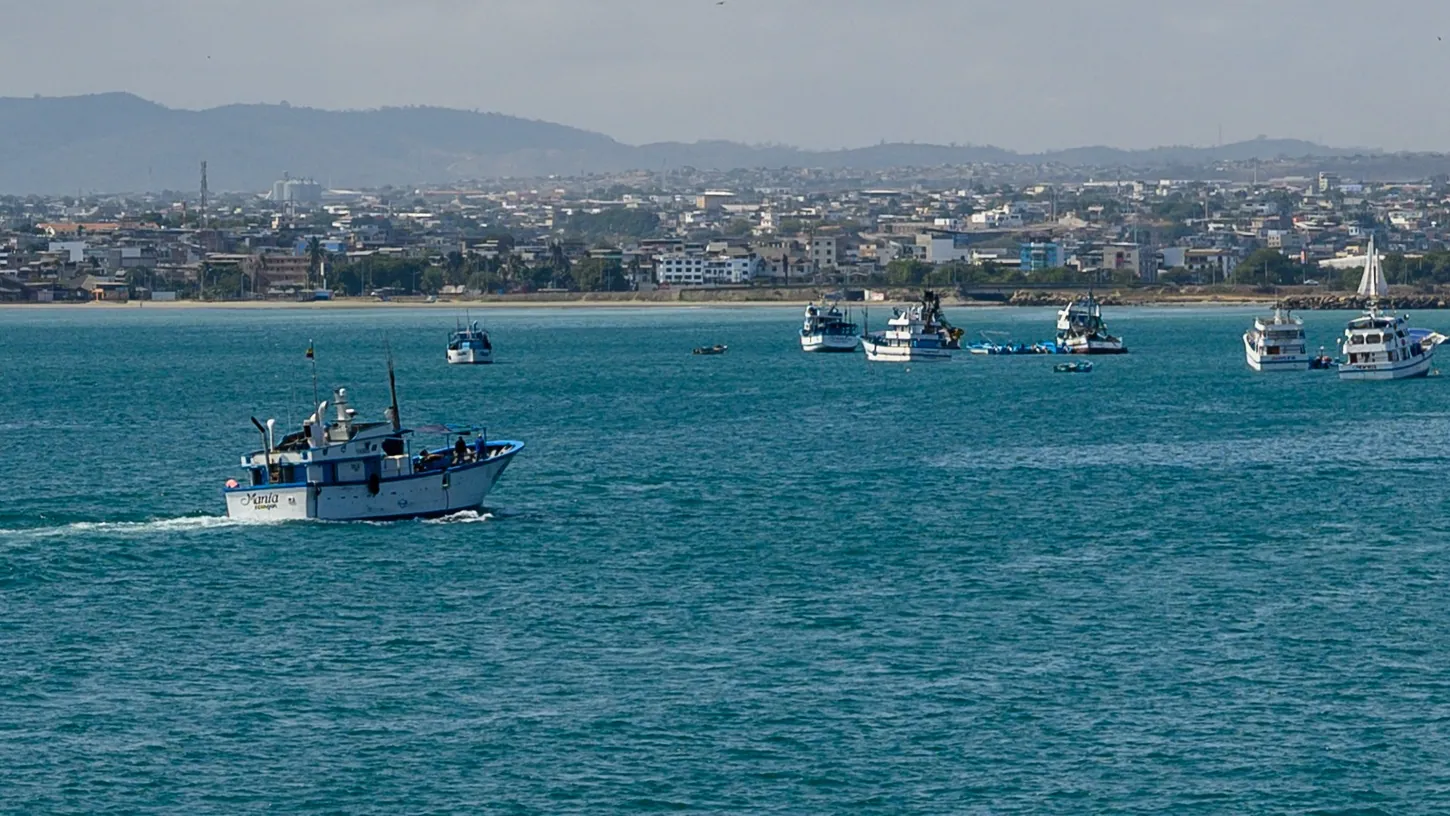
The crew of La Negra Francisca Duarte II, an Ecuadorian fishing boat that sank near the Galápagos Islands in March, sued the United States government in federal court in western Pennsylvania on Monday. They say American forces sent the armed drones that set the boat on fire on March 17 and sank it, badly burning two crewmen.
No government has claimed the attack, and the Defense Department and the Coast Guard have denied responsibility for it. An independent review of flight-tracking data later placed a drone registered to San Diego defense contractor Shield AI near the burning boat hours after the strike.
The Lawsuit Says Two Armed Drones Launched From a US-Operated Ship
According to the complaint, as UPI summarized it, the boat was heading home to Manta after two weeks of fishing when two armed drones, allegedly launched from a US-operated ship, hit it. The crew says the Ecuadorian Navy had searched the boat earlier and found no drugs.
The docket lists the case as Flores Franco v. United States, No. 2:26-cv-02459, filed November 16 in the Western District of Pennsylvania under federal admiralty jurisdiction. It lists 18 plaintiffs, the boat’s owner among them, and Judge Marilyn J. Horan was assigned to it the next day.
The survivors reached a nearby ship in small emergency boats. They say armed men in military uniforms and vests bearing US Coast Guard insignia restrained and hooded them, then handed them to a Salvadoran vessel. They were held in El Salvador until late March. The complaint alleges assault, battery, unlawful detention, emotional distress and destruction of property, and asks the court to stop US strikes on boats in the Caribbean and the Pacific.
The Washington Post reports the suit seeks $5 million in damages. UPI says the complaint leaves the amount to be set during the case. U.S. Southern Command declined to comment to the Post, citing the pending litigation, and the Justice Department also declined.
The fishermen are represented by American attorney Daniel Kovalik and Ecuadorian lawyer Jorge Chiriboga. “The fishermen clearly identified them,” Chiriboga told UPI, pointing to the US flag patches and the English the men spoke.
Three Ecuadorian Boats Were Struck or Vanished Between January and March
The Fiorella disappeared on January 20 with eight crew members. The Don Maca was hit on March 26, nine days after La Negra Francisca Duarte II. Human Rights Watch interviewed 13 survivors and concluded US authorities most likely had some involvement in, or knowledge of, the attacks.
The Washington Post reported in August, citing a person familiar with the matter, that the attacks were part of a presidentially approved CIA covert action program. Survivors described quadcopters dropping explosives with a larger drone circling above. The Post found no evidence that any of the three boats was carrying drugs, and it tied the incidents to a surveillance business jet flying as FENIX 701 out of Ilopango airport in El Salvador. Last week the Post reported that the jet was first owned by a company based in The Villages, the Florida retirement community.
That puts these strikes in a different category from the strikes on alleged drug boats the Trump administration has announced in public, starting with the Caribbean speedboat strike Trump posted about in September 2025. Nobody in Washington has put their name to the Galápagos attacks.
Flight Data Put a Shield AI V-BAT Near the Boat Hours After the Strike
Drop Site News reported on August 19 that its review of flight-tracking data put a V-BAT registered to Shield AI within 500 meters (1,640 feet) of La Negra Francisca Duarte II. The drone launched from a nearby boat about seven hours after the 1:02 p.m. attack.
The V-BAT is a vertical-takeoff surveillance drone that can also carry a weapons payload, and Drop Site says it matches the red and green lights the fishermen saw as they photographed the explosion. The survivors’ accounts in the Post describe quadcopters dropping the explosives, and the V-BAT is not a quadcopter. Drop Site’s report does not identify who was operating the drone, and its data shows the V-BAT arriving after the strike, not during it. Shield AI did not respond to Drop Site’s questions.
The Coast Guard is a V-BAT customer. Shield AI won a $198 million contract in 2024 to fly it from Coast Guard cutters, and the drone passed its operational tests aboard two National Security Cutters in July 2025. No published record links the V-BAT tracked on March 17 to that contract. In June the Coast Guard told The Guardian it sent its cutter Bertholf on a search-and-rescue mission after a Mayday call, which Drop Site says contradicted Southern Command’s earlier statement that it had no knowledge of US involvement. As of Drop Site’s August report, the Coast Guard had not said whether it flew drones during that mission.
DroneXL’s Take
I want this case to reach discovery, and the American drone industry should want that too. The US government has been happy to put its drone kill chains on display, from the Navy’s FLEX 2026 exercise against narco boats off Key West to the strike videos the president posts. The Galápagos attacks are the opposite: three boats, eight missing men, burned survivors, and every agency that has answered either denying responsibility or declining to comment. The first aircraft known to reach the wreck was an American-made V-BAT, and I’m not saying it dropped anything, because the record doesn’t show that. But every unanswered strike gets pinned on the hardware, and that’s a cost American drone makers carry when the government won’t say what its drones were doing. If this was a lawful counter-narcotics operation, a federal courtroom in Pennsylvania is a fine place to prove it.
Sources: Flores Franco v. United States docket (W.D. Pa.), The Washington Post, UPI, Human Rights Watch, Drop Site News.
DroneXL uses automated tools to support research and source retrieval. All reporting and editorial perspectives are by Haye Kesteloo. Read our editorial standards.