

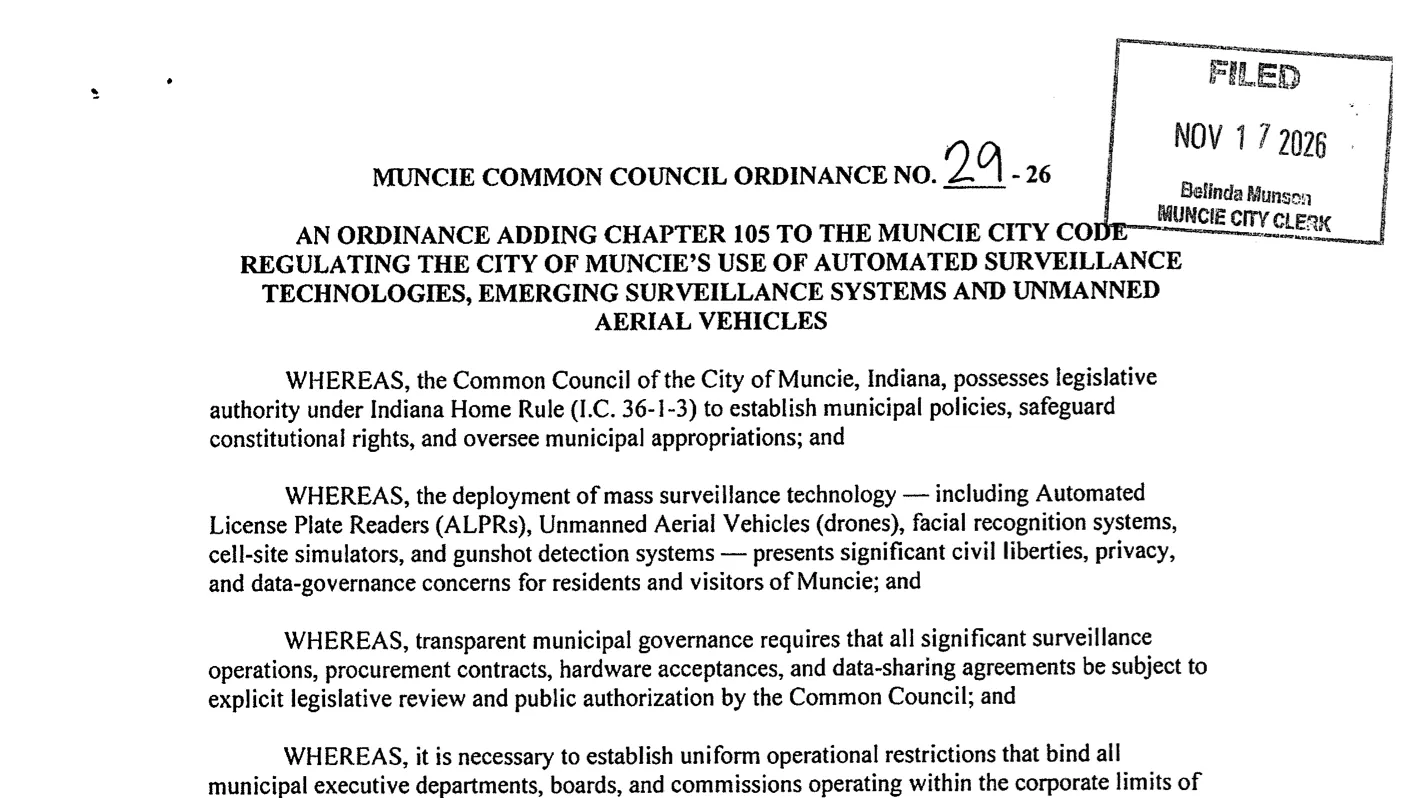
Three members of the Muncie, Indiana, City Council filed an ordinance on November 17 that would bar every city agency, the Muncie Police Department included, from buying, leasing or accepting a drone without a council vote first. Ordinance 29-26 puts drones in the same chapter of city code as automated license plate readers, facial recognition, cell-site simulators and gunshot detection.
The bill follows months of local reporting on police license plate cameras from Flock Safety, and it orders any plate readers installed on city property without council approval to be switched off and removed. It gives no such order for drones. The department already flies them, and it holds a Federal Aviation Administration waiver to fly them beyond the pilot’s line of sight until March 31, 2030.
Ordinance 29-26 Requires A Council Vote For Any Drone, Even A Free One
Ordinance 29-26 would add Chapter 105, titled “Automated Surveillance Technologies and Drones,” to the Muncie City Code. Section 3 requires a majority vote of the Common Council before any city entity buys, leases or accepts a drone system, whatever the cost and whoever pays.
The text closes the routes that usually bypass a council. The approval rule covers “zero-cost donations or vendor sponsored pilot programs,” which is how Flock, the plate reader company that now sells police drones too, put them in the air elsewhere in Indiana: South Bend police started a no-cost drone as first responder pilot with the company this year. It also covers grants, the path Detroit took when its police applied for a $2.2 million federal drone grant before the council had seen it, and agreements with other governments.
Any contract signed without the vote would be void, and money spent on it would be reported to the Indiana State Board of Accounts. Council members Nora Powell, Harold Mason and William McIntosh signed the filed copy as sponsors.
Muncie’s Council Tabled A Police Drone Base In March
The council has argued about police drones once already this year. On March 2 it tabled Resolution 4-26, a five-year agreement with Delaware County to put a police drone base on the roof of the county building at 100 W. Main Street, with the city paying every cost.
The resolution was filed on February 17, and the agreement attached to it made the city responsible for installation, power, insurance and any damage to the roof. Chief Nathan Sloan told the council the base would cost under $5,000 and that the department had been using drones for eight to ten years, according to Muncie Voice’s account of the meeting, which put the tabling vote at 6-3. Police leaders said they wanted one charged drone ready at a fixed spot for missing-person searches, crash documentation and tactical calls. Council members asked for a written drone policy and a cost estimate before voting, according to Citizen Portal’s summary of the meeting video, and sent the policy questions to the public services committee.
The department’s FAA waiver was not part of that vote. Certificate of Waiver 91.113-2026-00258, issued to the Muncie Police Department, took effect on March 3, the day after the vote. It lets the department fly BVLOS without a visual observer at or below 200 feet (61 meters), or within 100 feet (30 meters) of an obstruction in uncontrolled airspace. The FAA sets the effective date, and the terms match the shielded waiver that more than 1,000 public safety agencies received in ten months. Nothing in the certificate depends on a rooftop base. The certificate also says of itself: “It does not constitute a waiver of any State law or local ordinance.”
The Removal Clause Leaves Police Drones Flying
Section 5 orders plate readers installed on city poles without council approval switched off when the ordinance takes effect, unless that breaches a contract, and removed when the contract ends. For drones it blocks only the renewal of leases, service agreements and software licenses without a council vote.
So a drone the department owns outright keeps flying, and nothing in the text touches the FAA waiver. The deletion rule would apply to it, though. Section 4 requires that non-investigative imagery from any city drone be deleted within 30 days unless a court order or a warrant-backed investigation requires keeping it. The section’s ban on automated feeds to private data networks and its quarterly reports to the council are written for an “authorized” system, and the text does not say whether a drone bought before the ordinance counts as one.
The ordinance names Flock Safety in its definition of a plate reader, and Muncie Voice, a local outlet that has campaigned for the bill and said in September it had sent a proposed ordinance to council members, says the bill follows its reporting on the department’s Flock cameras. The outlet reported in September, citing a contract and invoices it says it obtained through a public records request, that the police chief signed a 60-month Flock agreement for 24 cameras in December 2023, worth $300,000 in total, and that the council did not vote on it. DroneXL has not seen those records, and the outlet’s report does not say a council vote was legally required. Muncie Voice reports that the ordinance will be introduced on December 7 with adoption expected in January. The city had not posted an agenda for that meeting on its website as of November 21.
DroneXL’s Take
I’d vote for the approval rule. If Muncie Voice has it right, the council learned about a five-year camera contract from the local press. A council in that position is going to write an ordinance like this one, and Muncie’s version doesn’t ground a single aircraft. It asks that the next drone come with a public vote, which is what Detroit’s council wanted in July and didn’t get.
I object to the label, though. The ordinance’s opening lines list drones as mass surveillance technology next to cell-site simulators, and I don’t think a quadcopter looking for a missing person belongs on that list. The honest test for a police drone is the flight log: where it went, why, and what happened to the video. The 30-day deletion rule and the quarterly reports would get Muncie most of the way there. A department that says it has flown drones for eight to ten years should be able to publish those numbers without being ordered to.
Sources: City of Muncie (Ordinance 29-26, Resolution 4-26), Federal Aviation Administration, Muncie Voice, Citizen Portal
DroneXL uses automated tools to support research and source retrieval. All reporting and editorial perspectives are by Haye Kesteloo. Read our editorial standards.
Advertise with DroneXLYour company hereReach 200,000+ drone readers a month with a sponsored article, a banner on your beat, or a partnership.See the options →


