
Amazon now says it hopes to launch Prime Air drone delivery in Tallahassee and Jacksonville “in the coming months.” The company emailed that statement to USA TODAY Network-Florida for a story published on Monday, November 23. It is the third wording of the Tallahassee timeline in five weeks, and the loosest. On October 20 an Amazon manager said deliveries there were slated for mid-November, and on November 18 the Tallahassee Democrat reported a company statement that it hoped to start by the end of the year.
Amazon’s statement does not say whether the year-end target still stands, and neither the USA TODAY Network story nor the Democrat’s report gives a reason for the missed mid-November date. Tampa, served from a warehouse in Ruskin, is the only Florida location Amazon lists as available, and DroneXL’s Ruskin guide dates its first deliveries to March 9, 2026. Jacksonville’s planning commission approved a launch pad on November 19.
Tallahassee’s Target Went From Mid-November to Year’s End, Then Lost Its Date
Josh Brundage, Prime Air’s senior manager of commercial operations, gave the mid-November date at an Amazon meet-and-greet at the Tucker Civic Center on October 20. The newest phrase, “the coming months,” does not rule out December. The USA TODAY Network story’s own summary line puts added Florida locations in 2027.
“We hope to launch in Tallahassee and Jacksonville in the coming months,” Amazon wrote to USA TODAY Network-Florida. The Jax Daily Record reported the same window for Jacksonville on November 19. In September, a pilot at Amazon’s airport briefing in Jacksonville wrote that deliveries there would begin in early December. Amazon’s own Prime Air site listed Tampa under “Available now” and Tallahassee under “Coming soon” when DroneXL checked it on November 23. It did not list Jacksonville.
The Democrat’s November 18 report draws on company documents the paper obtained. They describe a Prime Air Drone Delivery Center of about 12,000 square feet, fenced, in the parking lot of the Mahan Drive fulfillment center. It would hold launch pads, a battery charging system and a 2,800-square-foot operations building, and take up 90 to 120 parking spaces. In October the Democrat reported that the structure was still under permit review. The November report does not say where that permit stands.
The size matters under Florida law. Florida Statute 330.41 bars a city from withholding a development permit over the location of a “drone port,” which it defines as a stand-alone building of no more than 1,500 square feet and 36 feet tall in a nonresidential area. The operations building in Amazon’s documents is nearly twice that floor area. My reading is that it may not fit the definition, though I can’t tell from the report how the city or Amazon classifies it. The same statute keeps cities out of flight paths and altitudes, as DroneXL explained when Amazon began preparing the Tallahassee hub.
Ruskin Has Flown Since March. The FAA’s June Decision Covers 1,000 Flights a Day
Amazon’s Ruskin hub at 3350 Laurel Ridge Avenue is one of six Florida sites in an FAA environmental assessment signed on June 1, 2026. The decision covers up to 1,000 MK30 flights a day from each site, between 6 a.m. and 10:30 p.m., seven days a week.
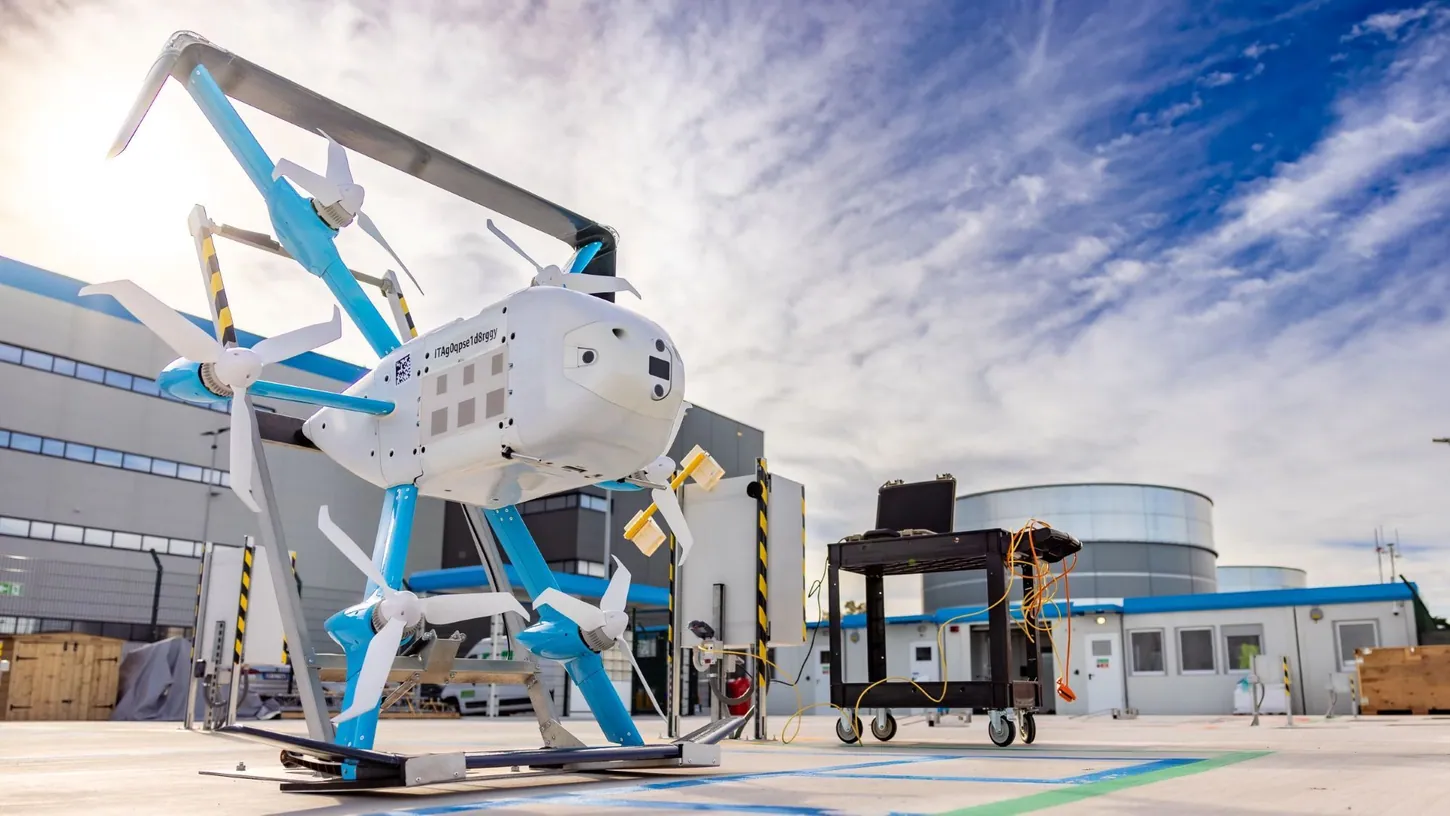
The USA TODAY Network story describes the Tampa service as recently launched and takes its aircraft figures from the FAA’s review of Amazon’s Baton Rouge hub. The Florida assessment has the same numbers for Ruskin. The MK30 weighs about 78 pounds (35.4 kilograms) empty and 83.2 pounds (37.7 kilograms) at maximum takeoff with a 5-pound (2.3-kilogram) box. It cruises between 180 and 377 feet (55 and 115 meters) and drops the package from about 13 feet (4 meters). The assessment mentions no parachute, and DroneXL reported from Commercial UAV Expo that the MK30 carries none. Zipline’s P2, in the same comparison, weighs 55 pounds (25 kilograms) empty, lowers its package on a tether and carries a parachute.
The other five sites in that document are a second Tampa warehouse on Harney Road, Orlando, Tamarac, Riviera Beach and Miami. Tallahassee and Jacksonville are not in it. The FAA’s drone environmental review index, last updated November 9, listed no document for either city on November 23. Since July 28 the FAA can clear a new hub against its national finding without a public site document, the change DroneXL covered in Washington clearing the runway for 500 cities. Amazon’s operating authorizations are not public.
On noise, Amazon’s August announcement says a drop-off is quieter than an idling delivery truck at the curb and lasts about 30 seconds. The FAA’s noise filing for Baton Rouge puts the delivery at 92.1 decibels SEL, measured 25 feet away, a metric that sums the sound energy of the whole event.
The announcement puts the price at nothing for Prime members on Amazon orders of $50 or more, $2.99 below that, and $4.99 without Prime. It says eligible items include groceries, cosmetics and medications, and it names iPhones, AirTags, Ring doorbells and an instant-read grill thermometer.
The Florida story also cites a New York Times account of residents opposing Amazon’s hub in Westborough, Massachusetts. It does not mention the outcome so far. Amazon asked to withdraw its site-plan application there after a 510 to 13 town vote, and the Planning Board accepted the withdrawal on November 10. Amazon has said it will file a revised project.
Florida residents who want to reach Amazon about the drones can call 1-888-280-4331 or use the customer-service chat, choosing “Something Else” and then “Amazon Drone Delivery.” DroneXL’s guide explains what residents can still do, and the Amazon Prime Air tracker follows every site.
DroneXL’s Take
I don’t mind a launch date that moves. An 83-pound aircraft with no parachute shouldn’t fly over Tallahassee or Jacksonville until the pad, the permit and the FAA paperwork are finished, and if that takes until 2027 I’m fine with it. My complaint is about how residents find out. Amazon gave the first date at its own public event, and the two later wordings reached residents through statements to reporters. The FAA’s drone environmental review page lists no document for either city. I’d support flights like these for medicine that someone can’t drive to get. I don’t think a grill thermometer justifies the up to 1,000 flights a day the FAA’s Florida decision covers at Ruskin, and Zipline’s P2 shows the job can be done with a lighter aircraft that carries a parachute. Amazon should post each Florida hub’s start date and expected daily flights on its own Prime Air site before the first drone leaves the pad.
Sources: USA TODAY Network-Florida, Tallahassee Democrat, FAA Florida Environmental Assessment, FAA, Florida Statute 330.41, Amazon, Amazon Prime Air
DroneXL uses automated tools to support research and source retrieval. All reporting and editorial perspectives are by Haye Kesteloo. Read our editorial standards.
Advertise with DroneXLYour company hereReach 200,000+ drone readers a month with a sponsored article, a banner on your beat, or a partnership.See the options →


