Portland, Maine City Council Votes Again on Police Drone Under Maine’s Strict UAV Law

Check out the Best Deals on Amazon for DJI Drones today!
The $45,000 drone Portland police want has been stuck in political limbo since November 2025, when the council rejected it 4-3. Now, under Order 88-25/26, the Portland City Council faces the same vote again — and the same legal reality: under 25 M.R.S.A. §4501, Maine police departments cannot acquire a drone without governing body approval. No council sign-off, no drone. Period.
Here’s a quick summary of where things stand heading into the March 2, 2026 vote:
- The Development: Portland’s City Council is voting for the second time on whether the Portland Police Department can acquire a drone, after the original proposal was rejected 4-3 in November 2025.
- The Legal Frame: Maine’s drone statute (25 M.R.S.A. §4501) requires a warrant for criminal investigations, bans weaponized drones, prohibits surveillance of protected free speech and assembly, and mandates written departmental standards before any flights begin.
- The Cost: The $45,316 total — roughly $16,500 for hardware, the rest for software, training, and servicing — would come from federal asset forfeiture funds already appropriated.
- The Source: The Maine Wire has full coverage of the council’s renewed deliberations.
Maine Law Already Answers Most of the Privacy Questions
Maine’s drone statute gives law enforcement defined use cases and hard prohibitions. Police can fly for search and rescue, emergency response, aerial photography at accident scenes, fires, flood monitoring, and storm damage assessment. For criminal investigations, a warrant is required — with recognized constitutional exceptions only. The law also explicitly bans weaponized drones and prohibits using any UAV to monitor citizens exercising free speech or the right to assembly.
That last point matters in Portland, where critics have repeatedly raised the specter of police drones circling protests. The statute already closes that door.
Maine law goes further than a simple prohibition list. Before a department can fly a single mission, it must adopt written policies covering officer training, authorization chains, prosecutorial approval for criminal-investigative deployments, restrictions on facial recognition and thermal imaging, procedures to avoid recording private spaces not relevant to a mission, data destruction schedules for unnecessary recordings, flight tracking logs, and regular public reporting. That is a serious compliance burden and a meaningful accountability mechanism.
Compare that to what police drone programs look like in states with no comparable framework. More than 6,000 departments now operate drones nationwide, and many face no equivalent warrant requirement, no written policy mandate, and no reporting obligation. Portland’s critics are debating a program that would operate under some of the strictest state-level drone rules in the country.
Portland’s Drone Fight Has Context and a History
This is not a fresh debate. As we reported in November 2025, the council rejected the original proposal 4-3 after a contentious public comment session. Critics cited surveillance risk and distrust of long-term oversight. Supporters — including Police Chief Mark Dubois — argued the drone would reduce officer exposure in barricaded-suspect situations and speed up missing-person searches.
The department already borrows drones from neighboring agencies when it needs them. Borrowing works until it doesn’t — until the neighboring agency’s drone is already deployed, or the mutual aid agreement has conditions, or the response window closes before the aircraft arrives.
The proposal survived November only because a separate motion to permanently table it also failed. It was postponed to March 2, 2026, which is where things stand now.
Portland is not the only city stuck in this loop. Syracuse, New York’s drone program was delayed by lawmakers four separate times in 2025, each time after community opposition mounted. The pattern — proposal, resistance, delay, repeat — is becoming its own political genre in American cities.
What a “Yes” Vote Actually Authorizes
Council approval under Order 88-25/26 does not put a drone in the air on Tuesday morning. It authorizes acquisition. The department then has to build out its written policy framework meeting state minimums before operations begin. That process takes time, requires additional administrative work, and is subject to public scrutiny. A “yes” vote is the start of a process, not the end of oversight.
A “no” vote means Portland police continue borrowing aircraft from other departments — with none of the local policy controls, none of the local reporting requirements, and none of the local accountability the statute would otherwise impose. The irony is real: rejecting the program doesn’t make drones disappear from Portland’s skies. It just means the city has no formal authority over how they’re used when they do show up.
Councilor Kate Sykes made exactly this point during the November session: “Saying whether or not the police can purchase a drone is not going to make drones go away. In fact, it only puts us in a more difficult position because we don’t really have control over the usage in our city.”
The practical case for a dedicated department drone isn’t abstract. A DJI Matrice 30T located a missing teenager in Ocean Township, New Jersey in just 17 minutes after ground teams were deployed. Similar results are documented across dozens of departments nationwide. Santa Ana PD recently sought council approval for its first drone program, citing search-and-rescue and barricaded-suspect response as primary use cases — the same operational rationale Portland’s department has put forward.
DroneXL’s Take
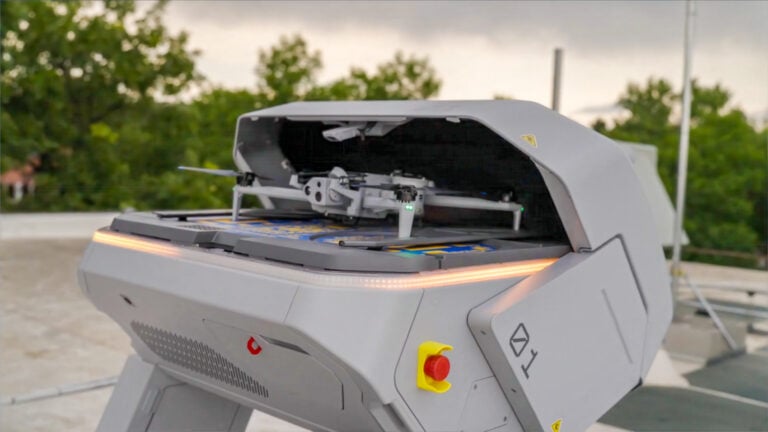
I’ve covered police drone politics long enough to recognize when a debate has stopped being about the drone. In Portland, it stopped being about the drone months ago. The Axon-contracted Skydio aircraft — supplied through Axon’s manufacturing partnership with Skydio — is almost beside the point. What’s actually being contested is whether the council trusts its own police department enough to let it use a tool that 22 other Maine law enforcement agencies already operate under the same state rules Portland would be subject to.
The privacy concerns raised by residents aren’t invented. I’ve written about the FBI’s push for AI-powered surveillance drones with facial recognition, and about how the NYPD’s drone flights surged 3,200% with limited oversight. Those are real problems in jurisdictions with weak or non-existent statutory guardrails. Maine’s framework is different. The warrant requirement, the weaponization ban, the assembly protection, the written policy mandate — these are real constraints, not window dressing. The harder question, one the article doesn’t fully answer and the council hasn’t fully engaged, is who audits compliance once flights begin.
The harder truth for Portland’s council is this: blocking acquisition doesn’t create accountability. It moves the accountability gap somewhere else, to the neighboring departments whose borrowed drones operate in Portland with zero local policy oversight.
My prediction: if the council votes no again on March 2, a revised proposal lands before them by June 2026 — this time with a pre-drafted policy framework attached, giving undecided members the political cover they need. The department will get there eventually. The question is how many missing-person searches happen with borrowed equipment in the meantime.
Editorial Note: AI tools were used to assist with research and archive retrieval for this article. All reporting, analysis, and editorial perspectives are by Haye Kesteloo.
Discover more from DroneXL.co
Subscribe to get the latest posts sent to your email.
Check out our Classic Line of T-Shirts, Polos, Hoodies and more in our new store today!

MAKE YOUR VOICE HEARD
Proposed legislation threatens your ability to use drones for fun, work, and safety. The Drone Advocacy Alliance is fighting to ensure your voice is heard in these critical policy discussions.Join us and tell your elected officials to protect your right to fly.

Get your Part 107 Certificate
Pass the Part 107 test and take to the skies with the Pilot Institute. We have helped thousands of people become airplane and commercial drone pilots. Our courses are designed by industry experts to help you pass FAA tests and achieve your dreams.

Copyright © DroneXL.co 2026. All rights reserved. The content, images, and intellectual property on this website are protected by copyright law. Reproduction or distribution of any material without prior written permission from DroneXL.co is strictly prohibited. For permissions and inquiries, please contact us first. DroneXL.co is a proud partner of the Drone Advocacy Alliance. Be sure to check out DroneXL's sister site, EVXL.co, for all the latest news on electric vehicles.
FTC: DroneXL.co is an Amazon Associate and uses affiliate links that can generate income from qualifying purchases. We do not sell, share, rent out, or spam your email.