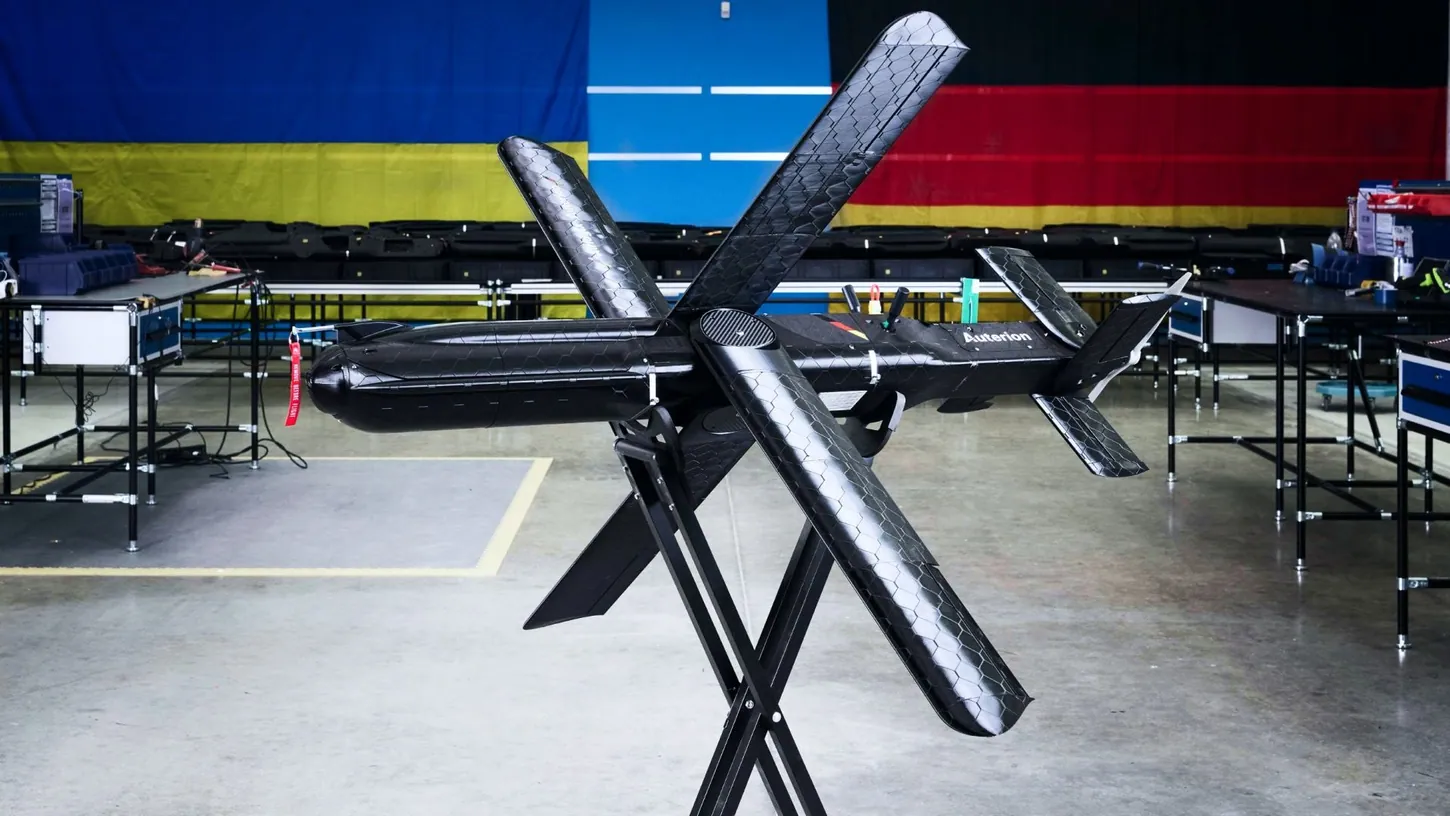

Lorenz Meier picked a fight with half the defense industry on July 1. The Auterion founder, creator of the Pixhawk flight controller and the widely adopted open-source PX4 autopilot, published an essay arguing that the United States, Germany, and Ukraine now buy attack drones the way consumers buy cell phones: interchangeable hardware, replaced every two or three years, purchased through competitions that repeat instead of contracts that last a generation.
His conclusion is that the airframe is turning into a commodity and the durable value is migrating into the software layer underneath it. Auterion happens to sell that layer. DroneXL has reported on all three procurement programs Meier cites as they unfolded over the past five months, and his reading of the record largely holds up.
What the essay never mentions is where its author sits. Auterion won a production award in the first American competition the essay describes, one of Germany’s three winners bought a piece of Auterion last fall, and the company co-owns a joint venture building strike drones for Ukraine. The argument deserves attention. So does the sales document wrapped around it.
Three Governments Ran the Same Play in Four Months
In the four months between late February and late June, the Pentagon ordered 30,000 one-way attack drones from its first Gauntlet winners, Germany signed loitering munition frameworks with three manufacturers in parallel, and Ukraine opened its first competitive drone tender, each structured around repeat competition rather than one long-term vendor.
Start with the American program, which anchors Meier’s essay. The Department of War‘s Drone Dominance Program ran its first Gauntlet at Fort Benning, Georgia, in February, putting 26 manufacturers through live strike missions and letting soldiers score the results. Eleven companies made the leaderboard and received delivery orders for a combined 30,000 one-way attack drones worth roughly $150 million, part of a plan the program office says will put more than 200,000 drones in the field by 2027. We broke down the Gauntlet 1 leaderboard when it posted in March. Gauntlet 2 expands the field to 48 companies and 78 designs this summer, splits off a long-range class for strikes beyond 19 kilometers (12 miles), and runs the entire trial under continuous jamming.
Germany moved in parallel rather than in sequence. On February 25, the Bundestag budget committee approved frameworks worth €268 million ($316 million) each for Stark Defence‘s Virtus and Helsing‘s HX-2, with options up to €1 billion per company, a deal we covered along with the spending caps lawmakers attached. Rheinmetall, passed over earlier after failing to field a working demonstrator, signed its own FV-014 framework on April 22, a first call-off of about €300 million ($351 million) inside a package the company values in the billions. Budget committee member Andreas Schwarz explained the three-way structure to Defense News in six words: “We want to treat everybody equally.” Soldiers will test all three systems side by side before the weapons reach Panzerbrigade 45 in Lithuania in 2027.
Ukraine went furthest. On June 25, Defense Minister Mykhailo Fedorov announced the Defense Procurement Agency’s first open competitive tender for strike drones and middle-strike reconnaissance-and-strike systems, the first drone purchase of this scale Kyiv has run through open competition. “We are procuring these types of drones not by specific model names,” Fedorov said, but by tactical and technical characteristics, a method he credits with saving more than 16 percent on a 155mm artillery ammunition tender. Deep-strike and FPV categories are slated to follow this summer.
The Cell Phone Argument Rests on Removing the Human
Meier’s logic starts with cost: crewed platforms are expensive because everything on board exists to keep a person alive, autonomous systems protect nothing, so they get cheap and short-lived, and once hardware ages out every few years, buyers stop marrying one contractor and start running repeat competitions.
The F-16 first flew in the 1970s and still flies, which made sense when a platform cost hundreds of millions of dollars and carried a crew. A $5,000 drone with a two-year shelf life inverts that math. Meier maps the drone industry onto computing history: chips came first, then vertically integrated boxes, then the platform layer that outlived every box. Microsoft never built the best computer. It built the layer every computer ran on and compounded while the hardware turned over.
The essay’s sharpest section goes after the companies Meier calls neo-primes, software-first contractors that own the integration layer while building their own hardware. He never names them, but his description of a vendor that publishes an SDK and signs interoperability partnerships while competing against its own partners reads like a direct shot at Anduril and its Lattice platform. Rational vendors, Meier argues, will never commit their best work to a platform controlled by a rival. His verdict: “a faster prime is still a prime.”
The record mostly supports him, with two edges rounded off. Ukraine’s tender covers strike and middle-strike systems today, with deep-strike promised for later in the summer rather than already underway. And Germany’s three parallel contracts arrived in two waves, the startups first and Rheinmetall only in April after its earlier demonstrator failure. The direction of travel is the one Meier describes. The tidiness is his.
Auterion Has Skin in All Three Procurement Stories
The essay presents three government programs as neutral evidence of a structural shift, and Auterion is commercially entangled with every one of them: a production award in the American Gauntlet, a shareholder tie to one of Germany’s three suppliers, and a strike-drone joint venture selling into Ukraine.
Start in the United States. The same qualifier list that details Gauntlet 2 marks Auterion as a Gauntlet 1 award winner returning for round two. The company preaching airframe commoditization entered a drone competition and won a production order. In Germany, Rheinmetall bought a sizable equity stake in Auterion in November 2025, which puts one of the Bundeswehr’s three loitering munition suppliers on Auterion’s cap table. And in Ukraine, Auterion and Kyiv-based Airlogix announced a joint venture at the Munich Security Conference in February to mass-produce AI-guided strike drones, on top of the 50,000 Skynode modules Ukraine is slated to receive and a $50 million Pentagon contract for 33,000 strike kits.
None of that makes the analysis wrong. Meier has more claim to the open-platform story than anyone else in this industry: he gave away PX4 and the MAVLink protocol more than a decade ago, and both still run across much of the industry. Auterion raised $130 million led by Bessemer Venture Partners in September 2025 at a valuation past $600 million and reports revenue near $100 million. Meier writes that the winning platform will belong to none of the hardware makers. Germany’s largest hardware maker owns a piece of his.
DroneXL’s Take
I lined the essay’s three claims up against the primary record today, and every one held: the February Gauntlet order, the three German frameworks, the June 25 Ukrainian tender, with the dates and dollar figures matching what Meier says they are. The surprise came from the qualifier list, where the loudest voice for airframe commoditization holds a hardware production order the manifesto never discloses. Founders talking their book is normal. Presenting your own bid pipeline as neutral market evidence is the part I would flag in any press release, and I will flag it in a better-written one.
On the substance, Meier is right about the shift, and the shift is good. Repeat, merit-based competition is exactly what this site keeps asking for, whether the distortion comes from Chinese state subsidies or from American protectionism dressed up as security. Gauntlet-style contests give an Alabama shop or a Croatian transplant a real shot at a Pentagon order every few months. That beats a thirty-year marriage to a prime, old or neo.
Where I get off the train is the Microsoft ending. Windows standardized computing and then taxed it for two decades. Trading airframe lock-in for operating-system lock-in just changes the taxpayer’s landlord. A neutral layer that is venture-funded and part-owned by a manufacturer offers neutrality you have to take on faith. The version of Meier’s argument I would sign is the one where the government owns the interface: an open, buyer-controlled architecture that every vendor, Auterion included, competes to implement. The closest this industry ever came to that was MAVLink, and Meier is the one who gave it away.
The decision point already has a clock on it. Secretary of War Pete Hegseth’s June 29 memo stood up a single drone office, the Direct Reporting Portfolio Manager for Unmanned Systems, with authority over nearly every unmanned program in the department, the swarming software included, and a $53.6 billion drone budget request behind it. Its yet-to-be-named director owes a full program list within 90 days. Whether that office writes a government-owned reference architecture into the next Gauntlet or anoints a commercial operating system will decide who actually ends up holding the layer. Meier wrote the pitch. The Pentagon holds the pen.
Sources: Lorenz Meier (Substack), Inside Unmanned Systems, DefenseScoop, Defense News, Interfax-Ukraine, Rheinmetall.
DroneXL uses automated tools to support research and source retrieval. All reporting and editorial perspectives are by Haye Kesteloo.