
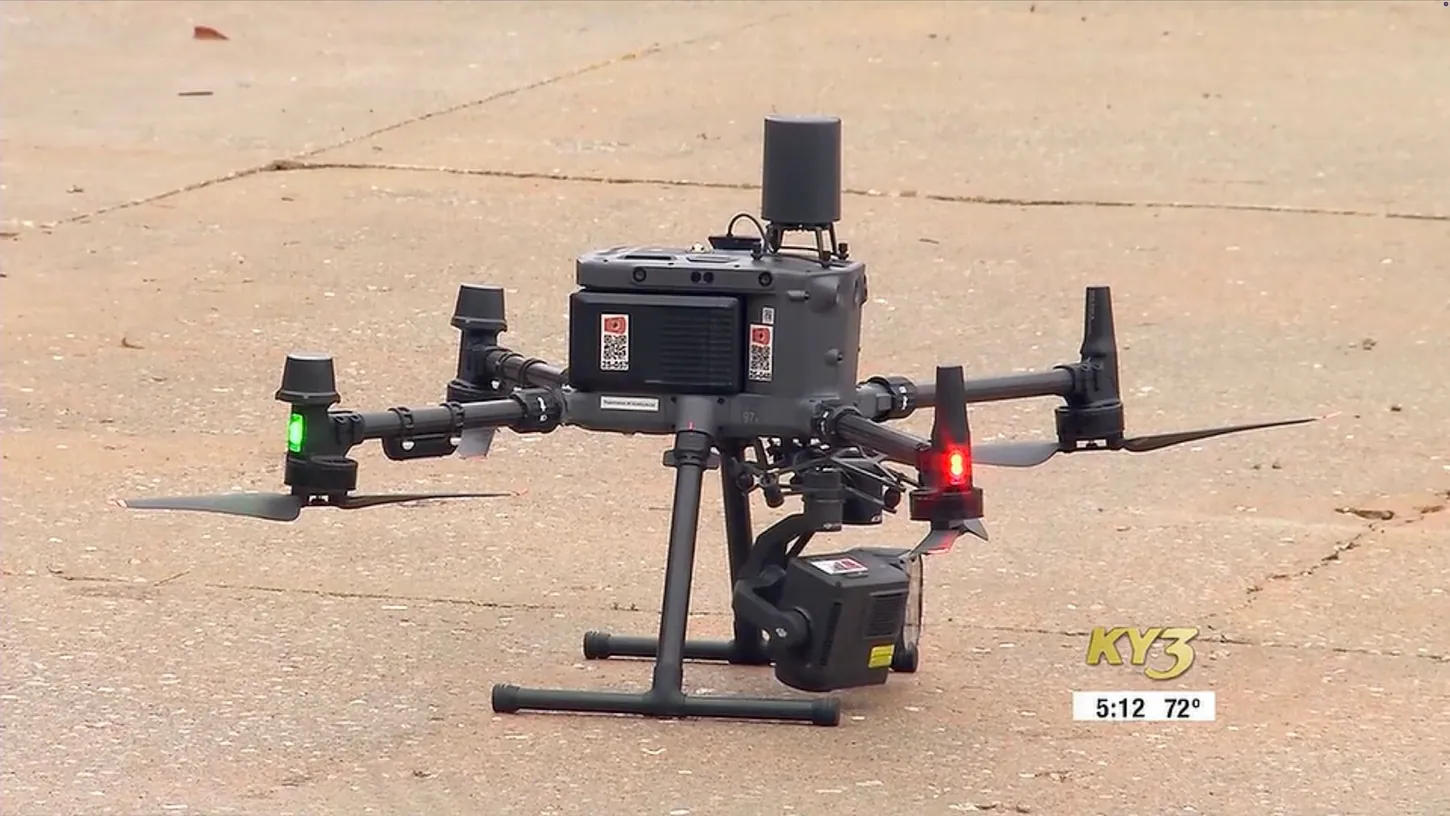
A drone from the Logan-Rogersville Fire Protection District showed Highlandville firefighters on Monday, October 12, that a 200-acre fire in Stone County, Missouri, had jumped across a river. The fire was burning along Curbow Road, and the wind had picked up to 30 mph.
Highlandville Fire Chief Stephens had never seen a drone at a fire before Monday. The aircraft that impressed him is a DJI Matrice, the airframe visible in KY3’s footage, and Logan-Rogersville now wants a second drone with a longer flight time at an estimated $60,000. Highlandville is looking into getting one of its own.
Logan-Rogersville’s Drone Spotted the River Crossing First
Chris Wescoat, one of the district’s certified pilots, flew the drone over the Curbow Road fire. It found hotspots and tracked the flames on the far bank, which became a second fire for Highlandville and other departments to fight. Stephens says the cause of the original fire is still unknown.
Assistant Fire Chief Grant Peters told KY3 the crew saw quickly that “they had a fire that had jumped their line.” Stephens said the aerial view showed where his structures were and which direction to send engines. “It let us know where we needed to send resources quicker,” he said.
A Water Rescue Drone Now Flies Every Week
KY3 now puts the Logan-Rogersville drone at $30,000, bought with grant money for water rescues. It has flown at least once a week since, adding fires and crash scenes to the job. At the September 2025 launch, Peters priced the full kit at $32,000 to $33,000.
KY3’s launch report listed a 200x zoom camera, night vision, radar, a spotlight, a rangefinder and a drop mechanism that can release a flotation device to a swimmer. The first search went to the Finley River, where Ozark Fire asked for help finding a missing kayaker and the drone located the paddler within minutes. The district shares the drone with mutual aid partners including Ozark, Battlefield, Nixa and Strafford, and every pilot holds an FAA Part 107 certificate. It expects six certified pilots by the end of 2026, up from five at launch.

None of KY3’s three reports names the model, but the footage shows a DJI Matrice 300-series airframe with a cylindrical radar unit on top and a Zenmuse H20-series camera underneath. The 200x zoom and night vision KY3 listed fit the H20T, the version of that camera with a thermal sensor. The controller screen shows two battery readouts, 75 and 76 percent, from the dual-battery setup the airframe uses.
The FCC Wants to Stop Sales of Foreign Thermal Drones
New DJI models have had no path to US sale since the FCC added foreign-made drones to its Covered List on December 22, 2025. Older authorized models can still be sold, and a July 21 notice in FCC Docket 26-189 proposes ending that for “military-grade” drones, including thermal models.
The notice lists seven capabilities that would earn the label, and LiDAR and docking stations are two more of them. Pilot Institute’s Greg Reverdiau walked through all seven for DroneXL in August; Pilot Institute is a DroneXL partner. DJI asked the two FCC bureaus to rescind the notice on September 2, the day comments closed, and the bureaus have not finalized it. KY3’s report does not say which drone the district wants next.
DroneXL’s Take
I’d like the bureaus writing Docket 26-189 to watch KY3’s clip. Finding hotspots on a brush fire is about the most civilian job a thermal camera does, and their definition files that camera under “military-grade.” Logan-Rogersville’s current drone keeps flying whatever they decide, because the notice covers sales and not aircraft already in service. The rule would hit the next purchase instead, the $60,000 drone Logan-Rogersville is waiting to fund and the first one Highlandville is looking into. Rural districts buy on grants and budget lines, and taking foreign thermal drones off the shelf shrinks what that money can buy. The FCC should drop thermal imaging from its list.
Source: KY3
DroneXL uses automated tools to support research and source retrieval. All reporting and editorial perspectives are by Haye Kesteloo. Read our editorial standards.


