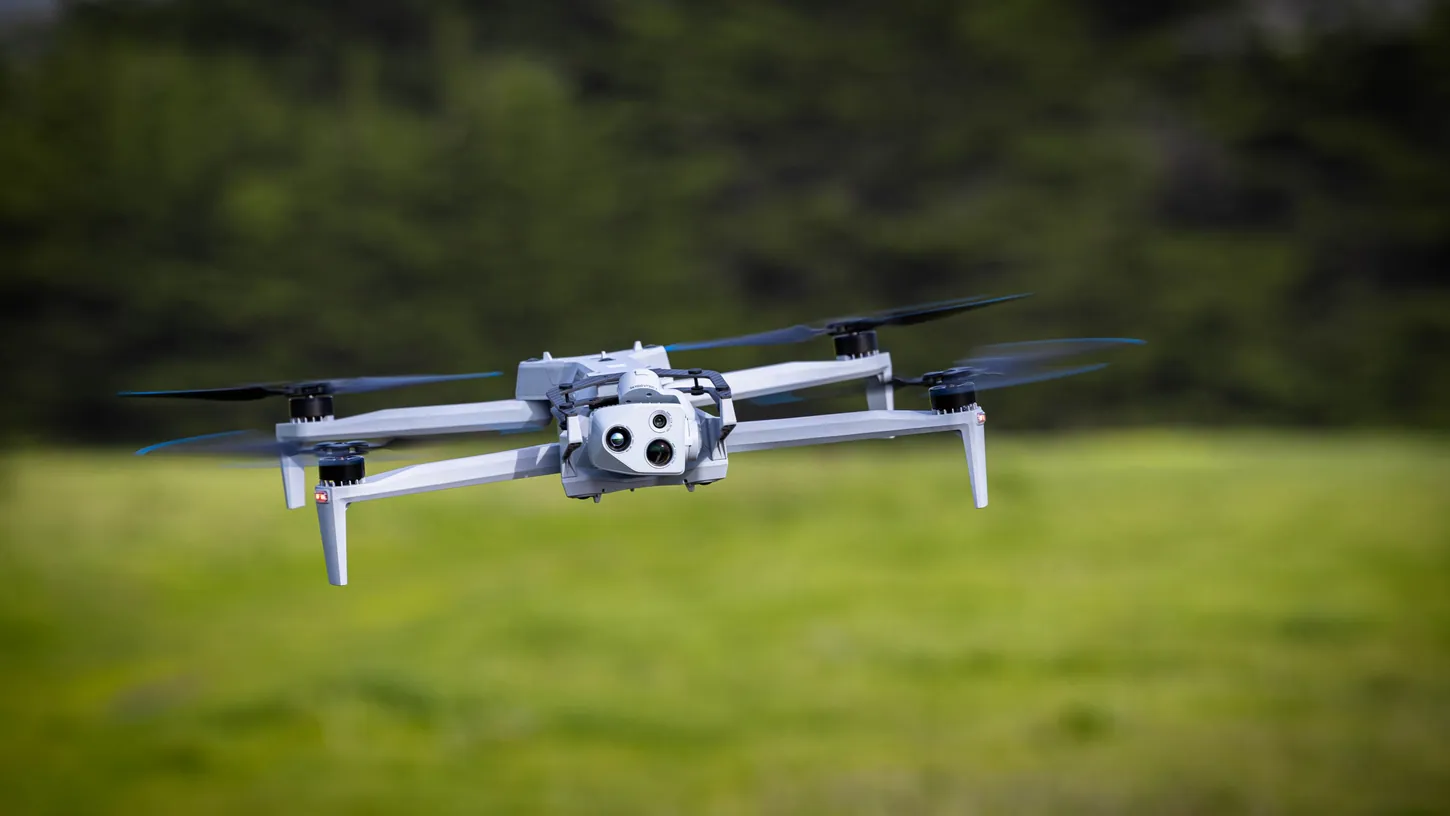
A University of Houston engineer says she has built a real-time monitor that keeps a quadrotor from crashing when a gust shoves it off course. Marzia Cescon calls it a “safety supervisor,” a software module that rides onboard the drone and watches its tilt and position while it flies.
When the math predicts the aircraft is about to cross into unsafe territory, the system takes over and steers it back. The work appears in the ASME Journal of Dynamic Systems, Measurement, and Control, credited to Cescon and a team from her lab.
The Safety Supervisor Watches Tilt and Position in Real Time
The supervisor is a separate module that sits alongside the drone’s normal flight controller and does one job, watch for trouble. While the main controller flies the mission, the supervisor tracks the drone’s tilt and position against a set of hard safety limits and stays ready to step in.
Cescon describes it as an invisible fence. The catch is that the fence isn’t drawn on a map. It’s drawn around the drone’s own motion, the angles and positions where the aircraft is still stable and recoverable.
When the supervisor predicts the drone is about to reach that boundary and tip toward a crash, it pushes the aircraft back inside. Her team built and tested the module in the UH Advanced Learning, Artificial Intelligence and Control laboratory.
A Control Barrier Function Does the Actual Work
Under the hood, the supervisor runs on a Control Barrier Function, a piece of control-theory math that marks off a safe set of flight states and holds the drone inside it. The function checks whether the drone’s next move would cross the line, and if it would, it rewrites the command just enough to keep the aircraft safe.
As Eurekalert reports, this sits on top of an idea called run-time assurance. Instead of trusting the main flight controller to always behave, run-time assurance runs a separate watchdog that only intervenes when a safety limit is actually about to break, and otherwise stays out of the way.
To prove it worked, the team fed the drone reference paths that deliberately aimed outside the safe zone. The barrier function caught each one and corrected the command in time. That is the real result here. Plenty of drones recover from wind already. A drone backed by math that is proven to catch it every time it drifts past a limit is something new.
Your DJI Already Fights Wind Gusts on Its Own
Here’s the context the press release skips. If you fly a modern DJI or Skydio, your drone already fights gusts on its own, holding position with GPS and a fast inertial stabilization loop. Recovering from wind is not the breakthrough.
My own drone already recovers from a gust without my help, so no, a lab didn’t reinvent dodging the wind.
If you ask me, reading the wind is one of the most important skills a drone pilot has. It’s hard to put into words, but once you’ve logged enough hours, you stop thinking about it. You just feel the air change and correct before the drone does.
The breakthrough is the guarantee. A commercial autopilot is tuned and tested until it reliably works, but it doesn’t come with a mathematical proof that it can never leave safe limits. This research provides that proof and shows it running live on hardware.
It’s also early. The tests ran on a lab testbed with motion limited to a couple of axes, not a full drone carving through open sky. This is a building block, not a firmware update headed for your Mini next month.
Provable Safety Is the Prize for Autonomous Flight
The reason this line of work matters sits in one word, provable. As drones move toward flying themselves past the pilot’s line of sight, regulators and insurers want more than a good track record. They want a guarantee the aircraft cannot leave its safe envelope.
That’s the gap run-time assurance is built to close. A drone delivering packages over neighborhoods or inspecting a bridge on its own can’t justify itself with “it worked in our tests.” It has to carry a safety case a regulator can check, and math like this is how that case gets made.
Cescon’s group is one of many chasing that goal. Control Barrier Functions now show up in quadrotor testbeds and even in the safety systems flown on an F-16, which tells you the control world treats this as foundational, not niche.
DroneXL’s Take
Here’s what I actually think, the University of Houston press office oversold the crash-prevention angle, and the real work underneath is more interesting than the headline. Your drone already survives a gust. What this team showed is a way to prove, in math and on real hardware, that it will stay inside safe limits while it does.
That distinction sounds academic until you remember where drones are going. Beyond-line-of-sight delivery, autonomous inspection, flights over crowds, none of that passes a regulator on a good track record alone. It passes on a guarantee.
And I really do believe most research papers don’t show their use right away. It shows up later, after the adaptations and testing that turn a lab result into something the field can actually run.
This is lab-stage plumbing, not a feature you’ll toggle on next season. But it’s the kind of unglamorous math that has to exist before anyone lets a drone fly itself over your street. Watch for run-time assurance and Control Barrier Functions to surface in certification fights long before they reach a product page
Photo credit: University of Houston