
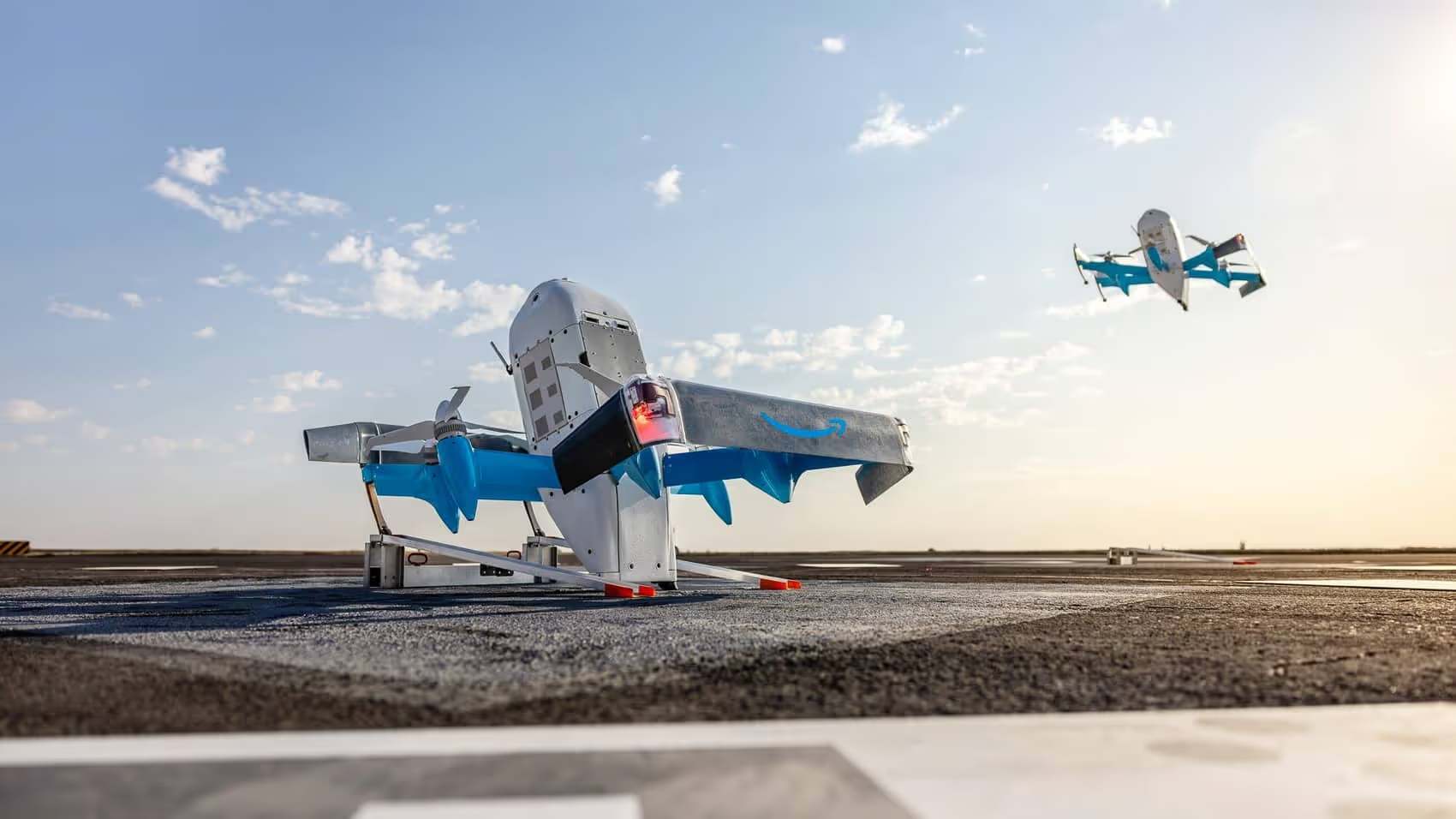
Amazon is bringing drone delivery back to California. The company told the Los Angeles Times it will launch Prime Air from its distribution center in Tracy within a month, flying the MK30 to customers up to 7.5 miles (12 kilometers) away with packages of up to 5 pounds (2.3 kilograms).
Those will be Amazon’s first drone deliveries in California since it closed its Lockeford site in April 2024. DroneXL covered the Lockeford launch when Amazon first announced it in June 2022, and the shutdown less than two years later. Tracy sits about 35 miles (56 kilometers) southwest of Lockeford, in the same San Joaquin County.
Erik Robertson, Prime Air’s regional operations manager for the West, gave the Tracy details in an interview with the Times. Residents get a first look at the aircraft Saturday at the Sweet Dreams Car Show in downtown Tracy.
Amazon Pulled Out of Lockeford in April 2024
Lockeford was Amazon’s first US drone delivery site. Amazon named the San Joaquin County town in June 2022 and began flying there that December. In April 2024 it announced the site would close. California has had no Prime Air service for the 28 months since, and Tracy ends that gap.
The Lockeford model was hand-built for a town of about 3,500 people. As DroneXL reported at the time, an Amazon employee visited each opted-in customer’s yard to scope out a landing spot, and the drone was the MK27-2, the hexagonal predecessor to the MK30. When Amazon moved the operation to Arizona in April 2024, Lockeford staff were offered jobs at other sites.
Tracy is a different kind of site. Instead of a purpose-built rural pad, the drones fly from an existing Amazon distribution center, and the service area is the same 175-square-mile (453-square-kilometer) circle Amazon draws around every MK30 location.
Tracy Gets the Same MK30 Terms as Amazon’s Other 11 Sites
Tracy gets the terms Amazon publishes elsewhere. The MK30 flies up to 7.5 miles (12 kilometers) from the building with up to 5 pounds (2.3 kilograms) aboard. Cruise altitude is 250 to 400 feet (76 to 122 meters). Delivery is free for Prime members on orders over $50.
Prime members pay $2.99 on orders under $50, and non-members pay $4.99, according to Amazon’s August 19 expansion announcement. Amazon says most orders land around 60 minutes after checkout and some arrive in under 30. The Times reports some Phoenix-area deliveries have completed in under 15.
Robertson told the Times that millions of items in the Tracy building are eligible, including medications and phone chargers. Customers in the service area will see a drone option on the Amazon website when an order qualifies, and can pick a drop-off spot and time. The aircraft are not remotely piloted. On-site flight monitors watch the airspace and coordinate with local airports, Robertson said.
“Every flight that we take starts with safety,” Robertson told the Times.
Amazon would not tell the Times how many drones it is sending to Tracy, saying the number will scale with demand.
California Was Missing From Amazon’s Own 500-City List
Amazon’s newsroom has not announced Tracy. Its August 19 post naming the 500-city target listed 11 live sites and five metro areas coming next: Chicago, Syracuse, Cleveland, Atlanta and Boise. California appeared nowhere on that page, and it still does not.
The Tracy launch surfaced through a newspaper interview instead. That gap matters for anyone trying to track where Prime Air is actually going. DroneXL’s coverage of the 500-city announcement worked from Amazon’s published site list, and Tracy was not on it ten days ago. Amazon’s own locations page, which the company says it updates as ZIP codes change, has no California entry as of this writing. Whether Tracy is the only unannounced site in the pipeline, or one of many, is something Amazon has not said.
Amazon’s math is easy to check. A 7.5-mile radius covers 176.7 square miles, which is the 175-square-mile figure Amazon uses. Reaching nearly 500 cities and towns by December 31 means drawing a lot of those circles in four months from a starting point of 11.
The Return Lands Twelve Days After the Texas Pool Drop
Prime Air’s California comeback arrives in the middle of a rough news cycle for the program. On August 17, an MK30 dropped a Richmond, Texas customer’s package into her swimming pool on camera, two days before Amazon’s 500-city announcement. The video spread nationally by August 19.
DroneXL’s analysis of the pool drop argued that Zipline’s tethered and parachute designs show why the 83-pound (38-kilogram) MK30 keeps missing. That followed the October 2025 crash of two MK30s into a construction crane in Tolleson, Arizona, the site Amazon opened when it left Lockeford, and a second FAA probe in November 2025 after a Waco drone clipped a cable.
Critics cited by the Times worry about hacking and about crowded airspace. Amazon’s answer, per the Times, is that the program improves as it grows. Prime Air holds an FAA Part 135 air carrier certificate, the same framework used for commercial air carriers, and Robertson said the Tracy flights are FAA-authorized.
DroneXL’s Take
Amazon’s return to California tells me more about Amazon than about California. The Lockeford experiment was a 2022 idea: a small town, a hand-scouted yard for each customer, a dedicated pad and an aircraft Amazon retired by late 2024. Tracy is the 2026 model: an existing warehouse with a 175-square-mile circle drawn around it, run on the same terms as Omaha or Baton Rouge. The state did not change. Amazon’s answer to “where do drones make sense” did.
I will grant the critics their strongest point. The pool video is real, the Tolleson crane crash is real, and the FAA opened two probes into Prime Air within two months last fall. A company promising 500 cities has earned the scrutiny it is getting. My read is that none of those incidents is why Amazon left Lockeford or why it is coming back, though. Lockeford died because the rural, per-customer model could not scale, and Tracy exists because the warehouse-radius model can. That is progress on the problem that actually kept drone delivery small, whatever the incident reel looks like.
What I do not buy is the way Tracy surfaced. A company that put out a 500-city press release on August 19 with a state-by-state site list, and then let a California launch reach the public through a regional operations manager talking to a newspaper, is either announcing sites faster than its own comms can track or choosing which launches get the press-release treatment. Neither is reassuring for anyone trying to count.
The count is the thing to watch. Amazon has given itself a December 31 deadline and a starting line of 11 sites. Tracy would make 12, plus the five metros it has named. Whether the December number is anywhere near 500, or whether “nearly 500 cities and towns” turns out to mean a few dozen circles that each touch a dozen municipalities, is the question this launch does not answer. Amazon’s locations page will settle it, one ZIP code list at a time.
Sources: Los Angeles Times, Amazon
DroneXL uses automated tools to support research and source retrieval. All reporting and editorial perspectives are by Haye Kesteloo.


